

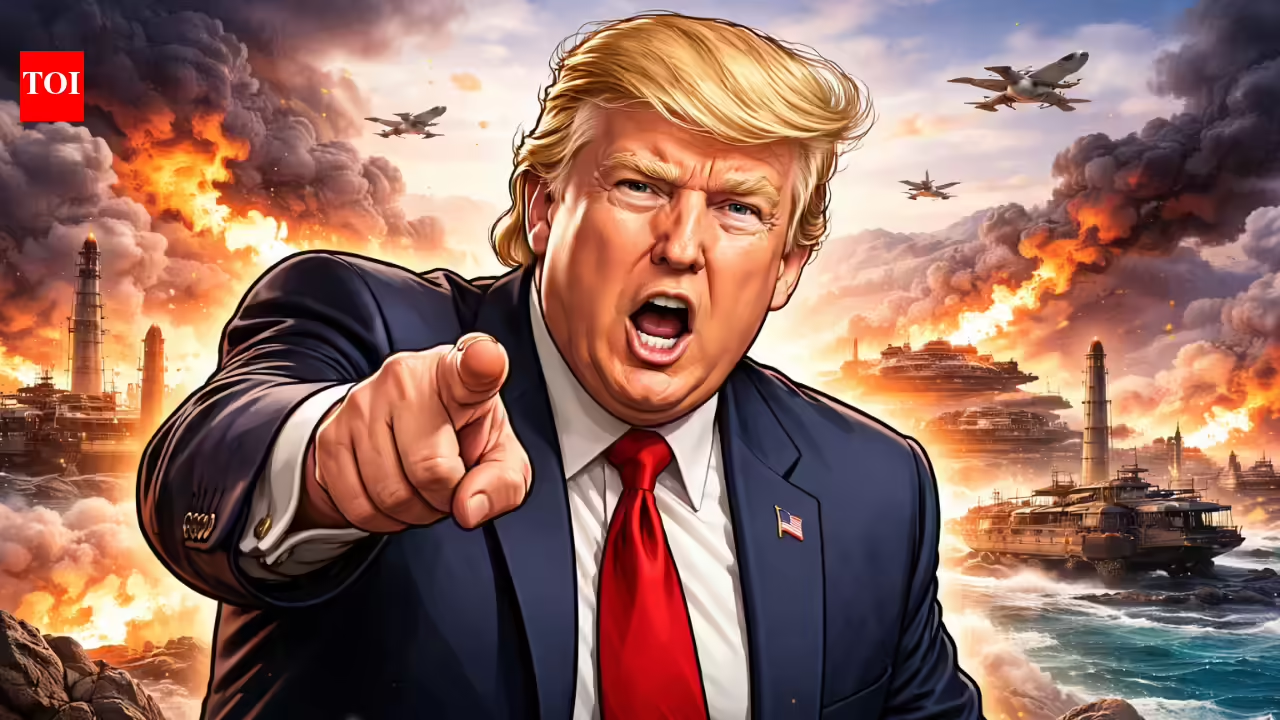
In a sudden turn of events, US President Donald Trump announced a two-week ceasefire with Iran just hours before the self-imposed deadline, leaving the world holding its breath.The conflict, which erupted after the death of Iran’s supreme leader Ayatollah Khamenei in US-Israeli air strikes on February 28, sent global oil prices soaring by 60% and sent international markets into turmoil.Trump’s announcement comes after days of escalating missile attacks, drone strikes and threats to ‘destroy’ Iranian cities. This incident has raised an important question: was it a strategic pause or an example of the ‘madman theory’ in action?
Inspiring news: apparent threats and sudden ceasefire
Before the ceasefire, Trump issued abuse-laden threats on social media and in interviews. He threatened to destroy Iran’s power plants, bridges and infrastructure if Tehran did not reopen the Strait of Hormuz.“Subject to the Islamic Republic of Iran agreeing to the full, immediate and safe opening of the Strait of Hormuz, I agree to suspend the bombing and attack of Iran for a period of two weeks. This will be a two-way ceasefire!” Trump wrote.The temporary pause in hostilities reopened the vital shipping route, calming global markets, while Iran cautiously agreed but stressed that a permanent agreement would require more concessions.According to news website The Conversation, experts highlight that these threats were central to Trump’s strategy: appearing unpredictable and dangerous, forcing the opposition to negotiate quickly.
What is the madman theory?
Madman Theory is a concept of international relations famously used by President Richard Nixon during the Vietnam War. The idea is simple: If a leader convinces opponents that he is irrational, unstable and willing to take extreme action (even nuclear war), they may negotiate more cautiously or succumb to demands.Three key elements made it effective historically:
- Controlled unpredictability: Nixon’s advisers carefully limited information so that the enemy could not immediately sense his threats.
- A rational opponent: The other party has to fear miscalculation and act carefully.
- Credibility through restraint elsewhere: The leader’s generally disciplined behavior sometimes made extreme threats credible.
In Nixon’s 1969 example, he placed the US military on nuclear alert to intimidate North Vietnam into negotiations.This strategy created uncertainty about how far Nixon could go, increasing pressure on his opponents.
Trump’s version of the madman theory
Trump’s approach toward Iran echoes this historical strategy but with a modern twist. By issuing profanity-laced threats publicly through social media, interviews and posts, his aim was to intimidate Tehran and pressure it into agreeing to a ceasefire.International law experts consider his threats highly aggressive, but potentially strategic. Professor Al Gillespie of Waikato University explained in an interview with RNZ: “The madman theory involves behaving in an illogical, erratic way and threatening to go to extreme lengths to end the war. The idea is that you don’t know whether the person will do it or not, and the opposition will be afraid to make a compromise.”However, the strategy depends on the opposition fearing the threat. Gillespie underlined: “In the case of an autocratic regime like Iran, they are often not afraid of such threats. Iran feels emboldened by Mr Trump’s increasingly extreme rhetoric… I think that is almost what they want right now.”
How does Trump’s unpredictability shape policy?
Trump has made unpredictability a formal part of his political strategy, sometimes called the “unpredictability principle”. Experts argue that he uses his erratic behavior not only to intimidate opponents, but also to pressure allies into concessions, the BBC reports. Professor Peter Trubowitz of the London School of Economics said: “Trump has made his unpredictability a major strategic and political asset. He has elevated unpredictability to the status of a principle. And now the personality trait he brings to the White House is driving foreign and security policy.”Examples include pressuring European allies to increase defense spending, pressuring Ukraine for resource deals, and making bold threats over Greenland and the Panama Canal.
limitations of strategy
The madman theory works best when opponents are rational, information is limited, and threats are unusual. In today’s hyperconnected world, news is transmitted instantly and extreme threats are often publicly ridiculed or dissected. As a result, unpredictability may lose its tremendous power.Julie Norman, professor of politics at University College London, explained: “It’s very hard to know what’s happening from day to day… but because this unpredictability is consistent, it can actually be expected. “Once expected, it loses power.”Similarly, experts have warned that Iran may view Trump’s threats as predictable posturing rather than a credible threat and may even accelerate its nuclear ambitions as a deterrent.
Conclusion: Strategic Display or Real Diplomacy?
Trump’s ceasefire with Iran shows both the potential and limits of the Madman Theory. Their threats and erratic behavior may attract short-term pauses and attention, but they do not guarantee compliance from opponents who are prepared for instability.As Professor Trubowitz summarized: “Trump’s unpredictability has changed the way allies and enemies view the United States. It is driving foreign policy, but it is a double-edged sword – effective in some ways, but risky and unpredictable in others.”So the real question is: Can the Madman Theory produce lasting results or is it just a temporary display of power?
