

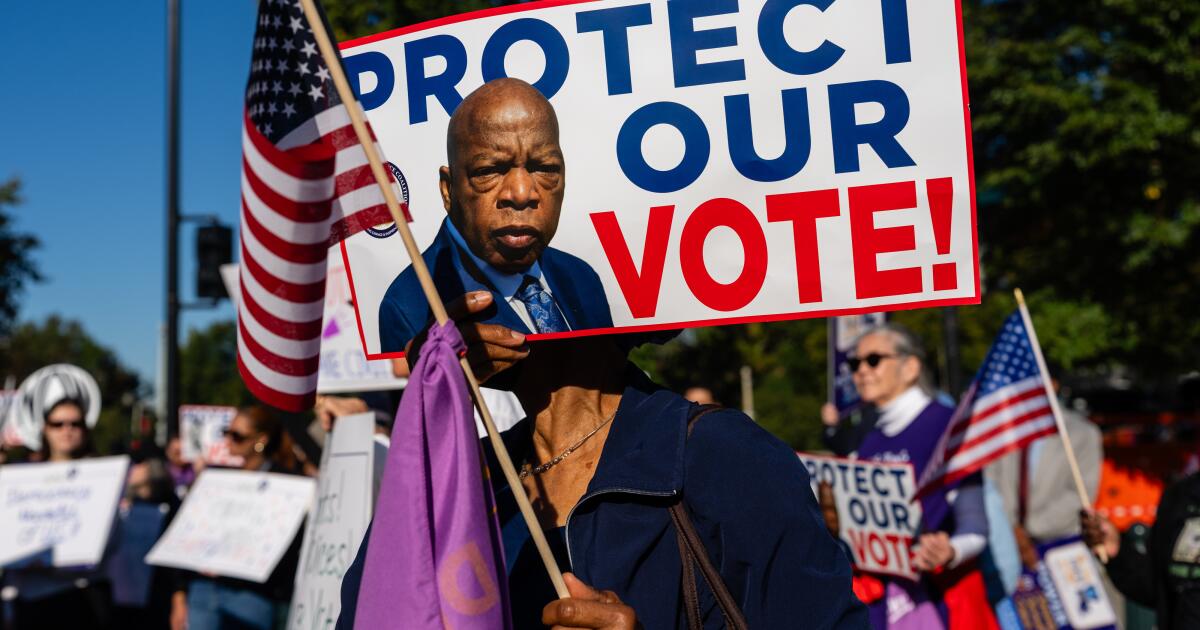
Sacramento – A new poll finds that a majority of California voters believe American democracy is under attack and support enacting a new state Voting Rights Act to bar discrimination and efforts to suppress the ability to vote, in the wake of U.S. Supreme Court rulings that slash federal protections.
The poll showed a sharp partisan divide on increasing voting rights protections, with Democrats and political independents overwhelmingly in support and most Republicans opposed. The fear that American democracy is either under attack, or at least “tested,” was shared across political allegiances, according to a new survey released Thursday by the UC Berkeley Institute of Governmental Studies.
Eric Schickler, co-director of the institute, said, “I think it shows that California voters, particularly Democrats and independents, are very concerned about what’s happening in Washington, both about court decisions and about the Trump administration.” “They see it as a threat to core American values.”
The concerns come after years of President Trump’s baseless claims that the 2020 election was stolen from him, as well as Republican-led efforts to restrict the use of mail-in ballots and impose new requirements for voters to show proof of identity and citizenship.
Trump earlier this week signed an executive order to impose new federal controls on voting by mail in states like California, an action that Democrats called unconstitutional and vowed to challenge in court.
Schickler said Republican concerns about the fate of American democracy may largely stem from allegations of voter fraud promoted by Trump and his supporters, including unfounded claims that large numbers of undocumented immigrants are influencing the election.
The survey found that 67% of California voters believe American democracy is under attack, including 84% of Democrats, 40% of Republicans and 64% of voters with “no party preference” or registered with other political parties. Nearly the same number of Republicans, 38%, believe democracy is being “tested” but not attacked, compared with 13% of Democrats and 26% of independents. The rest of the people surveyed said that American democracy is not in any danger.
The poll found that the partisan divide was more pronounced when voters were asked whether they wanted California to create its own Voting Rights Act after a Supreme Court decision limiting federal protections against discrimination and unequal access to ballots.

Overall, 66% of California’s registered voters supported the adoption of new state voter protections, while 88% of Democrats supported the new laws, compared to 25% of Republicans and 66% of voters who are political independents or belong to other parties. Support for the new state laws was strongest among black voters – 72% – who have historically been targeted with discriminatory voting policies, including Jim Crow-era laws such as literacy tests and poll taxes.
The federal Voting Rights Act of 1965 banned those policies, ensuring that the right to vote could not be denied because of race. The law also ensured that Black Americans and other communities of color had the opportunity to participate in all parts of the political system and elect leaders of their choosing, thereby drawing political districts. The Act was reauthorized by Congress in 2006 with an overwhelming bipartisan majority.
Matt Barreto, faculty director of the UCLA Voting Rights Project, said, referring to Trump, “It’s now come to the point where the president has tried to convince people that somehow equal voting rights are bad because, in his words, ‘the wrong people are voting for the right.’ “You have a super majority, a very large percentage of Californians who want the state to do more to protect voting rights, I think, because of the very tenuous environment right now, with the president constantly going out to states asking for vote by mail and trying to get their voter rolls and things like that.”
Recent decisions by the conservative-leaning Supreme Court have also rolled back federal protections under the Voting Rights Act. Barreto said a pending case, Louisiana v. Calais, which involves drawing congressional districts, could overturn some of the remaining protections.
He said, “I think people should be extremely alarmed that this court has not shown a lot of support for voting rights and that’s why California has the opportunity to pass its own state laws.”
Barreto said laws California lawmakers could adopt would include protections for early voting, banning onerous requirements on voters to prove citizenship and provide identification, and ensuring that congressional and other political districts are drawn to allow minority groups to elect representatives of their choice.
The Berkeley Poll found widespread support among California voters for a requirement that the top three financial backers supporting and opposing ballot measures be listed in the official ballot voter guide. Most Californians also supported expanding access to translation and interpreter assistance for populations that make up at least 5% or 5,000 voters in a county.
The Berkeley IGS survey surveyed 5,109 registered California voters online in English and Spanish from March 9 to 15. The results are estimated to have a margin of error of 2.5 percentage points in either direction for the overall sample and larger numbers for subgroups.
Funding for the poll was provided to IGS by the Evelyn and Walter Haas, Jr. Fund, a private foundation based in San Francisco that aims to increase civic participation and improve state democratic processes.
