
Updated on: 04 Jul 2026, 12:30 am
On the Fourth of July, Americans celebrate a nation. But before there was a nation, there was a document. And before there was a document, there was a printer
America, in many ways, was founded by ink. On July 4, 1776, a Philadelphia printer named John Dunlap pulled sheets from his press carrying words that would change history. The colonies did not become a nation through armies alone. They became a nation through ideas – ideas fixed onto paper and carried across towns, taverns, churches, and public squares
Two hundred and fifty years later, those words continue to reverberate. That is why I find myself captivated by Declare, the extraordinary new publication from Arion Press. More than a book, it is a meditation on the American experiment. Part artist’s book, part historical artifact, part civic conversation, Declare gathers more than one hundred American hands – writers, artists, printers, binders, woodworkers, designers, and craftspeople – to re-engage with the nation’s founding text
What makes the project remarkable is not merely its craftsmanship, though that alone is breathtaking. It is the question at its heart: What does the Declaration of Independence mean today?
The answer, like America itself, is complicated. The story begins with wood. Not ordinary wood, but tulip poplar salvaged from trees associated with Monticello, trees that stood witness to centuries of American history. Wood that might easily have been discarded has instead been transformed into medallions, artworks, and objects of reflection. Dead trees have become vessels for living ideas
It is an apt metaphor. Democracies, too, are built from inherited materials. Every generation receives ideals from the past and must decide what to do with them. Preserve them? Reinterpret them? Expand them? Challenge them?
The Declaration itself invites precisely this kind of engagement. When Thomas Jefferson drafted the document, he was writing in a world dominated by kings, empires, and inherited privilege. Against that backdrop, one sentence detonated like intellectual dynamite:
“We hold these truths to be self-evident, that all men are created equal…”
Today those words feel familiar. In 1776 they were revolutionary. The Declaration proposed something astonishing: that governments derive their legitimacy not from divine right, hereditary succession, or military conquest, but from the consent of ordinary people. Human beings possess inherent rights. Governments exist to protect them. When governments fail in that duty, people have the right to alter or abolish them
This transformed a colonial rebellion into something larger – a revolution of ideas. Yet the greatness of the Declaration lies not in its perfection. Its greatness lies in its tension. The same society that proclaimed equality tolerated slavery. The same nation that championed liberty excluded women, Indigenous peoples, and countless others from its promises. The Declaration did not solve these contradictions. It exposed them. And in doing so, it created a moral standard against which future generations could measure themselves.
Abraham Lincoln returned repeatedly to the Declaration’s language while confronting slavery. A century later, Martin Luther King Jr described its promises as a promissory note that America had yet to fully honor
The Declaration became both inspiration and indictment. It remains both today. That is why Declare feels so timely. The project does not treat the Declaration as a sacred relic sealed behind museum glass
Instead, it presents it as a living conversation. Writers, artists, military leaders, historians, poets, and designers bring their own perspectives to the text. Their contributions are not always harmonious. Nor should they be. Democracy is not harmony. Democracy is participation
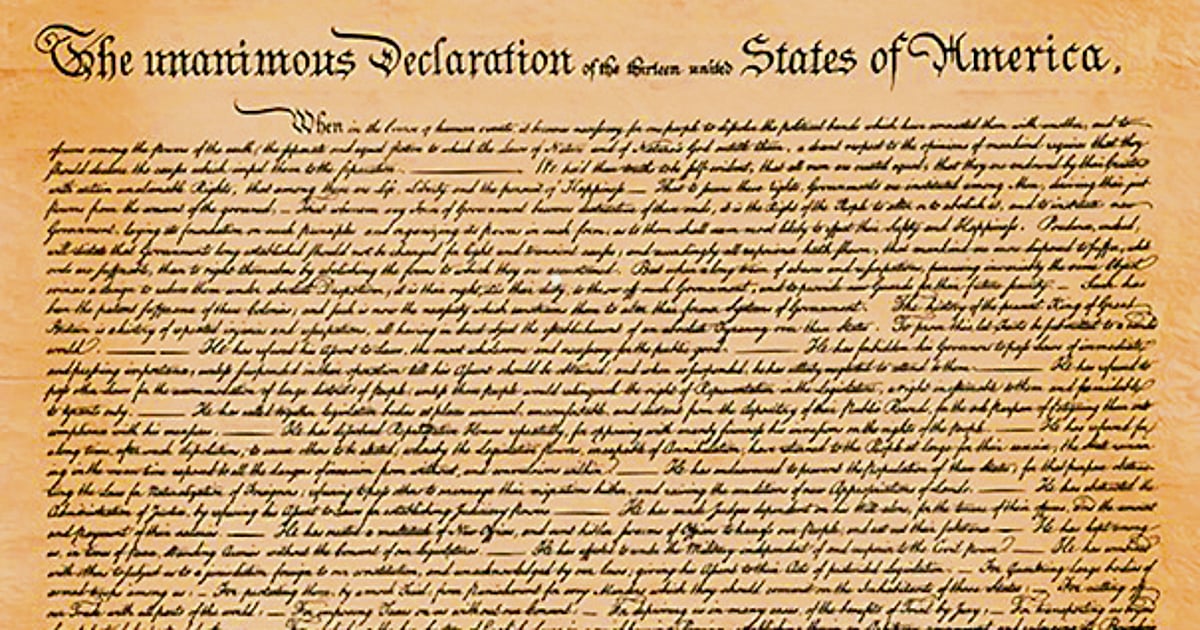
One of my favorite elements of the project is its contemporary broadside of the Declaration’s preamble. Designed for clarity rather than ornamentation, it emerged from a simple observation: a child visiting an exhibition could not read the cursive script of the original document
That moment contains a profound lesson. Every generation must learn to read freedom in its own language
The Declaration survives not because it is preserved. It survives because it is continually reinterpreted. This idea reminds me of something filmmaker Ken Burns has often said. He regards the Declaration’s famous second sentence as perhaps the most important sentence in the English language after “I love you”. He describes it as a love letter to the future – a statement whose full meaning had not yet entered the bloodstream of humanity when it was written
I think he is right. The Declaration was not a description of reality. It was a declaration of aspiration. And aspirations are powerful things. They outlive governments. They outlive generations. They continue whispering possibilities long after their authors are gone. For readers who wish to explore those possibilities more deeply this Independence Day, I would recommend a small library of companion books:
* Common Sense by Thomas Paine — the pamphlet that helped ignite the movement for independence
* American Scripture: Making the Declaration of Independence by Pauline Maier — still the definitive history of how the Declaration came into being
* Our Declaration by Danielle Allen — a brilliant line-by-line interpretation of the text
* The Greatest Sentence Ever Written by Walter Isaacson — a meditation on the Declaration’s most famous words
* These Truths by Jill Lepore — a sweeping history of America’s struggle to live up to its founding ideals
Read together, these works reveal something important: the Declaration is not a finished achievement. It is an unfinished invitation
That is perhaps the deepest lesson of both the Declaration and Declare
The inside lid of the Arion edition carries fourteen words from the closing pledge of the original document: “We mutually pledge to each other our Lives, our Fortunes and our sacred Honor.”
The signers understood that democracy is not self-executing. Freedom requires stewardship. Equality requires expansion. Justice requires participation. Every generation inherits that responsibility. On this Fourth of July, as fireworks briefly illuminate the night sky, it may be worth remembering that America’s most enduring achievement was not military victory, territorial expansion, or economic power. It was an idea. An imperfect, unfinished, endlessly demanding idea. That human dignity matters.
That power must answer to principle. And that a nation, like a finely crafted book, is never truly finished. It is revised, repaired, and reimagined by every generation that inherits it. The Declaration of Independence was the first draft of that story. The rest, as always, remains in our hands
<a href="https://www.whatsapp.com/channel/0029VaAJz0Q2f3EFfUEev01O” rel=”nofollow noopener” target=”_blank”>Follow The New Indian Express channel on WhatsApp
Books
American Independence day
