

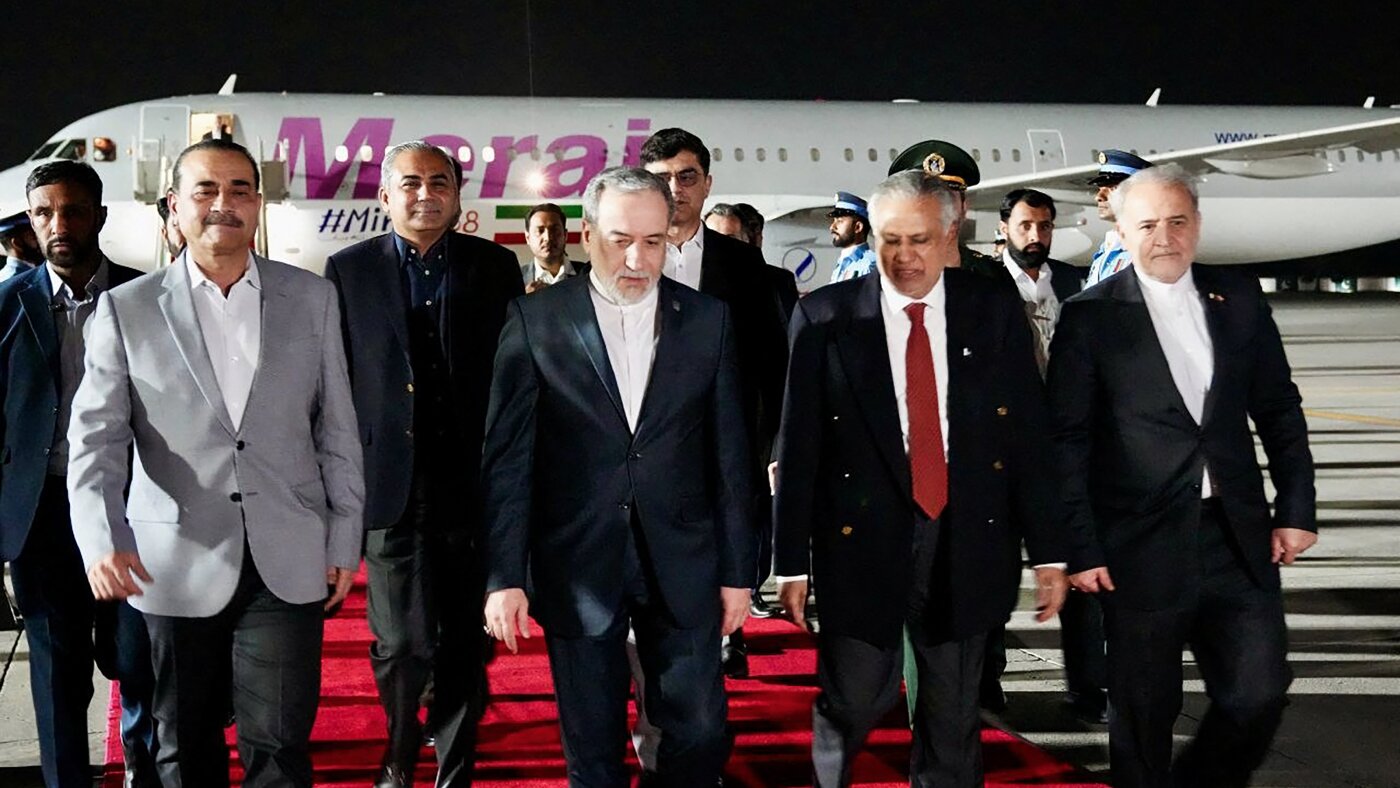
This handout photo released by the Iranian Foreign Ministry shows Pakistan Foreign Minister Ishaq Dar (left) welcoming his Iranian counterpart Abbas Araghchi upon his arrival in Islamabad on April 24, 2026. US envoys headed to the Pakistani capital on April 25 to begin a new round of peace talks with Iran amid a fragile ceasefire, although the prospect of direct talks remained uncertain.
/Iranian Foreign Ministry/AFP via Getty Images/AFP
hide caption
toggle caption
/Iranian Foreign Ministry/AFP via Getty Images/AFP
After a stormy weekend of diplomacy, Iran’s foreign minister arrived in Russia on Monday in an attempt to score political points and foreign support as peace talks with the United States remain stalled.
But missing from this bustle of diplomacy is any sign of a meeting between Washington and Tehran.

Abbas Araghchi was in Islamabad last week but left on Saturday, prompting President Trump to cancel his planned visit to the Pakistani capital by the US negotiating team.
Araghchi instead moved to Oman – which is located directly across the Strait of Hormuz from Iran – and met the sultan Haitham bin Tariq Al and his Omani counterparts.
“Important discussions on bilateral matters and regional developments. As only Hormuz littoral states, our focus included ways to ensure safe transit that are for the benefit of all dear neighbors and the world,” Araghchi Said on X. “Our neighbors are our priority.”
for his part, Foreign Minister of Oman Sayyid Badr bin Hamad Al Busaidi said that he had “A meaningful discussion on the Strait of Hormuz… As two littoral states, we feel our shared responsibility to the international community and the urgent humanitarian need to release the long-detained seafarers.
“
“Ensuring lasting freedom of navigation requires intensive diplomatic efforts and practical solutions,” he said.
Araghchi also spoke by phone with the foreign ministers of Saudi Arabia, Qatar and Egypt.
From Oman, he returned to Pakistan on Sunday and on Monday Araghchi reached Russia, one of Iran’s key allies.
He is expected to meet President Vladimir Putin in St. Petersburg and plan to “discuss the war-related development and coordination situation,” according to the State-affiliated. Tasneem News Agency.

In this photo obtained from Iran’s ISNA news agency on April 24, 2026, Iranians are seen on Suru beach in Bandar Abbas along the Strait of Hormuz.
Razieh Paudat/AFP via Getty Images
hide caption
toggle caption
Razieh Paudat/AFP via Getty Images
Who has the “cards”?
While living in Pakistan, Iranian media Araghchi was reported to have given Pakistani mediators a list of “red lines” for negotiations, which included nuclear issues and the Strait of Hormuz.
Trump has repeatedly said that the complete elimination of Iran’s nuclear program is a key US demand.
on weekends, Trump said: “We have all the cards. If they want to talk, they can come to us, or they can call us.”
Iran’s parliamentary speaker and chief negotiator took to social media to challenge Trump’s comments.
Mohammad Baqer Qalibaf said, “They brag about the cards. Let’s see.” On X. He then presented a complex supply and demand equation that he intended to show the economic challenges facing America.

A helicopter flies over the Red Zone area of Islamabad on April 25, 2026.
Asif Hasan/AFP via Getty Images
hide caption
toggle caption
Asif Hasan/AFP via Getty Images
But Iran is also suffering the consequences of the US Navy blockade of its ports. Trump told Fox News on Sunday that Iran only has three days of storage left before oil pipelines explode due to pressure because it is running out of storage vessels.
Asked about that timeframe, Amina Bakr, head of Mideast energy at research firm Kpler, told NPR that although Iran is running out of storage, it is closer to 20 days at current production levels.
Bakr also said Iran has a southern terminal outside the Strait of Hormuz that could be used to re-route oil, provided they could take their ships there and bypass the US blockade.
Aya Batrawi in Dubai and Kate Bartlett in Johannesburg contributed to this report.
