

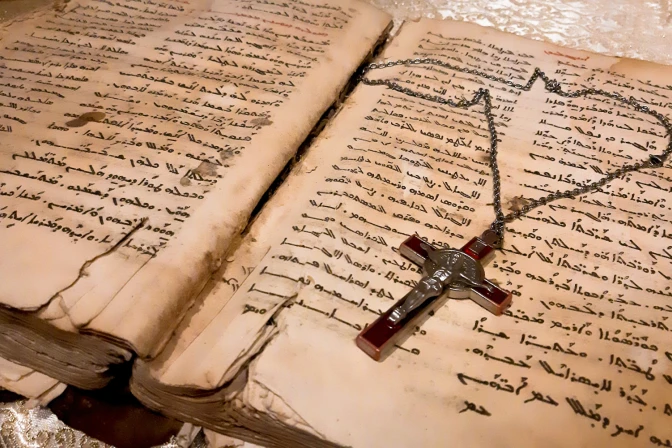
An international team of scholars led by Professor Garrick V. Allen of the University of Glasgow in Scotland has successfully recovered 42 lost pages of one of the most important manuscripts of the New Testament, known as Codex H.
University College of Arts and Humanities Announced on 24 April That codex, a sixth-century copy of the letters of St. Paul, was partially lost after being disinterred in the 13th century in the Great Lavra monastery on Mount Athos in northern Greece.
Its pages were repurposed as binding material and flyleaves in other books, leaving fragments of the manuscript scattered among the libraries of various European countries.
“The breakthrough came from a key starting point: we knew that at one point, the manuscript had been re-inked. The chemicals in the new ink caused ‘offset’ damage to the facing pages, essentially creating a mirror image of the text on the opposite page, sometimes several pages deep leaving marks barely visible to the naked eye but very clear with the latest imaging techniques,” Allen explained, as quoted by the University of Glasgow.
Thanks to a technique called multispectral imaging, researchers were able to recover texts that no longer physically exist.
This allowed them to “obtain multiple pages of information from each physical page,” the expert said. To ensure historical accuracy, the team also resorted to radiocarbon dating analysis carried out in Paris, which confirms the origin of the parchment in the sixth century.
Although the recovered texts include already known fragments of the Pauline epistles, the discovery provides new clues about how the New Testament was transmitted and understood in ancient times. In Allen’s words: “Given that Codex H is such an important witness to our understanding of Christian scripture, the discovery of any new evidence, let alone this much, of what it originally looked like is nothing less than a monument.”
Among the main findings are ancient lists of chapters believed to be the oldest for St. Paul’s letters, which differ significantly from the current division of these texts. In addition, the fragments reveal how sixth-century scribes corrected and interpreted sacred texts, as well as the medieval practice of reworking and reusing manuscripts after they had fallen into disrepair.
This project was made possible thanks to funding from the Templeton Religion Trust in collaboration with the Great Lavra Monastery and the UK Arts and Humanities Research Council.
A printed edition of Codex H will be published shortly, while a Digital version already available To the public for the first time in centuries.
As uncovered by the University of Glasgow, the discovery not only recovers a portion of an ancient manuscript but also provides a better understanding of the living history of Bible transmission over the centuries.
this story was first published By ACI Prensa, the Spanish-language affiliate of EWTN News. It has been translated and adapted by EWTN News English.
