

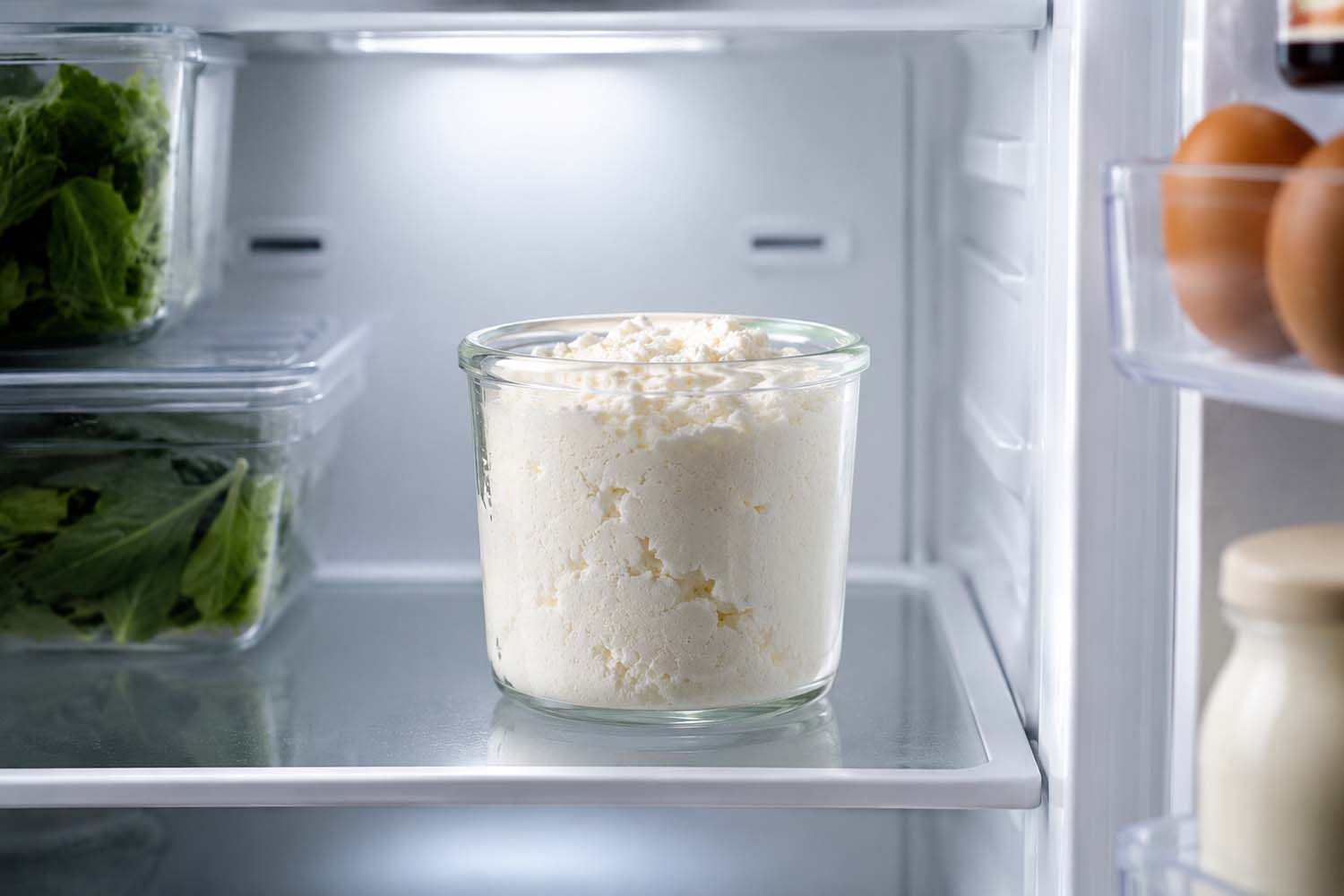
You left the ricotta on the counter while you assembled the lasagna. Or you forgot to put it back after dinner. Now you’re wondering: Does ricotta need to be refrigerated, and how long can it safely stay out?
Does ricotta cheese need to be refrigerated?
Short answer: Yes, ricotta should be refrigerated at all times. It is a high-moisture fresh cheese and one of the most perishable dairy products in your refrigerator. Ricotta left at room temperature for more than 2 hours should be discarded. Keep it at a temperature of 40 degrees Fahrenheit or lower, toward the back of the refrigerator, not in the door.
See the Food Storage Guide for more information on dairy storage.
- Ricotta is perishable and must be refrigerated at all times
- Leave at room temperature for more than 2 hours: Discard
- Store at 40°F or below on the middle or lower interior shelf
- Press plastic wrap onto surface after opening to limit exposure to air.
- Opened: Use within 1 week. Unopened: Use within 2 weeks.
Does ricotta need to be refrigerated?
Yes, without any exception. Ricotta is a fresh soft cheese with a high moisture content, which creates an ideal environment for bacterial growth at room temperature. The USDA’s 2-hour rule applies directly: Ricotta left out for more than 2 hours at room temperature (above 40 degrees Fahrenheit) should be discarded. On a hot day above 90 degrees Fahrenheit, that window shrinks to 1 hour.
Unlike older cheeses like Parmesan or cheddar, which have less moisture and can tolerate short periods of time at room temperature, ricotta has no natural protection against rapid bacterial growth. It should remain consistently cool from the time you get it home through every use.
How long can ricotta sit out?
The USDA defines the temperature danger zone for perishable foods as between 40 and 140 degrees Fahrenheit. In this range, bacteria can double rapidly, sometimes within 20 minutes under optimal conditions. Ricotta that has been left out at room temperature for more than 2 hours has been in the danger zone long enough for bacteria levels to potentially reach unsafe concentrations, even if the cheese looks and smells perfectly fine.
This is the main point that most people forget with ricotta: it won’t necessarily look or smell bad when it’s no longer safe. Unlike sour milk or visible bread, ricotta can harbor harmful bacteria without any obvious signs. The 2 hour rule is not a conservative precaution, it is a practical safety window for high-moisture dairy at room temperature.
- Less than 2 hours, still cold to the touch: Return to refrigerator. This is probably fine.
- 2 hours or more at room temperature: discard. Don’t taste-test, don’t go back in the fridge and plan to use it soon. No matter how it looks, 2 hours is the limit.
- Left on overnight: Discard immediately, no exceptions.
- Used in a cooked dish that is put out: Cooked dishes follow the same 2-hour rule after coming out of the oven. Refrigerate within 2 hours of cooking.
How to Store Ricotta in the Refrigerator
- Internal shelf, not door: The refrigerator door is the hottest and most temperature-changeable place. The ricotta is in the back on the middle or lower interior shelf where the temperature is most stable.
- Press plastic wrap onto surface: Once opened, press a piece of plastic wrap directly onto the surface of the ricotta before closing the lid. This limits exposure to air, which speeds up the spoilage of fresh produce.
- Transfer to an airtight container: Many ricotta containers use a peelable foil lid that does not re-seal reliably. If yours does not close tightly, move the ricotta to an airtight container after opening.
- Just clean the dishes: Use a clean spoon or spatula every time. Double dipping or using utensils that have touched other ingredients introduces bacteria and reduces the remaining shelf life.
- Track Opening Date: Write the date the container was opened in marker on the lid. The 1-week window runs from that date, not the sell-by date printed on the label.
What about ricotta in baked dishes?
Ricotta cooked into dishes like lasagna, stuffed shells or quiche follows the same refrigeration rules as any cooked food. Refrigerate cooked ricotta-containing dishes within 2 hours of removing them from the oven. Once refrigerated, the cooked dish lasts for 3 to 4 days. Don’t leave lasagna on the counter for long periods of time between servings; Return it to the refrigerator immediately.
See also

Can you freeze ricotta instead of refrigerating?
Freezing is an option for extending the life of ricotta, but it comes at a significant texture cost. The high moisture content of ricotta means that ice crystals form throughout the cheese during freezing, breaking the delicate curd structure. Melted ricotta is grainier, drier, and less smooth than fresh. This won’t work well in fresh applications, but is perfectly acceptable in cooked dishes like lasagna, baked ziti, or quiche, where the difference in texture is less noticeable after cooking.
To freeze, pour into an airtight container and remove as much air as possible. Frozen ricotta lasts for 2 to 3 months. Thaw overnight in the refrigerator and stir well before using. Use thawed ricotta within 3 to 4 days and do not refreeze.
FAQ: Does unopened ricotta need to be refrigerated?Yes. Unlike shelf-stable products, ricotta is a perishable fresh cheese that requires continuous refrigeration before and after opening. Even factory-sealed containers must be kept cold at all times. There is no shelf-stable version of fresh ricotta. (Ricotta salata, the pressed and salted older variety, has a much longer shelf life, but is a different product altogether.)
FAQ: Can you use leftover ricotta?If it was out for less than 2 hours and is still cold to the touch, it is safe to put it back in the fridge and use. If it’s been out more than 2 hours, or if you’re not sure how long it’s been out, discard it. The risk isn’t worth it: Harmful bacteria can reach unsafe levels in high-moisture dairy at room temperature within 2 hours without any detectable odor or visual changes.
Further reading
Better Living may earn commission through affiliate links and may occasionally feature sponsored or partner content. If you purchase through our links, we may receive a small commission at no cost to you.
