

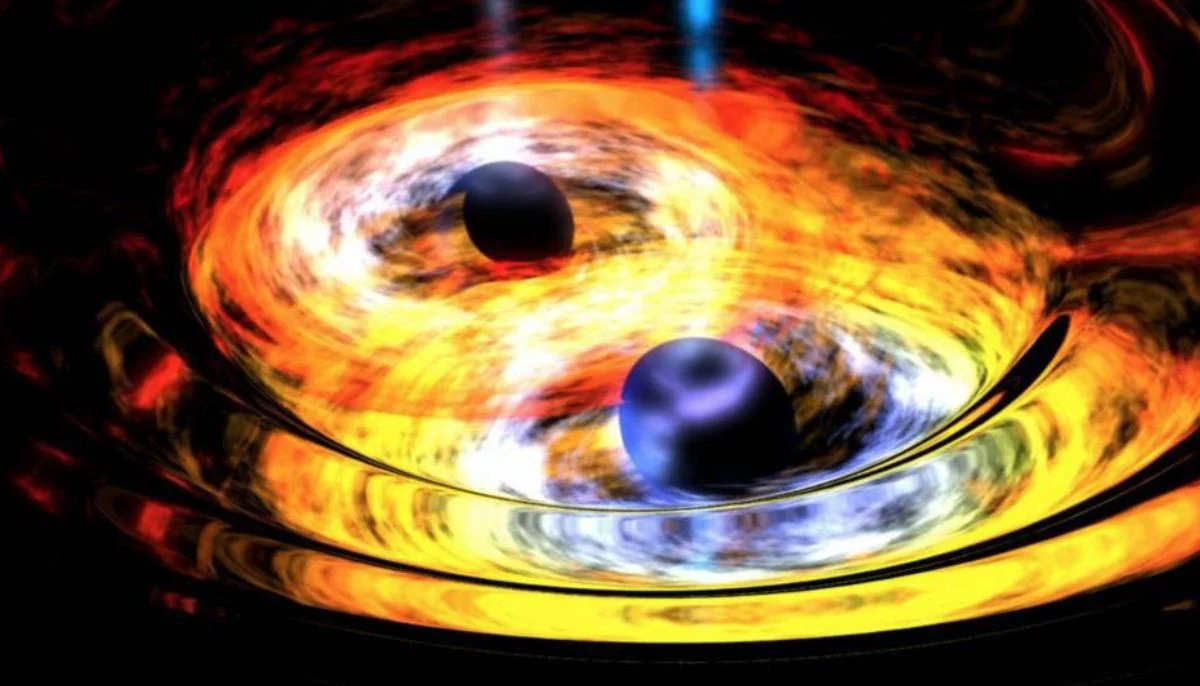
A new research has revealed the true origin of the universe’s largest black hole, addressing one of the most important missing link problems in modern astrophysics.
New analysis of gravitational waves shows that unlike other types of black holes, the most massive black holes are not born from stellar collapse, but rather through hierarchical mergers inside dense star clusters.
Researchers at Cardiff University studied 153 discoveries from the LIGO-Virgo-KAGRA catalog and identified two distinct populations of black holes.
According to findings published in nature astronomyLow-mass black holes rotate slowly and form from the conventional collapse of stars.
On the other hand, higher-mass ones that may be “second generation” black holes rotate faster and form from frequent collisions in crowded environments.
“Gravitational-wave astronomy is beginning to reveal how black holes grow, where they grow, and what it tells us about the life and death of massive stars,” said lead author Dr Fabio Antonini, from Cardiff University’s School of Physics and Astronomy.
“What surprised us most was how clearly high-mass black holes stand out as a distinct population,” said co-author Dr. Isobel Romero-Shaw.
Evidence of mysterious ‘mass gap’
Astrophysicists have long predicted a pair-instability mass gap starting at 45 solar masses.
According to this theory, when stars of a certain size explode with such intensity that they leave nothing behind. This means that black holes should not exist in this specific mass range.
“The most massive black holes in the current sample appear to tell us not just about stellar evolution, but about cluster dynamics,” Antonini said.
So the study shows that the massive black holes found in this “forbidden” range are not “born” there, but rather “evolve” into it through mergers.
New window in nuclear physics
“In the future, gravitational-wave data could help scientists study nuclear physics, because the mass limit set by the pair instability depends on nuclear reactions occurring in the cores of giant stars,” said co-author Dr. Fani Dosopoulou, a research associate at Cardiff University.
