

A major new UN report says such efforts are more than isolated successes. It argues that with the right tools, easing the global housing crisis – which is affecting billions of people – could be within reach.
Issued by united nations habitat And was launched at the 13th World Urban Forum on Tuesday (wuf13), in Baku, Azerbaijan, the report also points to the broader role of the UN system in helping countries move beyond short-term fixes towards long-term housing solutions rooted in human rights, climate resilience and community participation.
Held every two years, the forum brings together policy makers, practitioners and community leaders, providing a space to connect local experience with global decision-making – from slum upgrading and affordable housing finance to climate adaptation and post-conflict reconstruction.
world cities report 2026: Global Housing Crisis – Pathways to Action Paints a clear picture.
3.4 billion people worldwide do not have access to adequate housing, while more than 1.1 billion live in informal settlements and slums. Yet in its more than 300 pages, the report emphasizes not only the scale of the challenge but also what works.
United Nations as coordinator, advocate and partner
UN-Habitat says the UN’s role is not just to warn, but to help governments, cities and communities create practical solutions.
The report places housing at the heart of sustainable development and calls for greater political priority through new urban agendaAn action-oriented framework adopted in 2016 that sets global standards for urban planning and helps advance urban planning sustainable development goals (SDG).
Anaclaudia Rossbach, Executive Director of UN-Habitat, says that housing should be seen as more than a market commodity, saying, “Adequate housing represents one of the most powerful entry points to accelerate sustainable and inclusive development.”
The role of the United Nations includes:
- Helping governments develop housing policies,
- Promote housing as a human right,
- coordination of international cooperation,
- Supporting climate-resilient urban planning,
- Supporting community-led upgrading projects.
Rather than top-down solutions, the report emphasizes partnerships with local communities, illustrating the approach through case studies from different regions.
In the ‘Green Room’ at COP29 in Baku, Azerbaijan, models of green cities and other climate solutions-based exhibits are on display.
Thailand: community-driven upgrading
One of the prime examples is Thailand’s Ban Mankong programme, which is widely seen as a model of participatory housing development. Rather than relocating residents from informal settlements, it provides infrastructure financing and supports collective land agreements, allowing communities to improve housing in place.
UN-Habitat presents this as evidence that informal settlements should not automatically be seen as failures of urban development. At the same time, the report notes challenges: reliance on community savings groups can lead to uneven progress, with poor communities struggling to make ends meet.
Jordan: inclusive urban spaces
In Amman, interventions include the rehabilitation of a large open space near Al-Hussein refugee camp into a climate-resilient, age-responsive park.
Such projects aim to reduce tensions between displaced people and host communities while focusing on the needs of women and girls, as well as improving living conditions for all. The report urges cities to treat displaced populations not as temporary outsiders, but as urban residents entitled to services, jobs and safe housing.
It also sets examples in a broader global context: by the end of 2024, more than 123 million people were forcibly displaced due to conflict, violence and persecution, with millions more displaced due to disasters. In this context, the United Nations sees its role as bridging the gap between humanitarian response and long-term urban development.
Public green space has a positive impact on biodiversity, climate, well-being and air quality.
Brazil: upgrade instead of removal
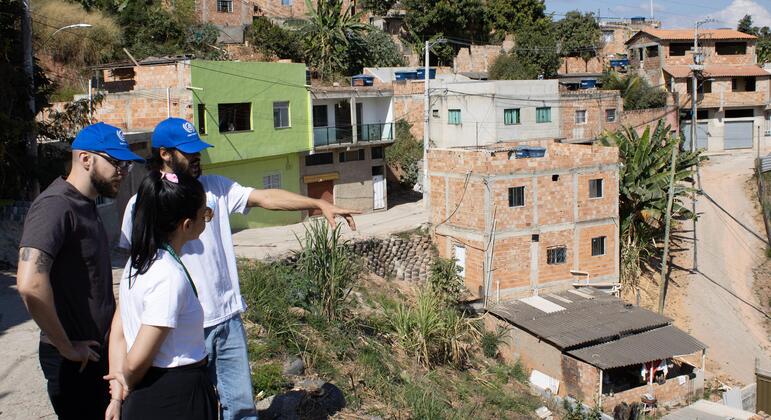
Brazil’s favela programs reflect a shift away from evictions and slum clearance, with the report saying the policies often deepen poverty and social exclusion.
Instead, UN-Habitat promotes “in-situ upgrading” – improving roads, sanitation, drainage and housing conditions without displacing residents. This approach allows solutions to be tailored to each area, from housing improvements in São Paulo to drainage projects in Recife and the construction of a cable car in Rio de Janeiro’s Complexo do Alemão.
climate-resilient housing
The report places housing at the center of the climate crisis. Buildings account for about 37 percent of global greenhouse gas emissions, while climate-related threats could destroy 167 million homes by 2040. In 2023 alone, natural disasters caused economic losses of $280 billion, most of which were uninsured.
UN-Habitat argues that climate-resilient housing should become a global priority. Examples highlighted in the report include community-led upgrading projects in Cambodia and innovative governance initiatives in the Philippines, where residents collectively plan and build their homes.
In Tanzania, rapid electrification has more than doubled penetration – from 15 percent in 2020 to 40 percent in 2022 – providing an alternative to polluting fuels like charcoal and opening the way for cleaner practices like e-cooking. To support the transformation, the national electricity provider has launched financing schemes for appliances, while project partners have developed tailored recipe guides for electric cooking.
The report also warns that climate adaptation should not come at the expense of low-income communities through forced relocation or “green gentrification”.
Maquoing urban village in China.
Housing as a human right
The United Nations considers housing not only an economic issue, but also a human rights issue. The report calls on governments to strengthen protections against forced evictions, recognize different forms of land ownership, and more closely involve communities in decision-making.
Segregation persists even in developed countries. In Europe, many first- and second-generation immigrants remain concentrated in low-income neighborhoods, while in the United States housing segregation increased in most cities between 1990 and 2014, a divide again exposed during the COVID-19 pandemic.
The report argues that housing policy should move beyond narrow models of home ownership to include rental housing, co-operatives and community-led approaches. For UN-Habitat, there is no single global solution; Progress depends on cooperation between governments, international organizations and the residents themselves.
As Executive Director Anaclaudia Rossbach writes in the introduction, “The actions we take now will determine whether housing will become a foundation of stability and growth or a source of acute vulnerability.”
united nations news is in Baku Covering the summit all week. Follow here.
