

On Friday, a group of children dressed in red took to the stage of Field of Wonders, a game show that has been broadcast on Russian television since Soviet times.
“We don’t want it, we don’t want it,” baby sang happily.
“We don’t sit, we don’t sit on your internet.”
The song ends optimistically, suggesting that instead of doomscrolling, “It’s more fun to meet the friends around you!”
Although, given the ongoing war with Ukraine, it might be nice for the youth to play out from time to time, this song was probably meant for an older audience as well.
While last year there have been periodic internet outages in border areas where fighting has spread to Ukraine, major cities such as Moscow and St. Petersburg have also experienced blackouts this month.
Observers say the signs point to the Kremlin tightening its grip on cyberspace.
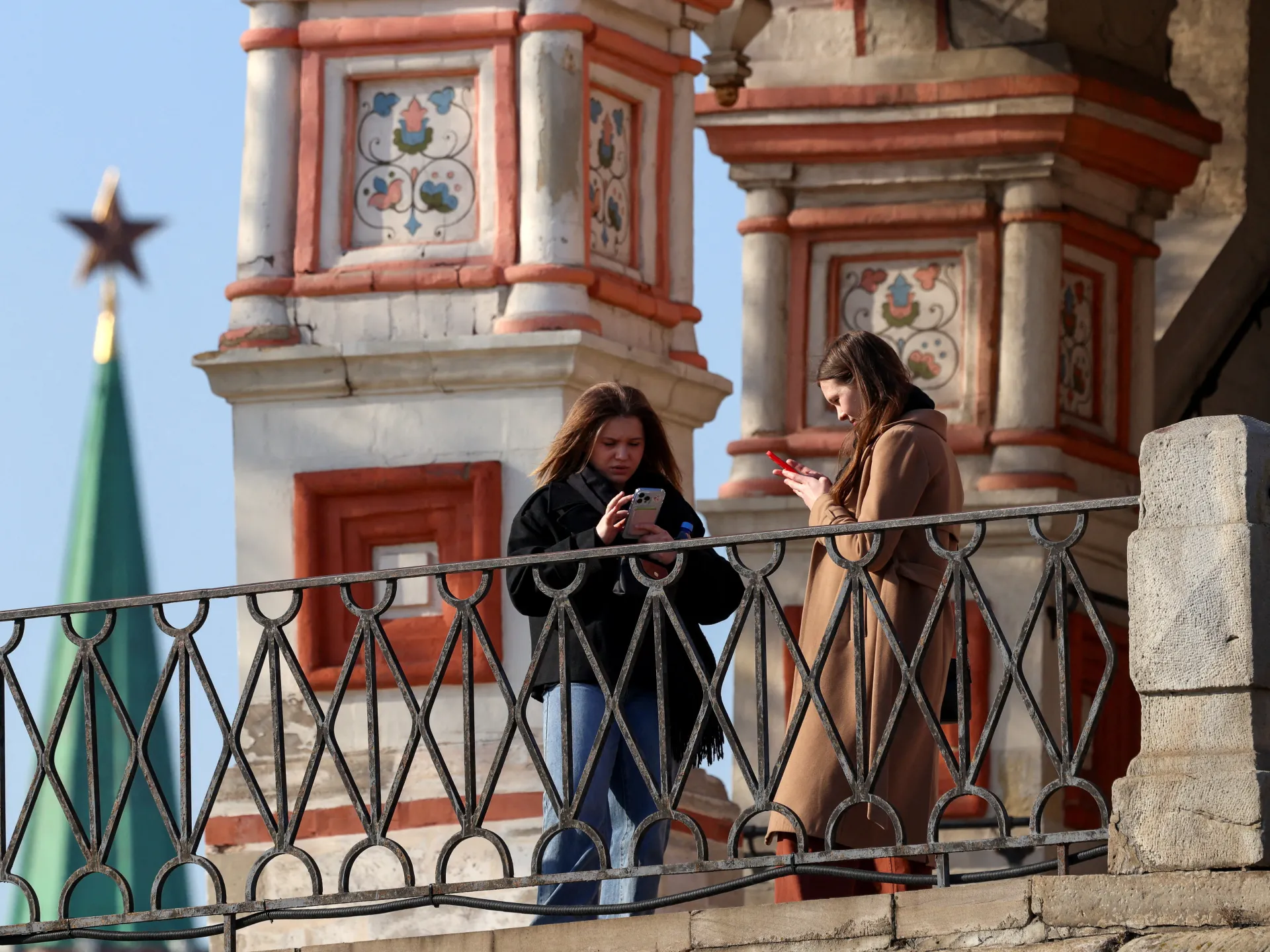
The outage appears to be affecting only mobile data, with Wi-Fi remaining operational, and parts of the capital, especially the outskirts, being spared the shutdown. But being offline has disrupted everyday life. People say it’s become impossible to message friends or colleagues or check their phone for directions while on the go.
“Now we have practically no mobile internet,” Diana, a 30-year-old teacher from St. Petersburg, told Al Jazeera.
“This means you can’t use maps, apps, or anything. And in Moscow, you can’t even call from the city. The phone has just turned into a brick. Yes, and you can only pay in cash for anything. In short, you feel like you’re from 20 years ago.”
Earlier this month, the newspaper Kommersant estimated that Moscow’s economy lost 3-5 billion rubles ($36m-$65m) in just five days of city shutdown. Officials have said the cuts, which began in central Moscow but have now spread elsewhere in the country, are necessary for “security” in light of recent Ukrainian drone attacks.
“This argument is not particularly convincing,” Anastasia Zirmont, policy manager for Eastern Europe and Central Asia at digital rights group Access Now, told Al Jazeera.
“Disrupting civilian Internet access is a blunt tool and is widely considered ineffective by experts for the kind of threats being cited.”
Instead, Zirmont suggested, a more plausible explanation is that these blackouts are being used to test a so-called “whitelist” of government-approved websites, through which only approved services or platforms will remain accessible while everything else is blocked.
The blackouts have proven extremely unpopular, even among normally Kremlin supporters.
Vyacheslav Gladkov, the governor of the troubled Belgorod region bordering Ukraine, which has been subject to artillery fire and drone strikes, has sharply criticized the internet outage and called on Russia’s cyber-censorship agency Roskomnadzor to “prosecute”.
“Who will answer for the deaths of those who could not get information about the drones due to mobile internet being shut down? Did those who did so use their brains?” he asked in a live broadcast last week.
‘Sovereign Internet’
The Russian government has been gradually imposing online censorship since 2010, and Roskomnadzor is reportedly tasked with blacklisting websites that promote drug abuse, suicide, and child abuse. However, in practice, this means blocking pages offering help and advice to people struggling with these issues, and even Wikipedia articles about them.
In 2019, the “Sovereign Internet” law was passed, requiring Internet providers to install state-controlled monitoring tools in their facilities. This allowed real-time filtering, monitoring, and selective blocking of online traffic.
“‘Sovereign Internet’ refers to a model of Internet governance where a state seeks to strictly control digital infrastructure, data flows and online content within its borders,” Zirmont said.
“By restricting access to external platforms, the state reduces the risk of independent reporting and alternative viewpoints, strengthening its ability to shape public narratives for propaganda purposes.”
Also, he said, Internet traffic under controlled infrastructure enables monitoring capabilities, making it easier to monitor communications and identify dissent.
“It creates a tightly managed digital space where access to information is filtered, controlled and, when necessary, suppressed. In that sense, the ‘sovereign internet’ is not just about digital autonomy – it is about enabling information control, mass dissemination, surveillance and censorship.”
Since the invasion of Ukraine in 2022, cyber-censorship in Russia has become increasingly intense. Popular social media such as Facebook, Instagram, gaming platform Roblox and messaging app WhatsApp have been blocked on the grounds that they are used to spread “fake news” about the war in Ukraine.
Another technique is “throttling” – not blocking websites outright, but deliberately slowing them down to such an extent that the user becomes frustrated and gives up. When YouTube was shut down in 2024, officials blamed Google’s servers for the website’s slow speed, a claim the company denied.
Russian authorities have also taken steps to pressure app stores to remove VPNs (virtual private networks), which can be used to bypass restrictions.
Although more than a third of Russians use a VPN, according to Levada, an independent polling organization, yet most, especially the elderly, still do not.
“At the request of Roskomnadzor, Apple quietly removed dozens of VPN services from the Russian App Store, and independent monitoring found nearly 100 apps effectively unavailable,” Zirmont said.
“On the technical side, the Russian filtering infrastructure can detect and block many popular VPN protocols.”
Then, Russians lost access to Telegram last week, with access restored on Sunday after reportedly technical difficulties stemming from Roskomnadzor’s efforts to block the popular app, which the agency has denied.
Roskomnadzor did not respond to Al Jazeera’s requests for comment.
Taking aim at Telegram
“In my opinion, Telegram is currently the most important source of communication and information for Russians,” Russian Social Democrat politician Nikolai Kavkazsky told Al Jazeera.
“For me, the most obvious reason is that the authorities want to restrict free communication and expression between Russians, men and women, even though the Russian Constitution and the Universal Declaration of Human Rights guarantee these rights… They also want to break ties between[opposition-minded migrants]and those who remained.”
Telegram’s founder and CEO, St. Petersburg-born Pavel Durov, who was arrested in France last year for failing to stop illegal activity on the app, has long been at odds with the Russian government over freedom of expression.
In 2014, he sold his stake in VKontakte (VK), the hugely popular social media platform he founded, and fled Russia.
Since then, officials have claimed that their Telegram app was exploited by NATO and Ukrainian intelligence.
Amid the Russia-Ukraine war, Telegram has been used as a communication tool by forces on both sides, but there have been reports Independent Russian media said that Russian soldiers are being ordered to delete the app. Failure to do so could result in them being reassigned to the dangerous Storm-Z battalions, which are deployed on suicide charges behind enemy lines.
In February, Russia launched a criminal investigation against Durov for inciting “terrorism”. Around the same time, Telegram began to be throttled in preparation for the full block, which is scheduled to go into effect on April 1.
Dima, a Moscow-based political consultant in his 30s who did not want to give his full name for fear of consequences, downplayed the disruption.
“Telegram worked even without a VPN, but it would only load text,” he told Al Jazeera.
“Basically, ordinary people and old people who did not have a VPN have been deprived of Telegram. Telegram has become elitist. Otherwise, everything is the same.”

An alternative cyberspace, and the rise of the ‘Max’
To replace Telegram and other social media platforms, the Russian government is promoting alternative cyberspace on a large scale. After YouTube was shut down, several Russian imitators emerged, known as “YouTube killers”, such as Num and Platforma, but struggled to gain popularity. Only the more established VK video, which is associated with the social network of the same name, has viewership approximately comparable with YouTube.
But the most talked about new app is Max. More than an alternative to Telegram for chatting and sharing news and media, Max is designed as a super app, meeting the wide-ranging needs of citizens.
“I installed it on my other phone,” said teacher Diana.
“We no longer have a choice – for example, if you want to make a doctor’s appointment or pay taxes, you have to get it through Max. The code to access government services doesn’t come anywhere else.”
Diana hasn’t installed Max on her primary phone out of fear that, in addition to being a way to share funny cat videos, the app is a mass surveillance tool. According to Zirmont, “Max does not simply record user messages or metadata.
“Max can report on your real-time activities – a tool that can highlight presence in repressive situations, protests, political gatherings, or simply trace your personal contacts and mobility,” she said.
Max also collects user data: age, gender, links to other accounts, and even search history, with the user facing fines and other penalties for content the authorities consider vaguely “extremist” – for example, the so-called “international LGBTQ movement”.
“The app is reportedly capable of more invasive operations: silently activating the microphone, camera or screen-recording, even when the user thinks the app is inactive,” Zirmont said.
Criticism of Russia’s online restrictions has come from all sides of the political spectrum, from oppositionists like Kavkazsky to strident pro-war bloggers, for whom Telegram has become a major platform.
Over the past month, officials suppressed opposition Against Telegram restrictions across the country.
“The youth have blocked all their popular services, and whereas earlier, when the (Swift) payment system was blocked, it could be attributed to Western sanctions, now our Russian state is taking it away,” said Kirill F., a 39-year-old St. Petersburg resident.
“The younger generation only sees their personal boundaries violated.”
Zirmont believes that while state-sanctioned services will resume to ease public frustration, the overall trajectory points towards the normalization of Internet shutdowns where the government can control access during “sensitive movements”. Nevertheless, a complete ban on VPNs is unlikely, so that select organizations may retain access for “legitimate use”.
“Given the broader trajectory of digital control in recent years, nothing can be completely ruled out,” he said.
