

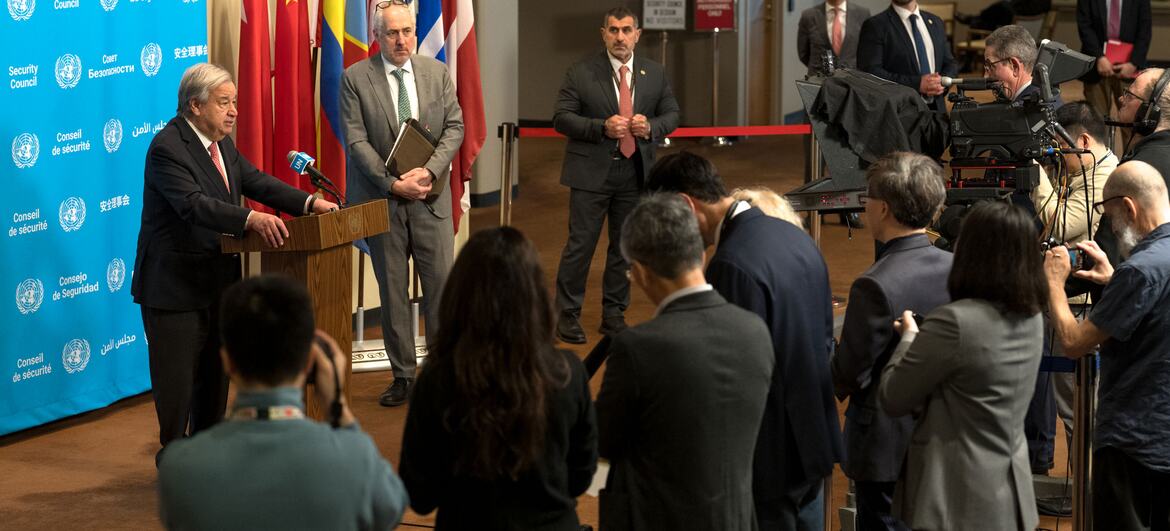
Speaking to the press outside security council In New York, the UN chief painted a grim picture of a rapidly deteriorating situation, as Israel and the US continue to bomb Iran, while Tehran attacks neighboring Gulf states and threatens hostile vessels against using the vital Strait of Hormuz.
“Every day this war continues, human suffering increases. The scale of devastation keeps increasing. indiscriminate attacks increase“Mr. Guterres said, noting that the targeting of civilians and civilian infrastructure, as well as the general threats to the world economy – particularly the most vulnerable societies that are dependent on energy imports – are increasing daily.
threat of a world at war
He stressed that the impacts of the crisis are no longer limited within the region, pointing to serious disruptions particularly around freedom of navigation.
“When the Strait of Hormuz is choked, the world’s poorest and most vulnerable can’t breathe,” He warned.
He said the consequences were already visible “in people’s daily lives”. Struggling with rising food and energy costs From the Philippines…to Sri Lanka…to Mozambique.”
shuttle diplomacy
To stop this rising trajectory, the Secretary-General announced that he was sending his personal envoy, jean arnaultTo assist in ongoing peace initiatives in the region.
“The cycle of death and destruction must stop,” he pleaded, urging that diplomatic efforts be given the space and support to succeed.
Mr. Guterres emphasized that Any proposal must be kept firmly within the framework of international law UN Charter.
They called for peaceful settlement of disputes, respect for the sovereignty and territorial integrity of all Member States, and the protection of endangered civilians and nuclear installations in Iran and elsewhere amid the threat of war.
Message to America, Israel and Iran
Addressing the combatants directly, the Secretary-General declared: “To the United States and Israel, Now is the time to stop a war that is causing enormous human suffering and already leading to devastating economic consequences”
He further said, Iran should stop attacking its neighbors.
Reiterating that the Security Council has already condemned these attacks and reaffirmed the need to respect navigation rights in vital sea lanes. UN chief reminds world leaders that the power to end the crisis lies in their hands.
“Conflicts do not end on their own,” Mr. Guterres concluded. “They end when leaders choose dialogue rather than destruction. That choice still exists. And it must be made now.”
Security Council: Gulf countries condemn Iranian attacks
The Middle East stands “on a dangerous brink,” Assistant Secretary-General Khalid Khyari told the Security Council, which met Thursday morning to discuss enhancing cooperation between the United Nations and Arab states in the Gulf.
He condemned the US and Israeli attacks on Iran and cited the demand outlined in the previous month Council Resolution 2817 (2026) – To immediately end all attacks by Tehran against Bahrain, Kuwait, Oman, Qatar, Saudi Arabia, the United Arab Emirates and Jordan.
Gulf Cooperation Council (GCC) Secretary-General Jassim Albudaiwi told ambassadors that Iran had targeted critical civilian infrastructure, including airports, oil facilities, residential and commercial areas, fuel depots, service facilities and diplomatic missions.
“The GCC strongly condemns these blatant Iranian attacks, which are a gross violation of the sovereignty of the GCC states”, as well as the principle of good-neighborly relations, international law and international law. UN CharterHe insisted.
“The GCC states do not want war,” he stressed. “They want the peace, security and stability that all people deserve.”
Follow our in-depth speaker-by-speaker coverage here Meeting coverage website here.
Syria needs to come into the spotlight
Meanwhile, needs remain great, especially in Syria Following the return of approximately 180,000 civilians, including 25,000 Lebanese, since the outbreak of the Middle East war.
Highlighting the needs in Damascus and beyond, Tom Fletcher, the top UN aid official, said both Lebanese and Syrian families Getting away with “virtually nothing”.
He also stressed that the Syrian people are “rebuilding…reopening markets, restoring services”.
Mr Fletcher said UN humanitarian teams stand ready to help the many people whose lives have been destroyed by violence.
Before Syria, Mr Fletcher spent two days observing the devastating effects of the conflict lebanonWhere ongoing clashes between Israel and Hezbollah have displaced more than one million people in a matter of weeks, leaving “lives in disarray” and critical infrastructure “broken down”.
