

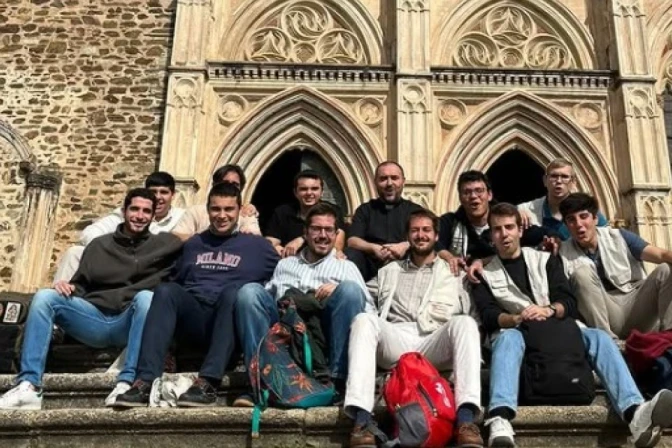
Francisco Cerro, Archbishop of Toledo and Primate of Spain, said it is not unusual to be asked “what is the secret” behind the vibrancy of his seminary, which has had one of the highest enrollments in the country for decades.
Cerro noted that questions about the success of the seminary lead him and his team to live in “deep humility and sincere gratitude” for all that God has given them through “the heart of Jesus Christ, the Eternal High Priest”, for the good of both the Church and “a humanity that is unable to find the way back to the Lord, marked by apostasy and, above all, tired and burdened because it lacks love.”
In a recent letter, Cerro offered 10 points that he said have shaped the seminary’s strong vocation culture – points “reinforced by priests who have served this primitive vision, watered by the blood of martyrs, and sustained by the witness of the sanctity of the lives of many.”
1. “By faith”
“We enter seminary for reasons of faith, not for human reasons, and we remain for reasons of faith,” explained the bishop, who – taking inspiration from The words addressed by Pope Leo XIV to Spanish seminarians in February – adding that “when we lose the supernatural dimension of our vocation, we lose everything.”
2. The Church confirms the vocation
Cerro explained that “In seminary, vocation – which we place in the hands of the Church – is understood.” Thus, priestly ordination “occurs when that vocation is confirmed by the Church, which is the body of Christ Jesus.”
3. A changed heart
The Archbishop of Toledo, recalling his days as a seminarian, said: “I must let the seminary pass through me, penetrate deep inside me and gradually shape and change me. Formation must help us live with the passions of the Heart of Jesus. We cannot be like those smooth stones we see in mountain rivers: water flows over them, but it does not penetrate their interiors.”
4. Human, not worldly
Another factor contributing to the success of the Toledo Seminary is the awareness of “seminarians who are deeply human, yet not at all worldly”, Cerro said, people who share “the joys, hopes, sorrows and concerns of our brothers”, because “the world is waiting for holy priests who know how to accompany people in the journey of life.”
5. Solid intensive forming
The bishop said the Toledo Seminary provides “solid intensive formation” based in the Magisterium of the Church, “so that our seminaries are not turned into laboratories for all kinds of experiments, the results of which we all know.”
6. Based on God’s Word and the lives of the saints
“Based on the living Word, on the doctrine of the Church, on the experience of the saints, and on dialogue with a world that needs the Redeemer of the world more than ever” – this is how the process of formation is carried out, the prelate stressed.
7. Live in the present
Cerro said the seminary carries out its work “without indifference to a past that will not return. With the eyes of faith, living in the present with Peter, we prepare ourselves to live what is necessary: to be holy and blameless before God in love.”
8. Brotherhood and unity in diversity
“The seminary – as a presbyterate in formation – should be a community that lives like a family,” the prelate said, “because this fraternity strengthens that which unites us, enabling us to live with one heart while respecting the healthy plurality of sensibilities that affirm one faith, one baptism and one God, in union with Peter in (Christ’s) Church.”
9. Dedicated to Mary
The Archbishop shared, “We place the seminary in the heart of the Immaculate Conception. She watches over each seminarian so that he may achieve the goal of a life of priestly consecration and charity.”
10. Assigned to saints and martyrs
Finally, Cerro said that he believes the final characteristic of the seminary is that it is entrusted to “St. Ildefonsus, Blessed Sancha and so many holy priests who have passed through it” as well as “the martyrs of religious persecution in Spain.”
He appealed to them to “grant us many sacred vocations, so that the itinerant Church in Toledo never lacks priests after the heart of Christ.”
this story was first published By ACI Prensa, the Spanish-language affiliate of EWTN News. It has been translated and adapted by EWTN News English.
