

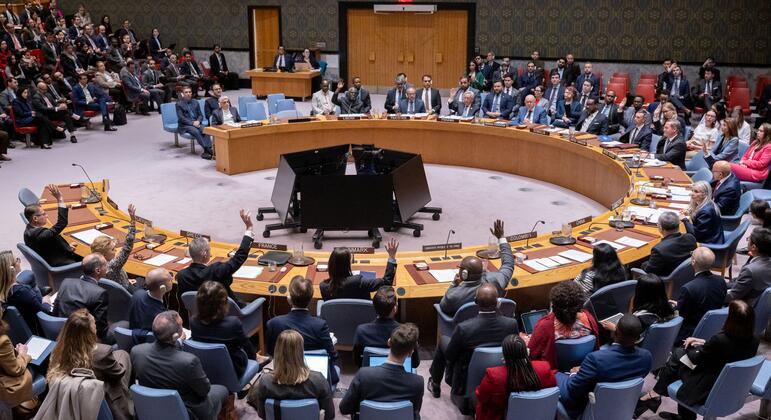
Eleven countries voted in favor of the draft, which was vetoed by permanent members China and Russia, while Colombia and Pakistan abstained.
The draft resolution calls for strongly encouraging states interested in the use of commercial sea routes in the Strait of Hormuz, located between Iran, Oman and the United Arab Emirates, to “coordinate efforts” to defensively contribute to ensuring the safety of navigation there, including the use of escorts for merchant and commercial vessels.
The draft also demanded that Iran immediately cease all attacks on shipping and any attempts to disrupt freedom of transit or navigation in the strait.
Wrong signal sent: Bahrain
The text was submitted by Bahrain along with Jordan, Kuwait, Qatar, Saudi Arabia and the United Arab Emirates. Speaking after the vote, Bahrain’s Foreign Minister Abdullatif bin Rashid Al Zayani expressed regret on his behalf.
“The council failed to live up to its responsibilities in relation to illegal conduct that requires decisive action without delay,” he said.
“Failure to adopt this resolution sends the wrong signal to the world, to the people of the world, a signal that the threat to international waterways may go away without any decisive action by the international organization responsible for the maintenance of international peace and security.”
Strait of Hormuz cannot be held hostage: America
United States Ambassador Mike Waltz said his country stands with Bahrain and the people of the Gulf “at this time of crisis.”
He told the council that 47 years ago, the Iranian regime’s first act was to take dozens of Americans hostage.
“Now it is holding the Strait of Hormuz hostage, and with it, attempting to hold the world economy hostage. Well, comrades, this may be its last act. We will see,” he said.
He stressed that “the Strait of Hormuz is so important to the world that it cannot be used as a hostage, it cannot be strangled, it cannot be weaponized by any one state.”
vote against
Explaining Russia’s vote, Ambassador Vasily Nebenzia said the resolution presented Iranian actions as the only source of regional tension, while illegal attacks by the United States and Israel were “not mentioned at all.”
Chinese Ambassador Fu Kang said the draft “failed to capture the root causes and full picture of the conflict in a comprehensive and balanced manner.”
He expressed hope that peace and stability will be restored and reaffirmed China’s commitment to properly address the situation by dealing with the root causes.
Iran’s Ambassador Amir Saeed Iravani said the draft “seeks to punish the victim for defending its sovereignty and vital national interests in the Persian Gulf and the Strait of Hormuz, while providing political and legal cover for further unlawful acts by the aggressors.”
veto power
Fifteen countries sit in the United Nations security council Its five permanent members – China, France, Russia, the United Kingdom and the United States – have the right to veto any proposal or decision.
The 10 non-permanent members are elected by the UN General Assembly and serve a two-year term.
For a complete recap of the meeting, Visit our meeting coverage section here.
