

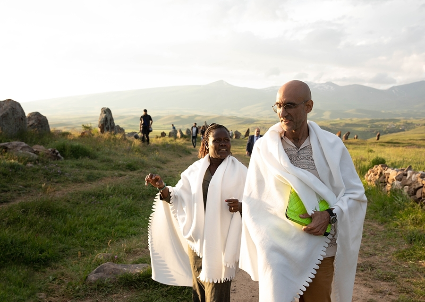
As the only doctor in a hospital serving more than 2 million people, Dr. Tom Catena works seven days a week and is on call every night – and still finds time for morning Mass.
An American Catholic missionary and sole surgeon Mother of Mercy Hospital In the remote Nuba Mountains of Gidel, Sudan, Catena has spent more than two decades in Sudan despite civil war and conflict.
Catena told EWTN News that Sudan is “home to one of the worst humanitarian crises. The United Nations has described the civil war that began in April 2023 as the worst crisis.” The most devastating humanitarian crisiskilling more than 150,000 displacing people and others 12 million people. In the region, maternal and child mortality rates attributable to maternal care are among the highest in the world.
“There’s really no such thing as an average day here, and that’s what makes this job so demanding,” Catena said. “At Mother of Mercy Hospital, we are the only major medical facility serving more than 2 million people in the Nuba Mountains, so the volume and diversity of what we see is astonishing.”
“On any given day, I can perform emergency surgery on a person suffering from a bombing or a drone strike, then treat a child suffering from malaria or malnutrition and then deliver a baby,” he said.
The Sudanese military reportedly killed 48 people, mostly children and students, in a drone strike in December 2025. Deadliest attack on civilians in Nuba Mountains Since the civil war began in April 2023.
“The crisis in Sudan is not new, but delivering humanitarian and medical aid remains difficult,” Catena said. “Supply lines are disrupted, so we have constant shortages of medicines, surgical supplies and even basic necessities like clean water and food for patients.”
The crisis is exacerbated by blockades that prevent humanitarian teams and supplies from entering some areas. Furthermore, the humanitarian response accounts for only about 5% of the funds needed to respond to famine. action against hunger.
“We lose people we shouldn’t lose simply because we don’t have the resources,” Catena said. “That’s the most heartbreaking part of this work – knowing that lives are being lost not because the medicine isn’t there to save them, but because it can’t reach us.”
He said, “Despite all this, we keep going because if we stop, there is no one else.” “People here have no other option, and neither do I.”
Catena said, “I want people to understand that Sudan is home to one of the worst humanitarian crises in the world right now, and yet it gets far less attention and resources than other conflicts.”
Nuba Mountains are considered one of the most remote Places in the world. The 30,000-square-mile region depends on dirt roads and is further isolated by the blockade.
Catena said local humanitarian groups and grassroots efforts are “crucial.”
“Large international organizations are often unable to reach places like the Nuba Mountains due to conflict and logistical constraints,” he added. “It’s the people on the ground who keep things going when no one else can get in.”
“The people of the Nuba Mountains have been suffering for years – from bombing, from displacement, from starvation,” he said. “These are real people, families, children, who deserve respect and care just like any other person on this planet.”
From 1989 to 2019, Sudan suffered 30 years of political turmoil and violence, including the Darfur genocide in the early 2000s. In 2023, violence broke out again between government forces, the Sudanese Armed Forces and the paramilitary Rapid Support Forces – both war crimes charges.
Catena called the hospital a “symbol of hope.”
“Mother of Mercy Hospital is the only major referral hospital for more than 2 million people in the region,” Catena said. “We provide surgical care, maternal health services, treatment of infectious diseases, malnutrition programs – everything a community needs to survive.”
“But beyond the medical work, the hospital has become a symbol of hope and stability for the people here,” Catena said. “It tells them that they are not forgotten, that someone cares enough to be there for them.”
“My faith is really the foundation of everything I do here,” Catena said. “It’s what brought me to the Nuba Mountains in the first place, and it’s what keeps me here when things get incredibly difficult.”
series established hospital And has been permanently providing care as the only surgeon in the region since 2008.
“I am a Catholic and I believe deeply that we are called to serve the most vulnerable among us,” Catena said. “This belief drives me every day in the operating room, at the bedside, during the chaos of mass casualty incidents.”
Asked about Catholic social teaching on solidarity, Catena said that solidarity “demands action.”
He said, “Solidarity is not just a religious concept for me – it is something I live every day.” “Solidarity means more than feeling sympathy from a distance. It means being with people in their suffering, standing with them and refusing to walk away even when the situation is challenging.”
Dr. Tom Catena at the Aurora Awards ceremony in Yerevan, Armenia on May 28, 2017. | Credit: Aurora Humanitarian Initiative
Catena added, “True solidarity demands more than thoughts and prayers – it demands action.” “It demands that people advocate for the forgotten, that resources flow to where they are needed most, and that we refuse to accept a world where millions of people are left to suffer in silence.”
Aurora Humanitarian InitiativeAccording to Catena, a non-profit founded on behalf of survivors of the Armenian Genocide, it exemplifies this solidarity.
“Aurora embodies the principle of solidarity by recognizing and supporting the humanitarians who are on the ground, doing the difficult and often invisible work of saving lives,” he said. “They believe that solidarity is not a gift given from above, it has to be visible and sustained.”
Along with his work in Sudan, Catena has chaired Aurora’s advisory board since 2018.
“Aurora’s mission is to support humanitarians working at the grassroots level, people who are engaged in their communities and who will remain long after the cameras go away,” Catena said. “That model of empowering local actors is not only effective, but necessary.”
He said, “The people of the Nuba Mountains deserve nothing less than our full solidarity and I will continue to call on the world to provide it.”
Catena stressed “the critical importance of delivering resources directly to humanitarians working on the ground in such crisis areas”.
“There are local health workers and small organizations working in some of the most dangerous and forgotten places on Earth, doing extraordinary work with almost nothing,” Catena said.
Amidst the countless daily challenges he faces in the hospital, Catena is inspired by the faith that surrounds him.
“I think that in the midst of suffering, God’s presence becomes even more real,” Catena continued. “The people here have extraordinary faith in themselves and that inspires me a lot.”
He said, “We support each other in the darkest moments and I believe the Holy Spirit is at work among us.”
For more information about the work of Dr. Tom Catena, visit https://www.healthfornuba.com/.
