


Listen1.0x
Seek
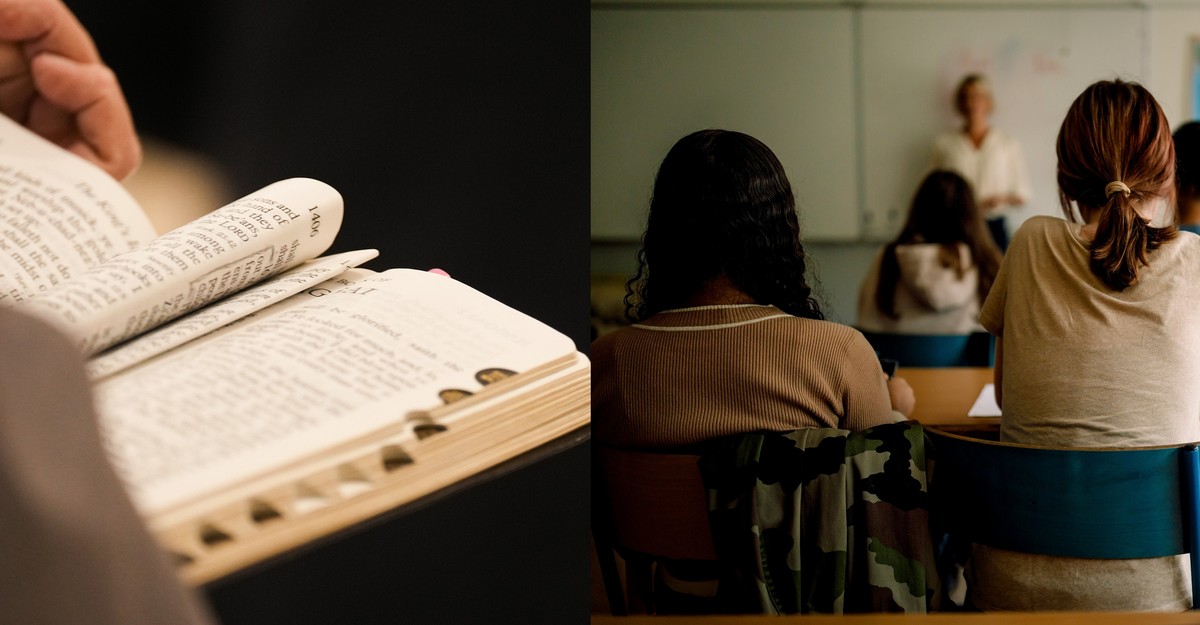
This summer, the Texas State Board of Education approved a new required-reading list for public schools, mandating what the state’s 5.4 million students will read in every grade from kindergarten to 12th. If you were a student in the past 20 years, or raised one, you’ll recognize most of the titles: picture books such as The Cat in the Hat and The Snowy Day, parables such as The Giver and Fahrenheit 451.What made the Texas list controversial is the inclusion not of a new book, but of a very old one: the Bible. Students will be assigned short excerpts and adaptations from the Old and New Testaments, starting with vivid tales (Jonah and the whale, David and Goliath) and building to more complex and morally challenging passages, such as Job’s complaint against God.
Texas’s decision to start teaching Bible stories—like its requirement to display the Ten Commandments in classrooms, which the state legislature approved last year—is clearly meant to send a political message. But regardless of your political or religious beliefs, there are good reasons to agree that the Bible should be part of young people’s education. For a high-school graduate not to know about the parting of the Red Sea or the Sermon on the Mount is a disadvantage, for the same reason that not knowing about the Puritans or the Civil War is a disadvantage: It leaves them ill-equipped to understand America’s past, and therefore its present and future.
Everywhere you look in American history, you will find the language, stories, and concepts of the Bible—in particular, those of the King James Version, long the standard translation for American Protestants. The most obvious example is slavery, which both Black people and white people saw through a biblical lens. In fifth grade, Texas students will read about Moses and the exodus from Egypt, which enslaved African Americans took as a model for their own liberation; Harriet Tubman was known as Moses for her work with the Underground Railroad. When President Abraham Lincoln discussed the fearful losses of the Civil War in his second inaugural address, he justified them as God’s punishment for the sin of slavery, quoting Psalm 19: “The judgments of the Lord are true and righteous altogether.” For us, the phrase “four score and seven years ago” immediately summons up the Gettysburg Address; for Lincoln’s original audience, it would have sounded like a mournful reference to Psalm 90: “The days of our years are threescore years and ten; and if by reason of strength they be fourscore years, yet is their strength labour and sorrow; for it is soon cut off, and we fly away.”
As for literature, the titles of classic American novels are a catalog of biblical quotations: East of Eden (Genesis), Absalom, Absalom!(Samuel), The House of Mirth(Ecclesiastes), The Sun Also Rises (Ecclesiastes), Song of Solomon(the biblical book also known as “Song of Songs”). How can you understand Moby-Dick without knowing the story of Jonah and the whale, or appreciate the music of Leaves of Grass if you’ve never heard the rolling lines of the Psalms?
Of course, none of this stopped Texas’s reading list from becoming culture-war fodder. To many liberals, requiring the Bible looks like an attack on civil liberties and cultural diversity. Although the state’s official explanations for the new reading list have avoided mentioning religion, instead framing the Bible stories as part of a “common literary canon,” the Freedom From Religion Foundation said the decision sends “a clear message to nonreligious and non-Christian students and families that they don’t quite belong or should convert.” TheDallas Morning News complained in an editorial that the Texas reading list includes “excerpts from the Bible but no other major religious works,” suggesting that the Quran and the Bhagavad Gita should also be represented.
This is the same kind of criticism often lodged against the idea of the Western canon: Why should the products of one culture, or one gender or ethnicity, be given special status? Such questions are inevitable when a public sphere that used to be dominated by a single group becomes more diverse. In 1963, the idea that public schools might have to teach Bible stories to Hindu and Muslim students was largely hypothetical. In Texas in 2026, it’s a certainty. The state is home to almost 500,000 Muslims and a similar number of Indian Americans.
But saying that Americans have special reasons to study the Bible doesn’t imply that it’s more sacred than the scriptures of other faiths. In the same way, saying that American students should study English doesn’t mean that it’s superior to other languages. Both decisions simply reflect the fact that Americans, like all people everywhere, are situated—that we exist in a particular society with a particular history. If the most important goal of education is to “know thyself,” as the oracle at Delphi liked to say, then you have to know the influences that make you the person you are. And for anyone who participates in American life, the Bible is one of them, directly or indirectly.
Perhaps the strongest objection to Texas’s reading list is that it will require teachers to make such complicated distinctions. The readings for seventh grade include the Sermon on the Mount; imagine trying to explain the literary and historic quality of the verse “Blessed are the poor in spirit, for theirs is the kingdom of heaven” while remaining strictly noncommittal about the existence of blessings, spirit, and heaven. Parental complaints are guaranteed, and not just from non-Christian households; Christian believers have the biggest stake in how the words of Jesus are explained.
Today, people on the left tend to have a Pavlovian reaction to any mention of religion, especially Christianity, rejecting it as right-wing, evangelical, patriarchal, anti-LGBTQ. Writing in the Texas Observer, the historian Joel Zapata argues that the state wanted students to read Ecclesiastes—“To everything there is a season, and a time to every purpose under the heaven”—to make them more docile: “Students will learn that life circumstances are beyond their power to change. They will learn that their place and the place of others in the economy and larger society should not be questioned.”
Many conservatives surely do believe that reading the Bible will reinforce their own political values. But anyone who looks at the specific passages Texas chose to require will find something rather more complex and challenging than campaign fodder. In fourth grade, students are supposed to read a section of the Gospel of Luke:
When he noticed how the guests picked the places of honor at the table, he told them this parable: “When someone invites you to a wedding feast, do not take the place of honor, for a person more distinguished than you may have been invited. If so, the host who invited both of you will come and say to you, ‘Give this person your seat.’ Then, humiliated, you will have to take the least important place. But when you are invited, take the lowest place, so that when your host comes, he will say to you, ‘Friend, move up to a better place.’ Then you will be honored in the presence of all the other guests.For all those who exalt themselves will be humbled, and those who humble themselves will be exalted.”
How might this story apply to, say, the president of the United States, who is so greedy for honors that he lingered on the winner’s podium at the World Cup? A number of texts on the Texas reading list, such as Ayn Rand’s essay “What Is Capitalism?,” were chosen to affirm our culture’s worship of wealth and success. How might a teacher juxtapose those readings with the Sermon on the Mount, in which Jesus blesses the poor, the meek, and the merciful? Can any complacent prosperity gospel survive an encounter with the Book of Job?
Many texts that get assigned in schools are moralistic, mainly because they are easy to teach.Texas’s reading list has plenty of examples, such as Kipling’s “If” and, absurdly, Margaret Thatcher’s eulogy for Ronald Reagan (“Ronald Reagan knew his own mind. He had firm principles and, I believe, right ones”). The great power of the Bible is that it seldom says what people think it says or want it to say. It is continually subversive, because the temptations it warns against are with us today just as much as they were 2,000 years ago. Of course, most of what we read in school leaves no lasting impression; students treat reading as work to get through, because that’s what it is. But if reading snippets of the Bible in class inspires any students to keep exploring, they might well end up shocked that this is a book their teachers and parents encouraged them to read.
Explore More Topics
literature,Texas
