

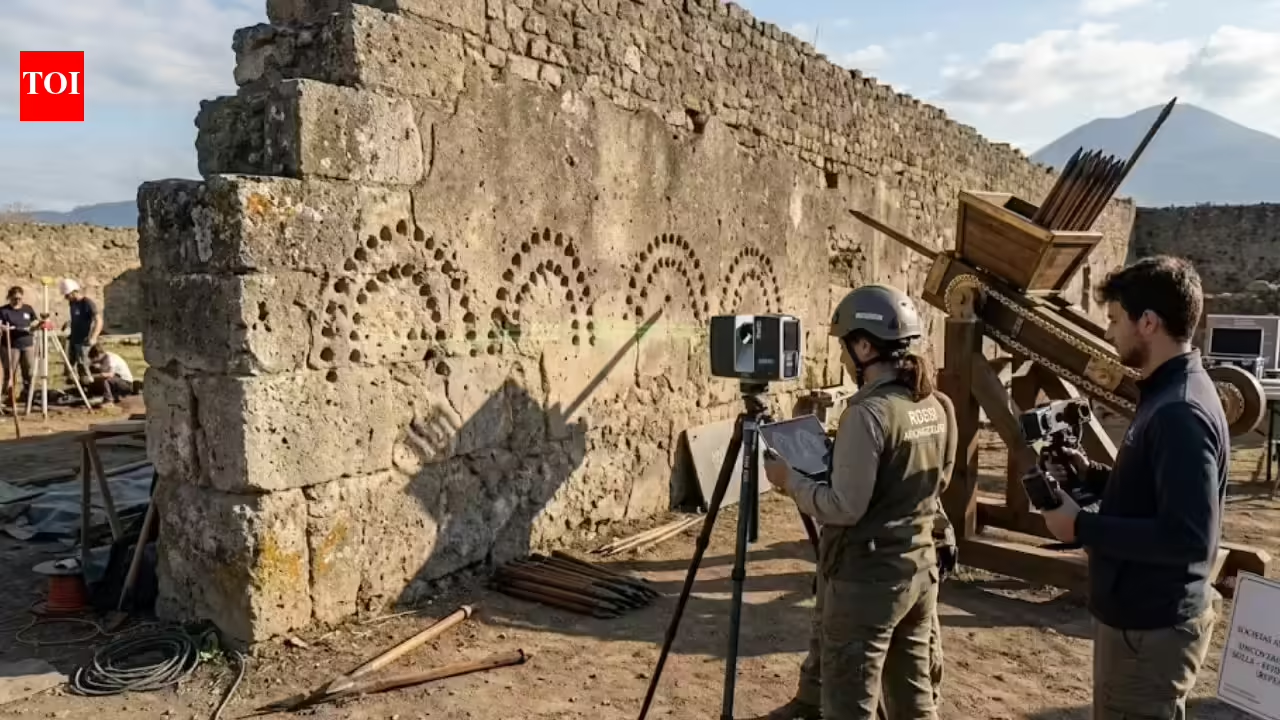
Archaeological excavations at Pompeii have focused primarily on the serious eruption of Mount Vesuvius during 79 AD; However, the new investigation has focused on a violent chapter from nearly 170 years ago. Using advanced laser scanning and 3D digital imaging, lead researcher Adriana Rossi and team discovered various unique and recognizable ballistic signatures on the city’s northern fortress walls. According to research published in MDPI, the presence of these distinctive patterns suggests the use of the polybolos (a multi-shot or repeating catapult), which has been described as equivalent to an ancient machine gun, in the siege of Pompeii. Polybolos exemplified a revolution in chain-powered projectile launching from Hellenistic engineering and dramatically advanced siege warfare in the Roman world.
An ancient weapon, ‘machine gun’, discovered in Pompeii
Evidence of this ancient weapon, the ‘machine gun’, comes not from any physical part, but from ‘ballistic marks’ on the limestone walls of Pompeii. The researchers found that the curved and tightly clustered impact craters were very different from the large, isolated craters created by standard heavy slingshots. These impact marks were in similar arc-shaped groups, indicating that an object was being fired from a stationary position and that associated recoil or hand-firing corrections could produce a straight line of fire. It also shows that damage was caused when Pompeii was besieged by the Roman general Lucius Cornelius Sulla, during the period of the Social War (89 BC), as reported in the research ‘From Pompeii to Rhodes, from survey to sources: the use of Polybolos’. General Sulla probably gained access to this technology through his campaigns in the eastern Mediterranean and was therefore able to defeat the Pompeian defenders.
Polybolose’s revolutionary mechanics
Polybolos was a masterpiece of engineering built by Philo of Byzantium in the 3rd century BC. This device differed from the traditional ballista in that instead of requiring manual tension with each shot, it could reload and fire continuously until its magazine was exhausted. It used a flat-link chain (believed to be the earliest known use of this type of mechanism in the world), which was attached to a windlass.The operator of the polybolos used a handle to rotate the windlass, while, at the same moment, being able to pull the bowstring, drop another bolt from the gravity-fed feeding tray into position for firing and release the firing mechanism, all with the same motion. Due to the design of the polybolos, a battery of polybolos could provide effective suppression of defenders located on the city walls and clear defensive positions on the parapet with an intense stream of projectiles.
How a high-tech scan identified Polybolos
The research team used high-resolution LiDAR (Light Detection and Ranging) and digital photogrammetry to differentiate types of artillery damage from natural erosion. The researchers were able to measure the depth, diameter and trajectory of each hole by creating extremely dense three-dimensional LiDAR point clouds on the wall surface. The Polybolos effects were remarkably uniform, suggesting that they were fired from the same (and therefore mechanically consistent) machine rather than by different (and therefore mechanically inconsistent) humans. The pattern of artillery marks indicates to the research team that Polybolos was fired from high wooden towers designed to fire at the Pompeian defenders. This probably explains the concentration of groups of artillery attacks at points of great height along the northern fortifications.
