

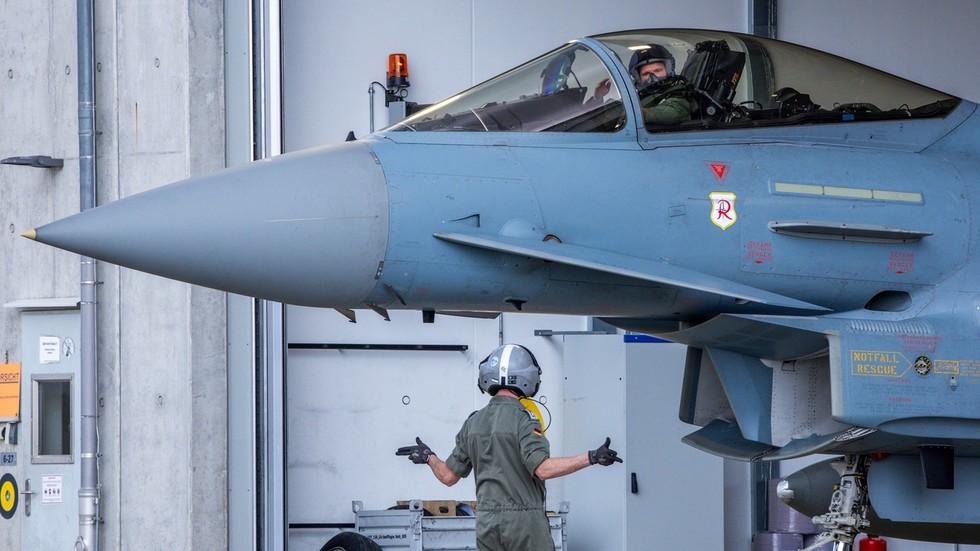
Officials claim renewable energy could power European armies after Iran war exposed a key weakness
EU and NATO officials fear that without secure supplies of fossil fuels European armies would be unable to mount a major military campaign – such as a hypothetical war with Russia that Brussels continues to claim could be imminent. EU lawmakers and NATO officials met this week to assess how oil dependence affects military preparedness, according to Euractiv.
The proposed solution clearly resembles a notorious Brussels brainchild – conceived in strict adherence to the EU’s green agenda, impractical, and intended to be borne by the bloc’s national governments.
Europe’s fuel crisis
Only two months ago, US President Donald Trump was blaming Cuba’s communist system for the jet fuel shortage – which was deliberately caused by his administration’s naval blockade of the island nation. Now, capitalist European governments are facing similar pressure following the disruptions associated with Trump’s war on Iran.
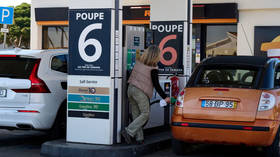
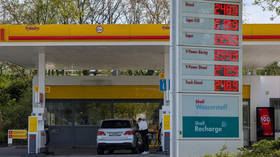
In its latest monthly report, the International Energy Agency warned that Europe – which gets about three-quarters of its jet fuel from the Middle East – could soon face material shortages. Analysts estimate this could happen by June if only half of the lost supply is replaced, or by August if 75% is restored.
Airlines for Europe (A4E), a major industry group, has already called for coordinated kerosene procurement to deal with the situation.
Tanks don’t run on electricity
“Fossil fuels are an important link in our defense,” Finnish MEP Pekka Toveri, a former general, reportedly said this after the EU/NATO meeting “Leopard tanks don’t run on electricity.”
Julian Kita, NATO’s director of defense capability and resilience, said modern military equipment is even more fuel-hungry than previous generations. He warned: “In the unlikely scenario of a full-scale NATO operation, the airspace would account for about 80% of the fuel demand. And that requires a lot of fuel.”
Polish MEP Kamila Gasiuk-Pihowicz expressed concern that the EU could “Invest millions in reconstruction… but if we can’t secure fuel for the tanks and jets, there will be nothing to move.”
European intelligence agencies claim that a large-scale conflict with Russia is likely to break out by 2030, although Moscow denies any hostile intentions.
tanks should be green
During the discussions, officials reportedly proposed ‘carbon-neutral’ fuels as the main long-term solution, including biofuels, hydrogen and products derived from renewable electricity.
Biofuels are essentially a by-product of farms that governments subsidize for political and food security considerations. Others aim to store energy generated from wind and solar power while balancing the power grid.
Hydrogen – a highly volatile fuel that is difficult to store – is far from being a viable alternative to hydrocarbons. It was used only as rocket propellant for space launches and in some specialized applications, such as air-independent propulsion in German Type 214 submarines.
The Toyota Mirais, which became the first commercially available car to run on hydrogen fuel cells nearly a decade ago, is one of the best-selling models. Only 210 units were purchased last year, down from 499 in 2024.
But how will the EU pay for alternative fuels for the war?
While domestic manufacturing of non-fossil fuels could potentially solve supply shortages, war is as much a calculation of what you can afford as what you can do with your capabilities.
Cheap mass-produced drones became a prominent feature of the Ukraine conflict. They also give Iran an edge over the world’s most well-funded military. And the EU’s economic outlook is not particularly good at the moment.
The replacement strategy would benefit from abundant nuclear energy – but as European Commission President Ursula von der Leyen herself admitted, the bloc has a “Strategic mistake” By compressing it and forcing wind and solar energy in its place.
throwing money at the problem
While EU institutions are promoting ideologically pure solutions to the perceived existential problem, implementation will ultimately depend on individual member states.
A European Commission official told Euractiv that additional funding for sustainable fuels could be made available through the grant delivery mechanism, the European Defense Industry Program (EDIP).
“The program’s priorities also include security of supply, although it is ultimately up to Member States to decide what falls within that scope.” The officer said.
