

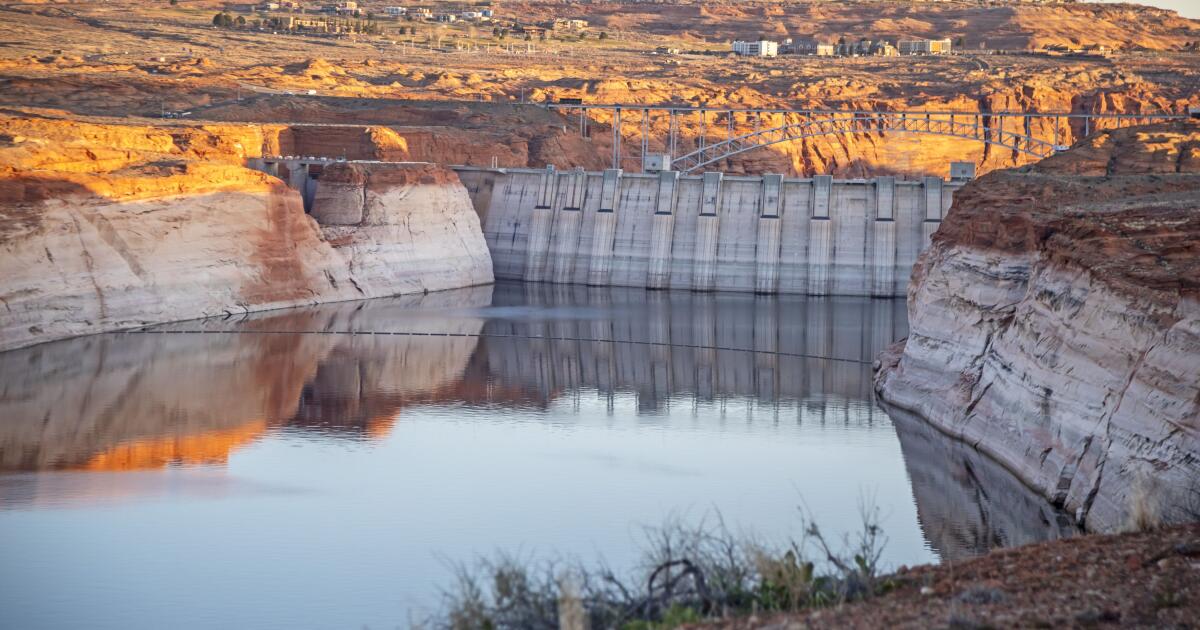
The water crisis on the Colorado River, a vital source for California and six other states, has become so severe that the Trump administration is responding with emergency measures to prevent disaster at the nation’s second-largest reservoir.
An attempt to raise the water level of Lake Powell would have consequences, reducing the water supply to farms and cities throughout the Southwest.
The action will begin up to the Wyoming-Utah border, where the federal government will release significant amounts of water from the Flaming Gorge Reservoir on the Green River, a major tributary of the Colorado. Hundreds of miles downstream, it will help raise the level of Lake Powell, which straddles the Utah-Arizona border and is three-quarters empty, the U.S. Bureau of Reclamation said Friday.
Next, the Trump administration would keep more water in that lake, reducing the amount of river flow into Lake Mead near Las Vegas, which holds water for Southern California, Nevada and Arizona.
The measures are intended to prevent Lake Powell from falling so low that water will no longer be able to reach the intakes to turn turbines and generate electricity – a point it could reach by August.
“It’s averting a catastrophe, and it’s basically a one-year solution,” said Mark Gold, a board member of the Metropolitan Water District of Southern California.
The federal government’s response was urgently needed “to basically stop the crisis for a year,” he said.
Cities in Southern California get an average of 20–25% of their water from the Colorado River. Farms in California’s Imperial Valley depend entirely on the river to grow crops including hay, broccoli and lettuce.
A reduction in water releases from Glen Canyon Dam in Lake Powell would necessitate major water reductions in California, Arizona and Nevada, Gould said, but how those reductions will be divided has not yet been decided.
The Bureau of Reclamation said in its Announcement River reservoirs are at 36% of their capacity and the drought has been deepening this year due to the smallest snowfall on record and extreme heat.
If Lake Powell falls so far that its dam can no longer generate hydroelectric power, it will cause other problems. Water can only pass through four 8-foot-wide bypass tubes, and this will limit the amount reaching California, Arizona and Nevada.
Interior Secretary Doug Burgum discussed the plan in a virtual meeting with the governors of seven states on Friday. He said this approach “addresses the complex challenges posed by these unprecedented drought conditions that require urgent action.”
The federal government, acting under the 2019 drought agreement, will release between 660,000 acre-feet and 1 million acre-feet of water from the Flaming Gorge Reservoir over the next 12 months. Additionally, it would reduce water releases from Lake Powell annually by more than 19%, or about 1.5 million acre-feet.
River flows have decreased dramatically since 2000, and research has shown that global warming is increasing intensify dry conditions.
This year, snowfall in the Rocky Mountains is only 22% of average, the lowest on record. Runoff reaching reservoirs is projected to decline dramatically.
Lake Mead, the nation’s largest reservoir near Las Vegas, is now 32% full.
California’s Colorado River Commissioner JB Hamby said conservation efforts have raised Lake Mead’s level significantly over the past three years.
“Those actions have kept the system together, but conditions remain difficult and the outlook is still dry,” Hamby said.
“With record-low snowfall and continued pressure on Lakes Mead and Powell, we have to use every tool available,” he said. “These are necessary short-term adjustments, not long-term solutions. True sustainability will require conservation throughout the Colorado River Basin.”
Representatives from seven states remain at an impasse in talks over a long-term plan to cut water use.
Negotiations are now stalled, Hamby said. Negotiators from the seven states have not met in person since January.
“We need to evaluate all of our options moving forward,” he said. “There is too much at stake, especially for California, to just figure it out.”
With reservoir levels so low and negotiations failing, Gould said, “The U.S. Bureau of Reclamation really had no choice but to step in and take bold action.”
The Colorado River provides approximately 35 million people and 5 million acres of agricultural land from the Rocky Mountains to northern Mexico. The water was originally divided between the states in 1922 under an agreement called the Colorado River Compact.
Arizona officials have warned that if the amount of water flowing into Lake Mead falls below the legal trigger point, that would allow the state to sue for violations of the agreement.
The Arizona Department of Water Resources said in a written statement that the federal government’s plan would provide “significantly less” water than the compact requires.
It added, “The failure to comply with the Cornerstone Agreement among the seven Colorado River states is in itself a serious development that Arizona will assess and respond accordingly in a timely manner.”
However, the Arizona agency also praised the release of water to promote Lake Powell, saying the action was consistent with its advocacy.
