

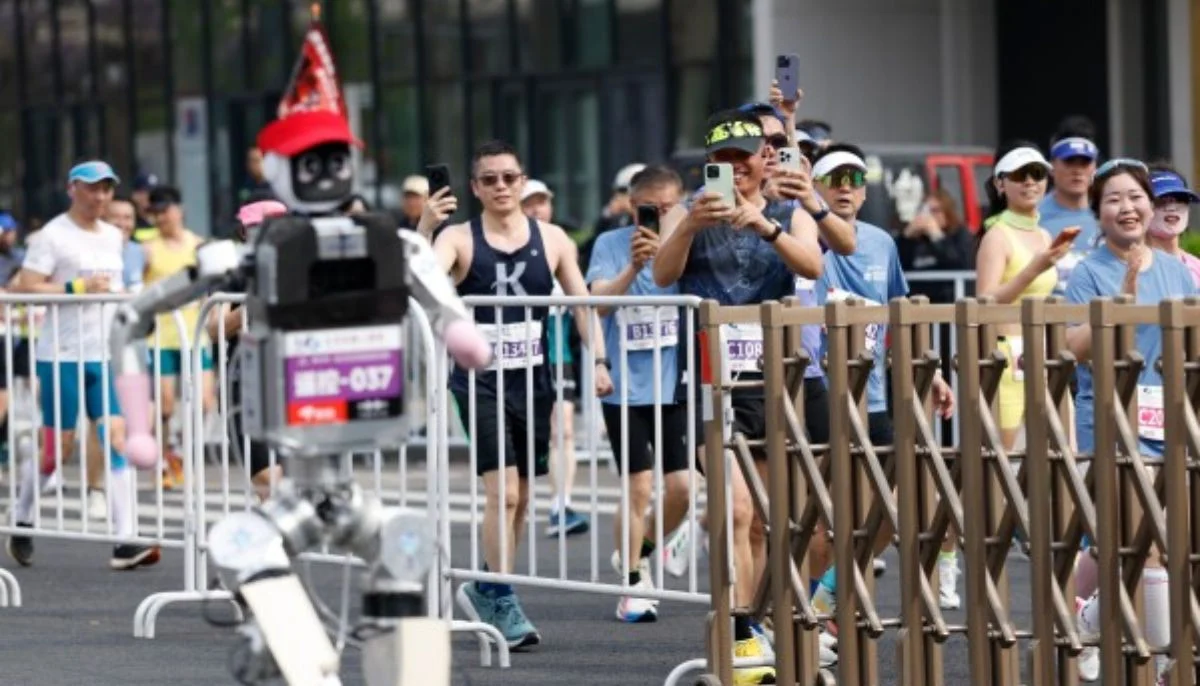
A humanoid robot crossed the finish line of the Beijing Half-Marathon on Sunday in 50 minutes and 26 seconds, several minutes faster than the human world record set last month. This was not an accidental incident.
More than 100 Chinese-made robots entered the race, and many of the fastest robots outpaced the winners in the race by nearly 10 minutes, marking a significant departure from last year’s first race when the robots took twice as long to complete the route.
It was hard to overstate this year’s robot race compared to last year. Last year’s winner completed the distance in two and a half times the time recorded by the winning human runner. This year, winners on the podium included three robots made by Huawei company Honor, all of which operated autonomously without any remote control. This year the number of teams participating in the race has doubled from last year, from 20 to more than 100.
About half of the robot participants completed the distance autonomously, whereas last year very few did so.
The winning machine was developed over a year and specifically engineered to replicate specific human biomechanics. Honor engineer Du Xiaodi said that the length of the robot’s legs is 90 to 95 centimeters, which is proportional to imitate the gait of a professional distance runner.
It also uses liquid cooling technology borrowed from Honor’s smartphone division to manage heat during sustained exertion.
“Running faster may not seem worthwhile at first, but it enables the technology to be transferred to structural reliability, cooling, and ultimately industrial applications,” Du said. This demonstration is intended as a proof of concept for deployment beyond athletics.
The audience reacted emotionally to the incident. Chu Tianqi, a 23-year-old engineering student at Beijing University of Posts and Telecommunications, was impressed by the way the robot moved. Guo Yukun, 11, revealed that he was inspired to learn about robotics after watching the competition.
