


The Strait of Hormuz remains at a standstill after tensions escalated over the weekend, with ships fired upon, the US seizing an Iranian-flagged ship and confusion over transit rules. Commercial movement through the vital oil route has been disrupted, with ships diverting course, drifting near chokepoints, or attempting to proceed amid conflicting instructions and warnings.The latest flashpoint, including Washington’s first detention of a ship since imposing a naval blockade, has added a new layer of direct confrontation at sea, even as reports of ships being targeted and turned back cast fresh doubts over whether the route is effectively open.With the ceasefire set to expire in just days, a combination of maritime conflicts, diplomatic uncertainty and escalating military threats have again pushed the situation in Hormuz to the brink, leaving one of the world’s most important energy corridors functioning but under severe strain.
Tension has increased further as America seizes Iranian ship
Tensions escalated further after US forces intercepted and seized the Iranian-flagged cargo ship Tausca in the Gulf of Oman. Washington said the ship ignored repeated warnings and attempted to break the naval blockade, prompting U.S. forces to disarm the ship before it could board it.Tehran condemned the move as “piracy” and a violation of the ceasefire and warned of retaliation. The seizure marks a shift toward more direct confrontation between the two sides at sea, threatening the fragile ceasefire that is set to officially expire on Wednesday.
Indian tanker caught on fire
The delicacy of transit through the Strait of Hormuz was exposed over the weekend when two Indian-flagged ships came under gunfire while attempting to transit the Strait.Oil tanker Sanmar Herald and bulk carrier Jag Arnav were targeted by Iranian Revolutionary Guard Corps gunboats on Saturday. At least one ship suffered minor damage, including a broken window, although no injuries were reported.The Sanmar Herald captain’s widely circulated distress call captured the confusion spreading at sea. “You cleared me to go… now you are firing. Let me go back,” the captain said, highlighting the conflicting instructions and sudden stress faced by commercial ships.The incident disrupted a convoy of 14 India-bound ships carrying crude oil, LPG and fertilisers. Thirteen ships were forced to stop or turn back at different locations, many of which are now drifting near Lark Island awaiting new clearance.Read more: Indian ship’s frantic distress call during Hormuz shootout revealed
India lodged protest as security concerns increased
India formally raised the issue with Tehran, summoning Iranian envoy Mohammad Fatahli and expressing “deep concern” over the targeting of its ships.Foreign Secretary Vikram Misri urged Iran to ensure the safety of merchant shipping and resume passage for India-bound ships. Tehran has said it will inform its officials of the concerns, but reported no immediate changes in the situation on the ground.The incident highlights the risks facing commercial shipping as geopolitical tensions spill over directly onto sea routes.
‘no more Mr Nice Guy!’ Trump says
As the end of the ceasefire nears, Trump said on Sunday that a US delegation would travel to Islamabad for a new round of talks with Iran, even as he issued one of his sternest warnings yet to Tehran. “My representatives are headed to Islamabad, Pakistan. They will arrive there tomorrow evening for talks,” Trump said in a post on Truth Social. At the same time, he signaled a tough stance, saying Washington had already offered a “very fair and reasonable deal” and would take action if it was rejected. “no more Mr Nice Guy!” He warned that if talks failed, the US could target Iran’s critical infrastructure, including power plants and bridges.
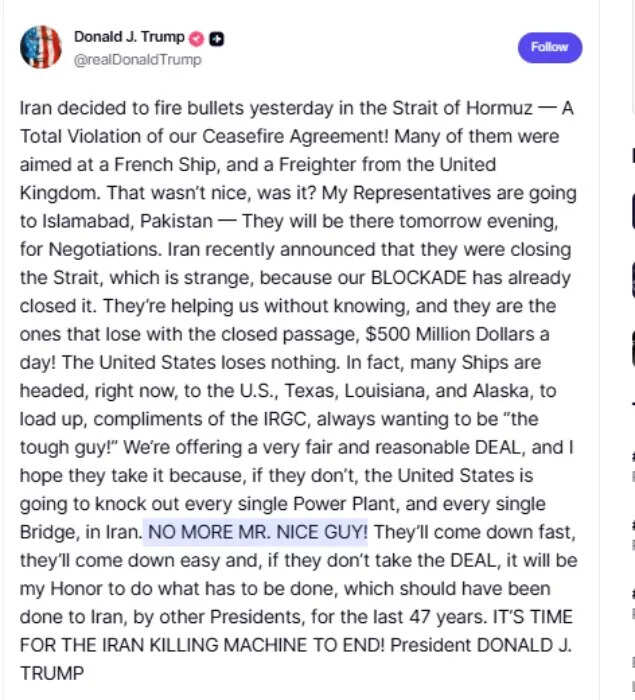
The comments underscore the dual-track approach adopted by the US, combining renewed diplomatic pressure with overt military pressure as the ceasefire deadline approaches. The upcoming outreach followed the first round of US-Iran talks in Islamabad on April 11, which ended without any results after nearly 21 hours of talks. Pakistan’s mediation stalled discussions on key issues including Iran’s nuclear program and sanctions relief. Washington has insisted on limits on uranium enrichment and long-term assurances against the development of nuclear weapons, which Tehran has rejected, insisting that its program is for civilian purposes and such conditions violate its sovereignty. With positions still far apart and tensions rising at sea, the latest warning adds to uncertainty over whether diplomacy can hold.
transit becomes unpredictable
Shipping through Hormuz has become highly unstable. While one tanker belonging to India, Desh Garima, managed to pass, most ships are facing severe disruption.Several ships, including Sanmar Herald, Desh Vaibhav, Desh Vibhor and Jag Arnav, were forced to turn back near the chokepoint. Others are stranded or wandering as operators wait for clarity on whether transit is permitted.Maritime agencies further reported that ships were receiving mixed signals, with some cleared for passage and others warned or fired upon. The result is that the backlog in the Persian Gulf is increasing and normal traffic flow has almost come to a standstill.Given that about a fifth of global oil and gas passes through this corridor, even a partial disruption is enough to put pressure on supply chains and destabilize energy markets.
Ceasefire uncertain as violations and mistrust increase
The already fragile ceasefire is now under serious strain ahead of its expiry. Events over the weekend, including cruise seizures and attacks on commercial vessels, have deepened mistrust between Washington and Tehran.Iranian officials have accused the US of acting in bad faith, while the US has justified its actions as enforcing the blockade. The growing gap increases the likelihood that the ceasefire will not hold.Casualties from the broader conflict remain high across the region, increasing the urgency of efforts to avoid renewed fighting.
Talks uncertain in Pakistan amid rising tension
Diplomatic efforts are also faltering. The US has said negotiators will visit Pakistan for a second round of talks, but Iran has denied any reports of their participation.Iran’s government media has already expressed doubt on this conversation. Fresh tensions at sea have further complicated the prospects for talks, even as mediators are trying to keep the channels open.
Energy and security risks have intensified
With the Strait of Hormuz destabilized, global energy markets are facing renewed uncertainty. Ships are idle, diverted or awaiting evacuation, while industry players have warned of potential supply disruptions if the crisis deepens.Also read: Oil prices rise 7%; US Energy Secretary issues warning as gas price exceeds $4 per gallon amid tensions in HormuzMilitary assessments have also become more serious, describing the security situation in the Gulf as critical. Increased naval activity, warning shots and vessel damage have increased the risk of miscalculation in an already volatile region.Thus, the Strait of Hormuz is not completely closed, but it does not yet function as a reliable trade route. Weekend tanker attacks, the seizure of a US ship and stalled diplomacy have pushed a ceasefire to the brink.
