

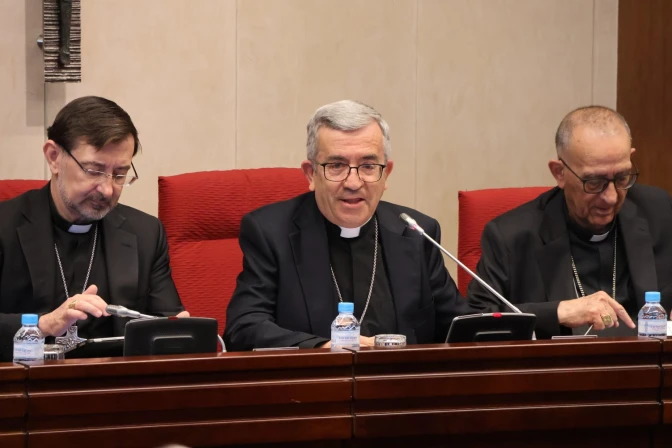
The President of the Spanish Bishops’ Conference (CEE, by its Spanish acronym), Archbishop Luis Arguello, addressed the problem of polarization and its effects while opening the 129th Plenary Assembly of Bishops.
In addition to offering thoughts on the Pope’s upcoming apostolic visit to Spain on June 6-12, the Archbishop of Valladolid devoted a large part of his address to analyzing the issue of polarization, which has important consequences both within and outside the Catholic Church.
drawing on a theoretical note Published by CEE in March, which warned about the dangers of emotionalism, a phenomenon he described as fundamentally based on emotions. Arguello said that “reductionism based on emotionalism poses a real risk,” which extends to social, ecclesiastical and political coexistence through polarization..
This polarization based on emotions “turns opinion into identity”, such that fear “becomes the strongest factor”. Polarization. One’s opponent is no longer seen as someone with whom one disagrees, but rather as a threat, which leads to dehumanization.
Arguello emphasizes that this phenomenon “denies the polarities that constitute us and make us fruitful,” namely, the Trinitarian polarity, which is “fundamental to all others”; Anthropological polarity, male and female; The polarity of “you and I, self and society”; and the polarity of “history and eternal life”.
Polarization affects the life of the church
The prelate addressed how this incident affects the life of the Catholic Church, pointing to the “generally polarizing controversy” that has emerged in various media outlets regarding the conversations held by members of the CEE Executive Committee with Pope Leo XIV in November 2025.
According to some media outlets, the controversy involved leaked comments from a meeting of Pope Leo, who reportedly said that his biggest concern was the “far right” in Spain. However, the CEE clarified that “In the conversation, the Holy Father considered, among other things, the risks of subordinating the faith to ideologies, without mentioning any specific group.”
Arguello said, “Ideologies in post-modern societies participate in the interplay of identity, belonging, and polarization, which serves as a struggle for power. Theological thought – and, arising from this, ecclesial life and pastoral action – are also influenced by ideological reductionism.”
The result is that these conditions “injure the deposits of faith, cause divisions within the Church, and weaken the missionary power of the gospel,” he said.
Polarization and Synod
Arguello also listed other negative fruits of polarization in various areas, such as human anthropology, attitudes towards immigrants, the role of the Church in public life, whether Spain is a single nation or a nation made up of nations, and ecclesiology.
Argüello pointed out that “democracy, when lived as an ideology, seeks to apply to all dimensions of existence; it disrupts the real synod – a shared conscience aimed at being more faithful to the missionary order of the Lord – and transforms it into an exercise in the distribution of power based on the theological-pastoral preferences of the participants.”
“In contrast, clericalism, both ideologically and emotionally, views every form of participation with suspicion and rejects the Synod under the pretext that it threatens legitimate authority, yet this only conceals the ambition to retain absolute power over the Christian community,” he said.
The government is forcing agreements
The CEE President also addressed relations with public authorities and condemned some of the government’s attitudes. Although the Spanish state is defined in its constitution as “non-confessional”, the priest commented ironically that the executive branch “tends to adopt a ‘confessional’ stance” – for example, in matters of anthropology.
“It also takes a confessional view of history and a selective view of the victims,” he said. Furthermore, it “reveals an excessive desire to interfere in civil society and control institutions,” as well as “double standards, depending on who is affected by abuse of power or cases of corruption. All this is done in an effort to secure control over the media.”
Argüello said that “many of these characteristics will apply to almost all governments” and renewed his commitment to cooperation, although without noting that despite having previously engaged in talks with Prime Minister Pedro Sánchez regarding various matters, “the priority interest of this government, the only interest on which it has sought to force agreements, has been the issue of abuse of minors committed entirely within the Church and the re-signification of the Valley of the Fallen,” both Memorial complex dedicated to the combatants of the parties of the 1936–1939 Spanish Civil War.
The bishop also took issue with Justice Minister Félix Bolaños’s claim, after signing the protocol to assist victims of abuse, that “the government decides and the Church pays,” pointing out that the Church has provided compensation “in many cases, without any government or court decision.”
Regarding the situation at the Basilica of the Holy Cross in the Valley of the Fallen, Argüello invited “the government and the monks of the Abbey of Cuellagamuros Valley to reach a fair and satisfactory agreement for both parties – one that, moreover, serves as a testament that it is possible to overcome polarization and find paths to reconciliation.
this story was first published By ACI Prensa, the Spanish-language affiliate of EWTN News. It has been translated and adapted by EWTN News English.
