

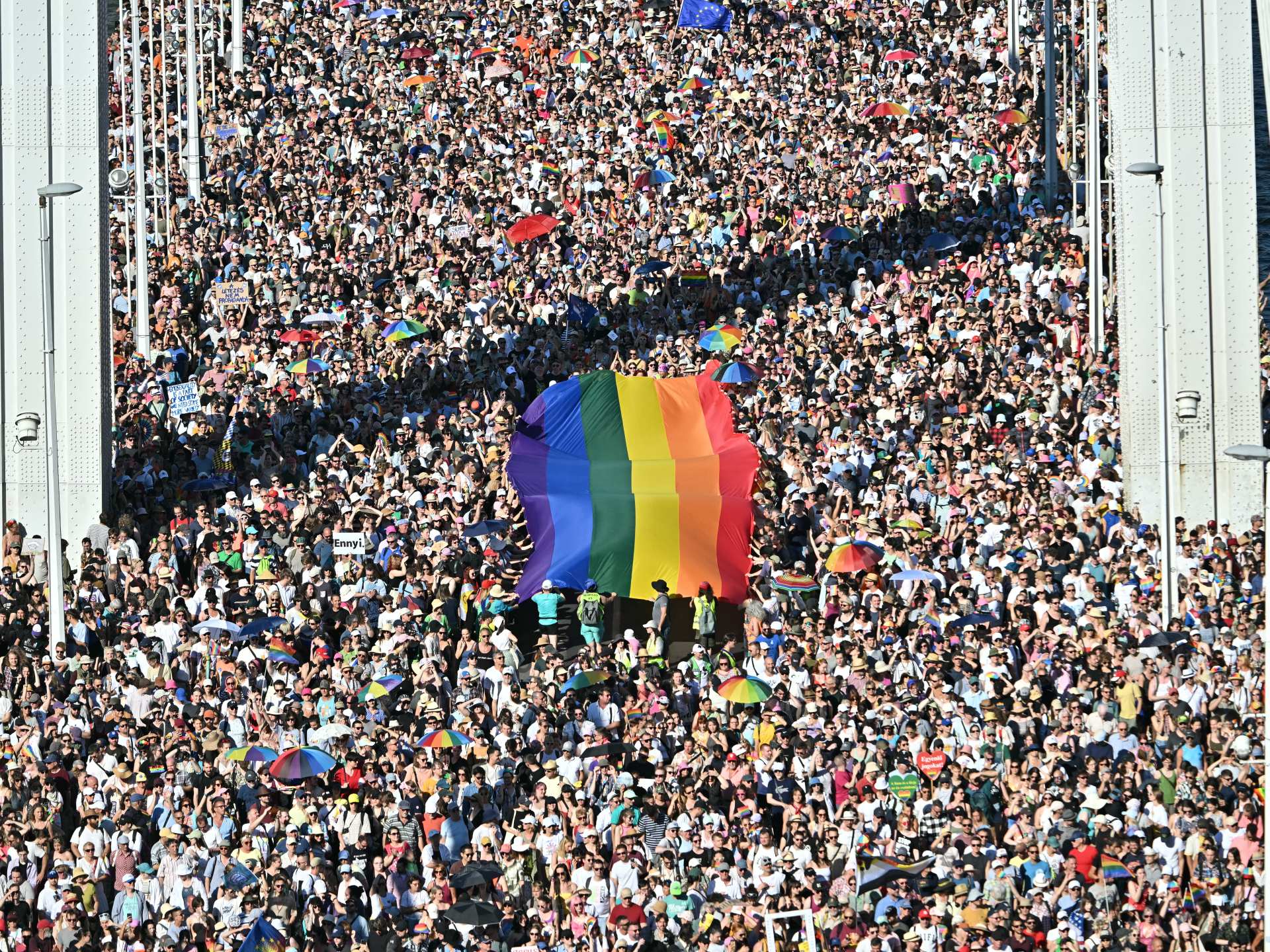
The European Court says Hungary has breached EU law ‘on several different levels’.
Published on 21 April 2026
The EU’s top court has ruled that an anti-LGBTQ law implemented by the Hungarian government in 2021 violates the bloc’s law.
The European Court of Justice (ECJ) found on Tuesday that Hungary’s law runs contrary to EU law “on several different levels”.
Recommended Stories
4 item listend of list
The victory in the case, which is considered the largest human rights case in the bloc’s history as it was initiated by the European Commission along with 16 of the 27 member states and the European Parliament, has been hailed as a “milestone”.
Nationalist Prime Minister Viktor Orban insisted when introducing the law five years ago that it aimed to toughen penalties for child abuse, but it was then amended to ban “promoting homosexuality” to people under 18.
Due to this law, books, plays and films were banned. Critics compared it to Russia’s harsh 2013 gay propaganda law, calling it stigmatizing of LGBTQ people and equating homosexual relationships with pedophilia.
However, Orbán’s “liberal” regime continued to suppress the issue. Last year, it introduced new laws and a constitutional amendment that effectively banned the Budapest Pride march by announcing a determination to protect children from “sexual propaganda.”
However, 100,000 people attended the event in defiance of the ban, forcing the government to back down due to the sheer pressure of numbers.
Last month, the election defeat signaled the end of Orbán’s 16-year rule.
Incoming leader Peter Magyar has promised to reset Hungary’s ties with the EU and is desperate to unblock some 18 billion euros ($21 billion) of funds blocked by Brussels because of Orban’s democratic backsliding and failure to set up corruption protections.
Although a conservative, Magyar avoided taking a clear stance on LGBTQ rights during the election campaign. But in his victory speech he said Hungary had decided it wanted to be a country where “no one will be stigmatized for being different or loving in a different way from the majority”.
Respect for human dignity, equality and human rights
The Court found that the law violates Article 2 of the Treaty on European Union (TEU), which protects the rights of transgender and non-heterosexual persons, as well as the values of respect for human dignity, equality and human rights, including the rights of persons belonging to minorities.
“This law is contrary to the Union’s recognition of the common legal order in a society in which pluralism prevails,” the ECJ said in a statement.
It states, “Hungary cannot legitimately rely on its national identity as a justification for adopting a law that violates the values outlined above.”
The European Commission welcomed the decision as a “milestone” and said it was now up to the Hungarian government to implement the decision.
