

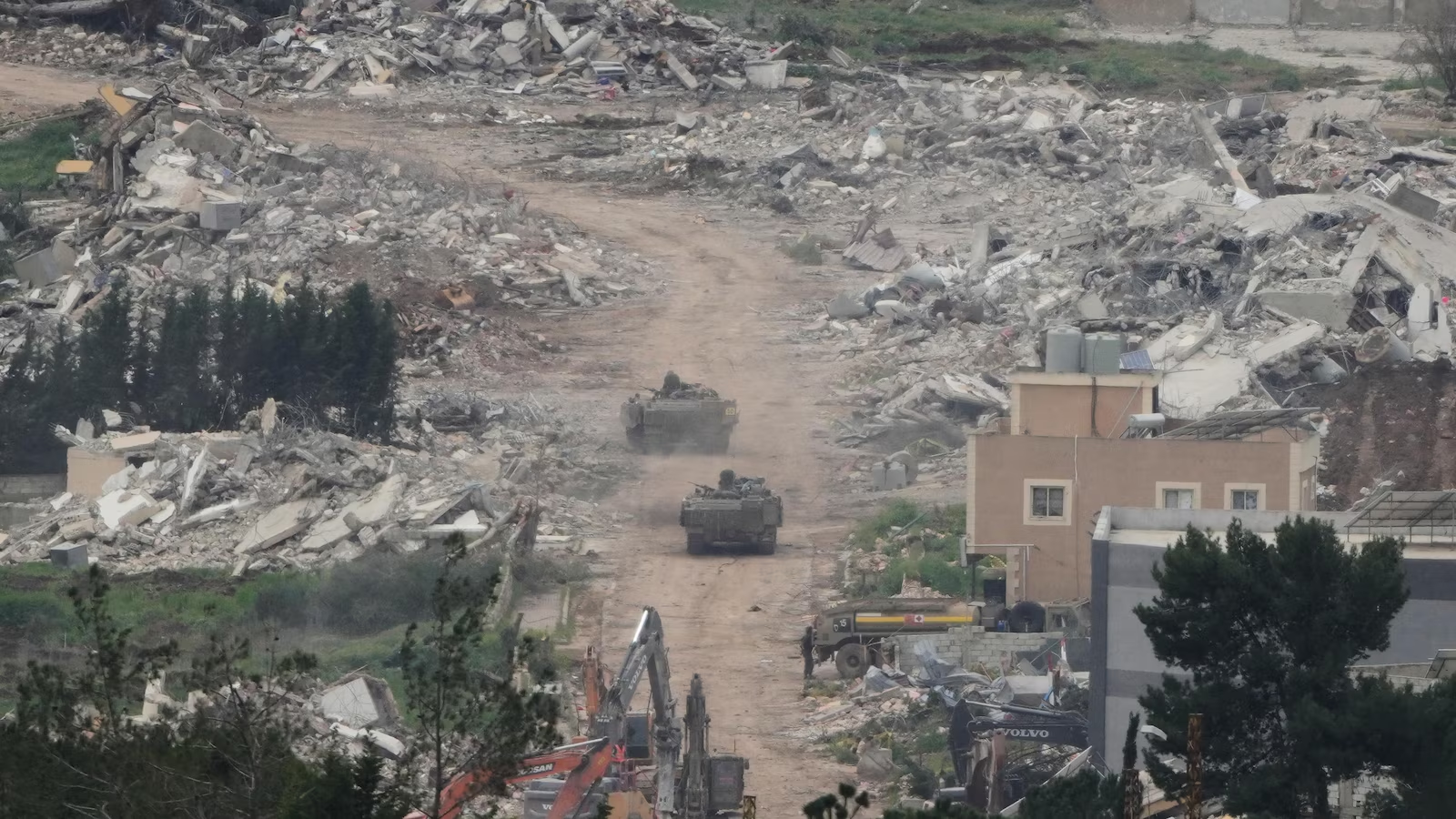
Beirut– It has captured areas of southern Lebanon since agreeing last week ceasefire with HezbollahThe Israeli military is destroying homes it says were used as outposts by the Iran-backed terrorist group.
But the destruction is occurring on such a large scale that residents, Lebanese officials and UN peacekeepers are concerned about large numbers of people being displaced. latest war If the fragile ceasefire holds, they will have nowhere to return.
From a hill overlooking Beit Life – about 4 km (2.5 mi) north of Lebanon’s border with Israel – Associated Press journalists could see The village, which was once home to a few thousand people, was almost completely destroyed.
“They were demolishing it slowly until they reached the main square and now, as you can see, there are no more houses,” said Hassan Swidan, a resident of a neighboring village.
Lebanese officials plan to raise the issue of widespread demolitions at a gathering on Thursday armistice talks with their Israeli counterparts in Washington – part of the first direct talks between the two countries in decades.
Due to security concerns and limited access, neither UN peacekeepers nor Lebanese authorities have been able to conduct detailed surveys of the villages where the demolitions are taking place. But observers have reported that in many villages entire residential neighborhoods have been systematically destroyed.
On March 2, two days after the US and Israel started war with Iran, Hezbollah entered the fray by firing missiles into northern Israel. The group was under pressure from the Lebanese government to disarm after its last war with Israel in 2024, but refused to do so.
Israel responded with an intensive bombing campaign and ground invasion of Lebanon, forcing hundreds of thousands of people to flee the southern part of the country. Nearly 2,300 people have been killed in Lebanon in the fighting, including hundreds of women and children.
The fighting had mostly stopped due to a 10-day ceasefire that started Friday. But since then both sides have launched attacks. Hezbollah has partially justified its attacks by pointing to the destruction of homes by Israeli forces.
Israeli officials have said they intend to capture parts of southern Lebanon, and the army has released maps of a “forward defense line” that extends several miles into Lebanon and covers dozens of villages whose residents have not been allowed to return.
Following the announcement of the ceasefire, Israeli Defense Minister Israel Katz said that the area “has been cleared of terrorists and weapons and is empty of civilians, and will continue to be cleared of terrorists’ infrastructure, including the destruction of homes in Lebanese villages bordering (Israel) and which have become terrorist outposts in every sense.”
After the ceasefire came into effect, Swede returned to the village of Yeter in southern Lebanon to inspect his home. It is still intact.
Since Sweidan’s village overlooks neighboring Beit Life, he is able to observe Israeli military operations there. Despite the damage caused by Israeli air strikes during the war, much of Beit life was still standing on the first day of the ceasefire, he said.
But the next day the Israeli army arrived with bulldozers, jackhammers and tanks.
“We will come every day to see how much of the village has been demolished,” he said.
Tilak Pokharel, spokesman for the US peacekeeping force in southern Lebanon, known as UNIFIL, said peacekeepers “have seen destruction taking place in many areas” since the ceasefire.
The Israeli military said in a statement that the target of the demolition work is Hezbollah, not Lebanon or its citizens, and that it “acts in accordance with international law and does not destroy civilian property unless there is a compelling military need.”
There was already widespread destruction in the border areas after the last Israel-Hezbollah war in 2024. Some homeowners could afford repairs, but large-scale rebuilding did not occur.
Demolition also took place during the recent war. Photos taken by AP on April 12 from the northern Israeli cities of Menara and Misgav Am show diggers and bulldozers destroying homes on the Lebanese side of the border.
Lebanon’s state-run National News Agency reported on Wednesday that Israeli bulldozers were destroying neighborhoods, roads and infrastructure in the city of Khiyam, a battlefield of the Israel-Hezbollah fighting, “in a scene that suggests an attempt to completely erase the city’s identity.”
The news agency also reported “systematic bombing campaigns” on Wednesday, hitting residential areas in the town of Bint Jbeil – another flashpoint in the fighting – and the villages of Beit Life, Shama, Tire Harfa and Haneen.
Hezbollah said on Tuesday it had launched drone and rocket attacks in response to Israeli “attacks on civilians and the destruction of their homes and villages in southern Lebanon”, the first since the ceasefire.
As Lebanese officials struggle to maintain the ceasefire, President Joseph Aoun called in a statement to “stop Israel’s demolition campaigns in southern villages and towns.” The Lebanese ambassador to the United States will raise the issue with his Israeli counterparts during ceasefire talks on Thursday.
The talks were expected to focus on a possible extension of the 10-day ceasefire and establishing a framework for future talks aimed at lasting peace between the two countries.
——-
Associated Press journalists Malak Harb in Beirut and Melanie Lidman in Jerusalem contributed.
