

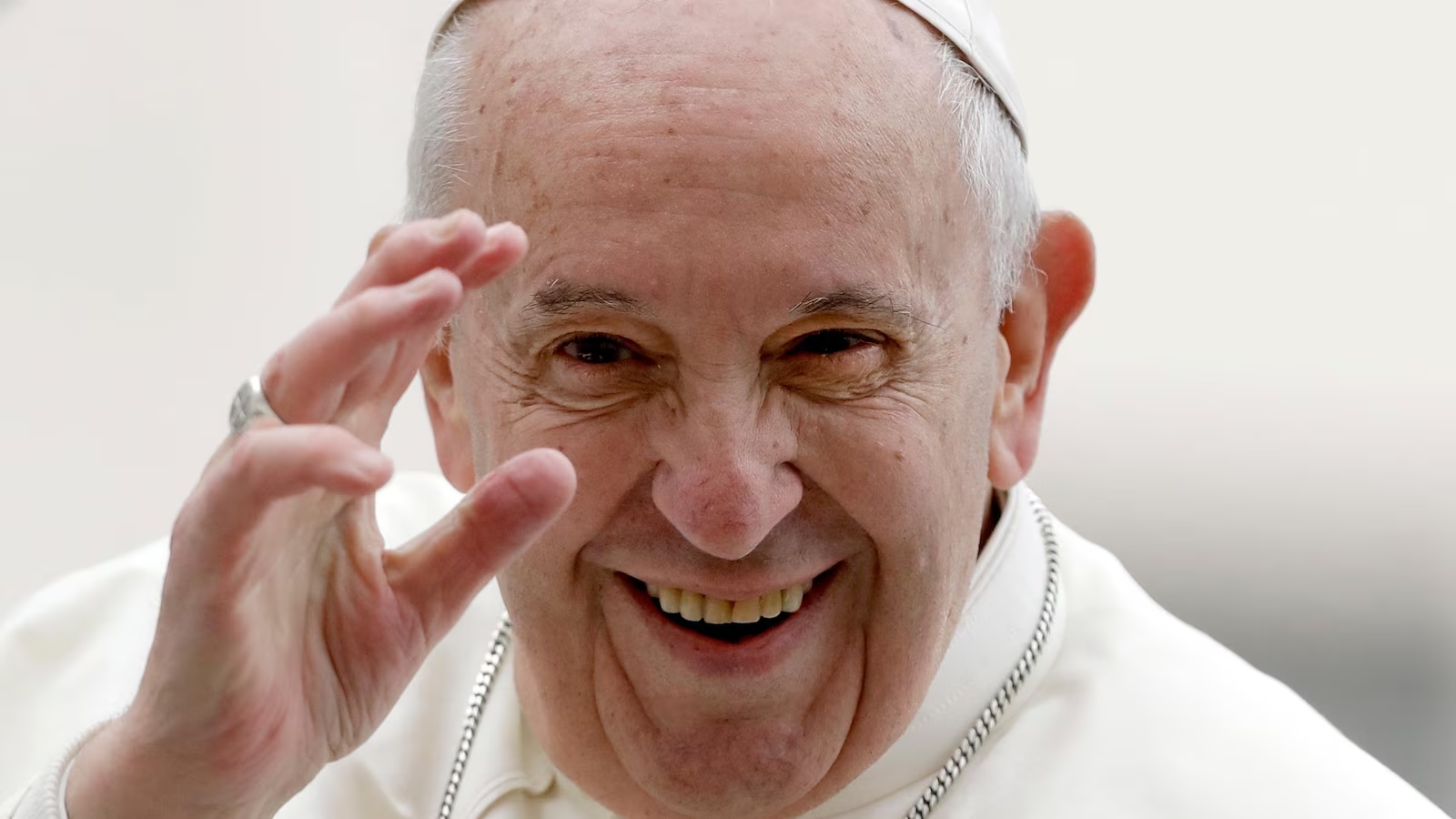
Rome — Pope Leo XIV on Thursday summoned Catholic bishops to Rome for a special meeting on the service of families, taking as its starting point Leo’s strong endorsement of one of these. Pope Francis’s most controversial policies on marriage and divorce.
Leo writes a special message marking the 10th anniversary of Francis’ 2016 document “The joy of love.” He called the text a “shining message of hope” that is more relevant and necessary today than it was a decade ago.
When it was released, “The Joy of Love” immediately sparked controversy because it opened the door for civilly remarried Catholics to receive Communion.
Church teaching holds that unless these Catholics receive annulment – the Church’s order that their first marriage was invalid – they cannot receive the sacrament, because they are seen as living in sin and having committed adultery.
Francis did not make a church-wide pass for these Catholics, but suggested — in vague words and in a strategically placed footnote — that bishops and priests could do so on a case-by-case basis after accompanying them on their spiritual journey of conscience. From later comments and writings it became clear that Francis intended such relaxation as part of his belief that God’s mercy extends especially to sinners and that the Eucharist is not a reward for the perfect, but nourishment for the weak.
This document became one of Francis’s most divisive documents and in many ways focal point of conservative opposition For his Holy See. This sparked a wave of criticism from mostly conservative Catholics, who said it had created confusion among the faithful about the Church’s teaching on the indissolubility of marriage.
But in his message on Thursday to mark the anniversary, Leo strongly supported Francis’s text. He cited Chapter VIII, which contained Francis’s opening statement on the question of divorce, although he did not explicitly mention access to the sacraments or Francis’ footnote number 351.
In the text, Francis told priests that they cannot impose moral law on people only in “irregular” situations. Rather, he said that the Church should help those who are in a technical state of sin, especially when mitigating factors are at work.
In related footnote number 351, Francis elaborated that “in some cases, this may include the help of the sacraments.” He told priests that “confession should not be a torture chamber, but an encounter with the Lord’s mercy” and that the Eucharist “is not a reward for perfection, but a powerful medicine and nourishment for the weak.”
Leo wrote, “On this tenth anniversary, we thank God for the encouragement that has encouraged reflection and pastoral transformation in the Church, and ask God for the courage to continue on this path.”
He called the presidents of bishops’ conferences to Rome for a meeting in October to decide “next steps for ministering to families in the light of ‘The Joy of Love’ today and in keeping with what is currently being done in local churches.”
Francis’s document sharply divided the church.
Within the first year of publication, four conservative cardinals formally asked Francis to clarify certain questions, or “dubia”, raised by the text. He argued that Church doctrine held that Catholics who remarried without a Church annulment were living in sin and could not receive the sacrament.
He never replied.
For various reasons, such annulments often cannot be obtained despite being issued by Francis. a different improvement Making the process simple, convenient and fast.
The following year, a petition from conservative Catholic theologians Francis accused of heresy.
But others embraced the lesson. The bishops of Francis’ native Buenos Aires issued a set of criteria to implement Chapter VIII, which explicitly allows civilly remarried Catholics to receive Communion, especially if the person concerned is not responsible for a failed first marriage, while emphasizing that it is not a free-for-all “as if no situation could adequately justify it.”
Francis ordered the Argentine norms to be published as an official act of the Vatican and wrote a letter to the bishops declaring their interpretation official. He wrote, “The document is excellent and clearly states the meaning of Chapter VIII.” “There are no other explanations.”
Maltese ChurchFor its part, the Holy See, in another sign of approval, issued its own set of guidelines which were published in the Vatican newspaper L’Osservatore Romano.
The Maltese guidelines say that if a Catholic in a new civil union, following a path of spiritual discernment seeking God’s will, believes that he can live at peace with God, “he cannot be prevented from participating in the sacraments of Reconciliation and the Eucharist.”
___
The Associated Press’s religion coverage receives support from the AP Collaboration With The Conversation US, with funding from Lilly Endowment Inc. AP is solely responsible for this content.
