

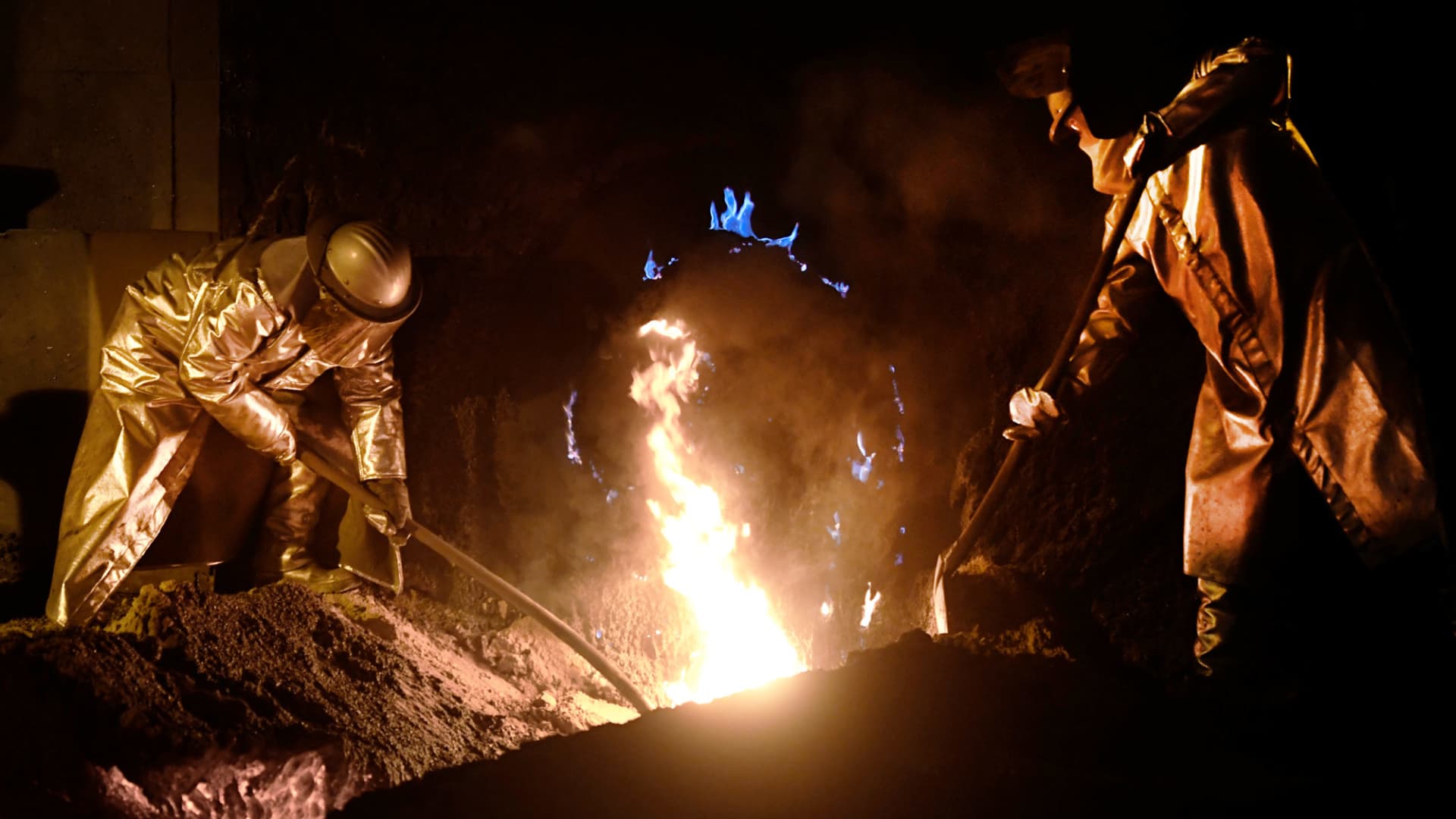
Workers at German steelmaker Salzgitter AG stand in front of a furnace at a plant in Salzgitter, Germany, March 1, 2018.
Fabian Bimmer | reuters
Private sector output in the euro zone fell to a 10-month low in March amid growing evidence of the impact of the Iran conflict on the global economy.
The closely watched S&P global flash Purchasing Managers’ Index (PMI) for the euro zone fell to 50.5 in March, a sharp decline from 51.9 reported in February.
Economists polled by Reuters had expected a mild decline to 51.0. The 50.0 range separates the expansion from contraction zones.
The reading provided fresh warnings that the region faces the threat of imminent stagflation – a toxic combination of high inflation and unemployment and stunted growth.
Chris Williamson, chief business economist at S&P Global Market Intelligence, commented on Tuesday, “The flash Eurozone PMI is ringing stagflation bells as the war in the Middle East is pushing prices higher and stunting growth.”
“Costs for firms are rising at the fastest rate in three years amid rising energy prices and blockage of supply chains as a result of the war. Supplier delays have reached their highest level since mid-2022, largely linked to shipping issues.”
Euro zone companies surveyed by S&P Global saw a modest decline in hiring during March, as S&P Global economists lowered output expectations for the year compared with February forecasts.
“Stagflation” is often seen as a “worse-case scenario” for economies and creates a dilemma for central banks because the tools they typically use to deal with high inflation – higher interest rates – can stifle growth and employment, while lowering rates can boost growth but increase demand and inflation.
The euro zone is not alone in slowing private sector activity due to the Iran war, with India’s PMI data on Tuesday showing output growth slowed to its lowest level since October 2022.
‘Severe’ energy crisis
The current turmoil in the Middle East has made previous growth and inflation forecasts largely meaningless, leaving businesses and policymakers to guess the direction of travel for input costs and inflation without knowing how long the conflict will last.
In revised forecast Released last week, the European Central Bank now expects economic growth of 0.9% in 2026 and headline inflation to average 2.6% this year.
However, this outlook may also be optimistic, with S&P Global’s Williamson saying that with the PMI survey’s price gauge indicating inflation rising closer to 3%, “cost pressures are likely to add further to selling price inflation in the coming months.”
“The outlook depends on the duration of the war and any potential lasting impact on energy and supply chains, but the flash PMI data underlines that the European Central Bank is no longer in a ‘good position’ with respect to growth and inflation,” Williamson said.
JPMorgan’s Rafael Brun-Aguirre reported on Tuesday that March PMIs show that the conflict in Iran is already having a significant impact on the euro zone economy.
“Overall, the survey points to a large near-term inflationary impact from higher energy that could weigh on core prices… Energy price shocks could hit business profitability and further damage to demand conditions and output in the sector are already affecting business sentiment significantly. european commission data (On Monday) consumer confidence has already suffered a major blow in March,” he noted in the email analysis.
A tanker carrying Iraqi fuel oil was damaged in unidentified attacks targeting two foreign tankers, according to Iraqi port officials, near Basra, Iraq, March 12, 2026.
Mohammed Ati reuters
Early Tuesday, European Commission President Ursula von der Leyen said that given the “serious” nature of the global energy crisis, it is time for talks with Iran.
“The situation is critical for energy supply partners around the world. We all feel the impact on gas and oil prices, our businesses and our societies, but it is extremely important that we reach a negotiated solution, and that ends the hostilities that we see in the Middle East.”
