

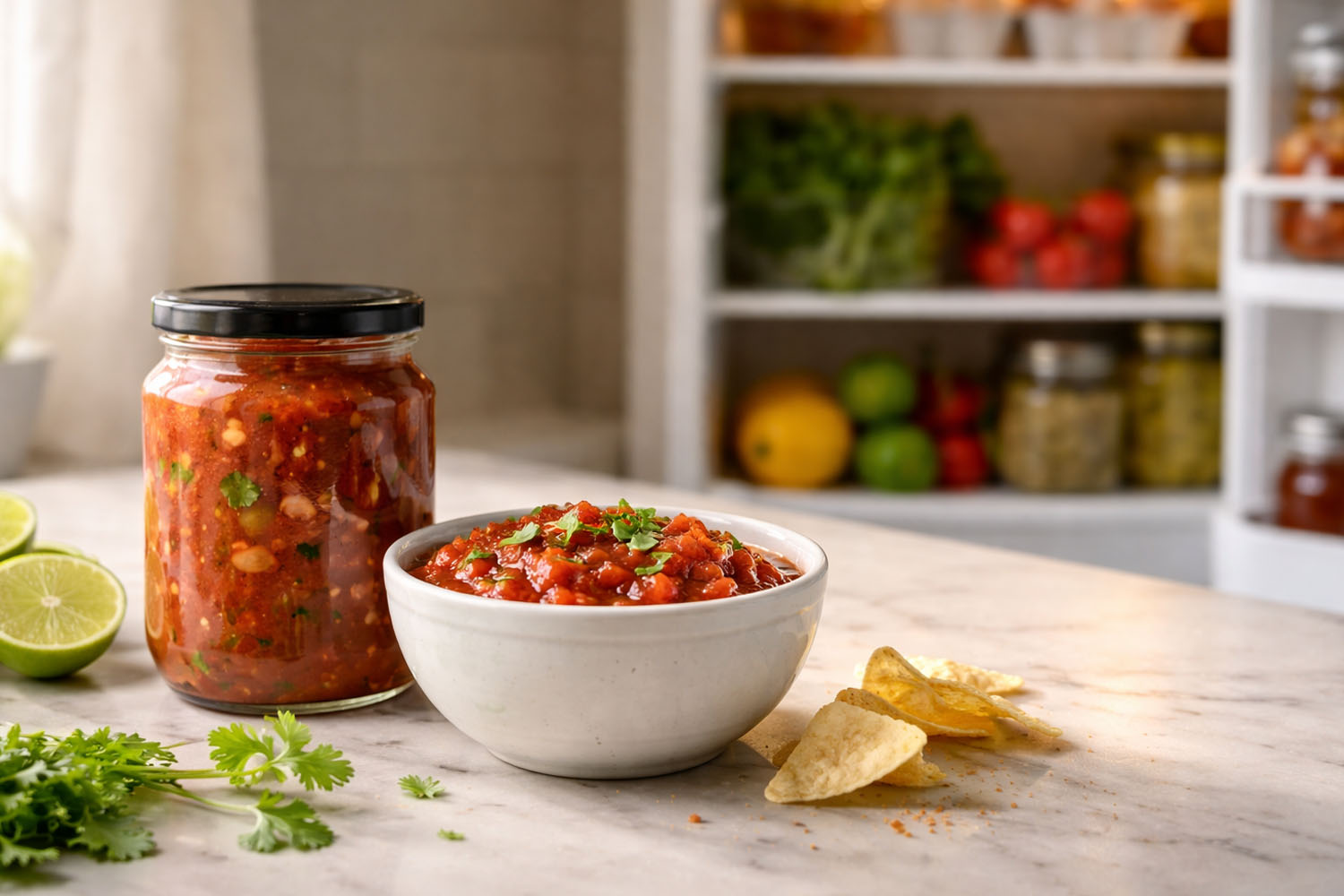
You’ve just opened a jar of salsa or made a batch at home and now you’re wondering where it is. counter? Pantry? fridge? Does salsa need to be refrigerated?
Short answer: It completely depends on the type.
Fresh homemade salsa and store-bought refrigerated salsa should always be kept cold. Shelf-stable jarred salsa does not require refrigeration before opening, but should be refrigerated immediately afterward. There is no one answer that covers all salsas.
For a full overview of how spices and pantry staples compare on storage needs, visit our complete food storage guide.
key takeaways
- Fresh Homemade Salsa and Pico de Gallo: Always refrigerate immediately.
- Store-Made Refrigerated Salsa (Plastic tub, deli section): Must remain refrigerated from purchase until use.
- Shelf-Stable Jarred Salsa (non-refrigerated grocery shelf): Pantry until opened, then refrigerator.
- Once opened, all types of salsas fit in the fridge. No exceptions.
- Salsa was out for more than 2 hours Should be thrown away at room temperature.
Refrigeration Rules by Salsa Type
The confusion surrounding salsa refrigeration stems entirely from the fact that the storage requirements of different types are fundamentally different. Each type is addressed directly here.
| salsa type | before opening | after opening |
|---|---|---|
| Fresh Homemade/Pico de Gallo | refrigerate immediately | Keep refrigerated, use within 4 to 7 days |
| Store-Made Refrigerated (Deli/Plastic Tub) | Keep refrigerated | Keep refrigerated, use within 5 to 7 days |
| Shelf-Stable Jarred (Tostitos, Pace, etc.) | cool, dark pantry | Refrigerate, use within 1 to 4 weeks |
| Homemade Cooked/Roasted Salsa | After it cools down, keep it in the refrigerator | Keep refrigerated, use within 7 to 10 days |
Why does shelf-stable salsa not require refrigeration before opening?
Commercial jarred salsa sold on non-refrigerated grocery shelves has been heat-processed and vacuum-sealed during manufacturing. That process kills the bacteria and creates a sealed environment with no oxygen. The jar usually contains measured amounts of vinegar and salt that reduce a specific acid level enough to prevent bacterial growth. This is why it can be stored in the pantry for more than a year without spoiling.
When you hear the jar seal pop, this is the vacuum being broken and air entering the jar for the first time. From that moment on, the salsa is exposed to air, ambient bacteria, and anything else introduced by the utensils and chips. Refrigerate immediately after opening and keep it sealed between uses.
Why should fresh and refrigerated salsa always stay cold?
Fresh salsa and store-made refrigerated salsa have never been heat-processed. They depend entirely on cold temperatures, acidity from lemon juice or vinegar, and salt to survive. Remove any one of those protective factors and the rate of deterioration will accelerate exponentially.
USDA Food Safety and Inspection Service Defines the danger zone as temperatures between 40 degrees Fahrenheit and 140 degrees Fahrenheit, where bacteria grow fastest. Fresh salsa at room temperature falls squarely into this area. The guideline is clear: Discard fresh or refrigerated salsa that has been stored for more than 2 hours or for more than 1 hour when the temperature is above 90 degrees Fahrenheit.
This has a direct impact on parties and gatherings. A bowl of fresh salsa on the table for a two-hour cookout is at its absolute limit. If a summer cookout lasts four hours, that salsa should be changed or served in a bowl filled with ice and refreshed regularly.
Store-Bought Refrigerated vs. Shelf-Stable Confusion
Two completely different products, same store
What many people don’t realize is that refrigerated salsa in the deli section and jarred salsa on the unrefrigerated grocery shelf are fundamentally different products with completely different shelf lives, even though both are commercially made and often of the same brand.
Refrigerated Section Salsa is made with fresh or minimally processed ingredients and is never heat-sealed. It must be kept consistently cold from the store to your fridge, to your table and back. Jarred shelf-stable salsa has been cooked, processed and sealed. It does not require cold storage until you open it. This is your first clue as to where a product is sold in the store. If it was in the refrigerator compartment, keep it refrigerated. If it was on a regular shelf, pantry storage is fine until opened.
Best Storage Practices
How to Keep Salsa Fresh
Store fresh salsa in an airtight glass container. Glass does not absorb odor or taste. An airtight seal slows oxidation and keeps refrigerator odors out. Plastic tubs come in handy but are not ideal for storage more than a few days.
Mention the date of creation or opening. Fresh salsa looks the same after a few days in the fridge. A date on the lid takes away all the guesswork.
Store towards the back of the fridge. The back of the refrigerator near the door or door seal maintains a more consistently cool temperature than the front of the shelves.
Never double dip. Putting food particles from chips, vegetables or utensils directly into the container introduces bacteria and significantly reduces shelf life.
Serve the salsa in a separate bowl. Pour whatever you need into a serving bowl instead of straight from the storage container. This keeps the main supply uncontaminated.
See also
For parties in warm weather, hide serving bowls in snow. This extends the safe serving window and keeps the salsa at its best-tasting temperature, which is cold, not room temperature.
Add lemon juice or vinegar to homemade salsa. The added acid extends the shelf life of fresh home-made salsa by lowering the pH. It usually improves the taste as well. A tablespoon of lemon juice or white vinegar per batch really makes a difference.
Ready to make salsa? Try these recipes
Frequently Asked Questions
I left jarred salsa open on the counter overnight. Is it still good?
For shelf-stable commercial jarred salsa, one night is probably fine given its high acid content and preservatives, but at room temperature both quality and safety degrade rapidly. Check the smell and appearance before using it. If something looks bad, discard it. Going ahead, keep it in the refrigerator immediately after opening it. For fresh or refrigerated-style salsa, leaving overnight at room temperature is beyond the safety guideline of 2 hours. Discard it.
Does salsa need to be refrigerated if it has not been opened?
Only if it came from the refrigerated section of the store. Shelf-stable jarred salsa purchased from the regular grocery shelf does not require refrigeration before opening. Keep it in a cool, dark pantry. Salsa from the deli section or refrigerated case must remain constantly cold even before opening.
How long can I serve salsa at a party before putting it back in the fridge?
According to USDA food safety guidelines, two hours at normal room temperature is the maximum temperature. In hot weather above 90 degrees Fahrenheit, this reduces to one hour. If your party lasts longer, either fill with fresh refrigerated supplies or place serving bowls in a large bowl of ice to maintain a safe temperature.
Can I put hot homemade salsa straight into the fridge?
Yes. The concern about storing hot food in the refrigerator is that it may increase the temperature of surrounding foods. To minimize this, don’t let your cooked salsa cool at room temperature for more than 30 minutes before refrigerating, then divide it into smaller containers for faster cooling. Leave it at room temperature for no more than 2 hours total before refrigerating.
Further reading
Better Living may earn commission through affiliate links and may occasionally feature sponsored or partner content. If you purchase through our links, we may receive a small commission at no cost to you.
