

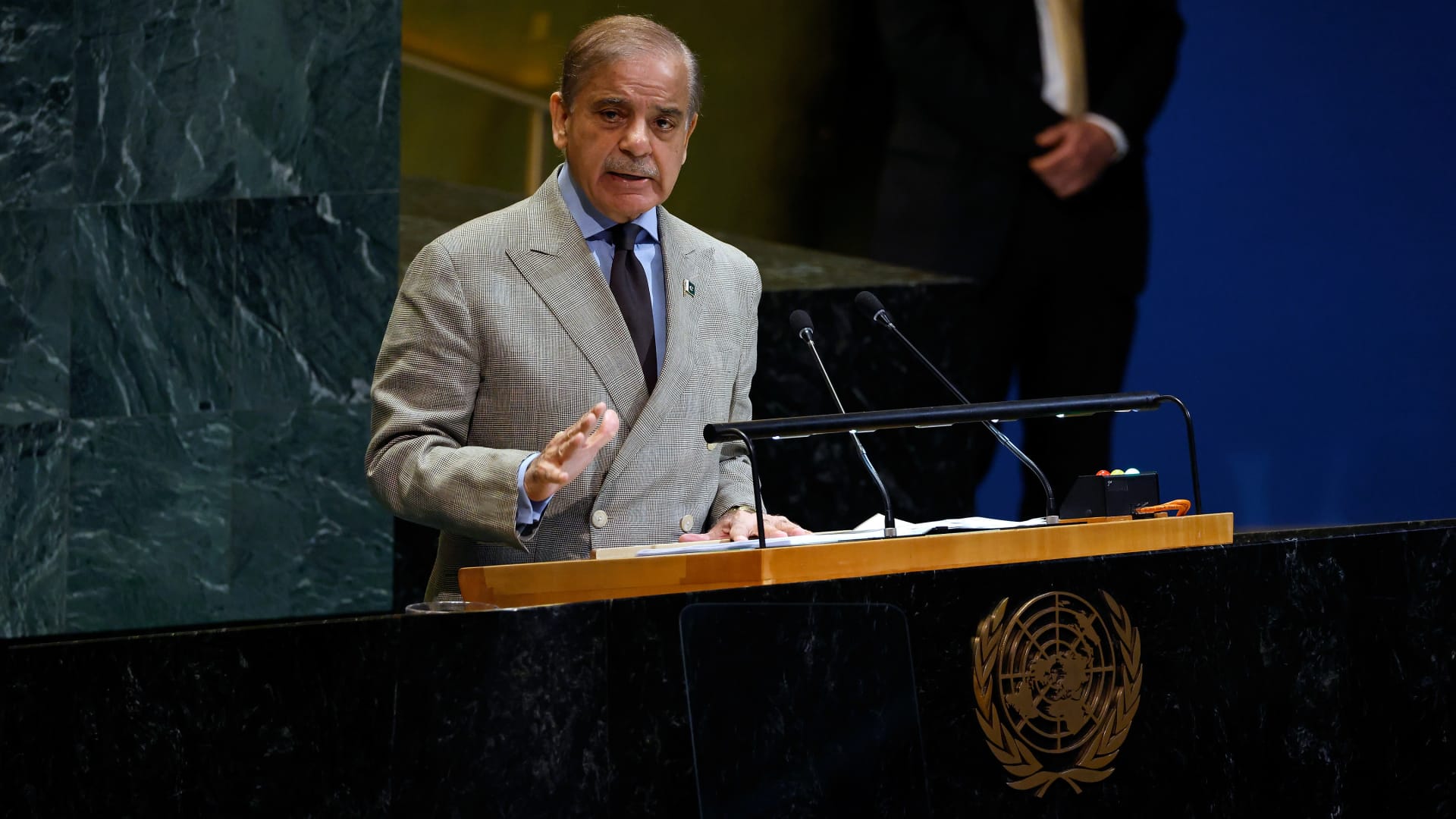
Pakistan Prime Minister Shehbaz Sharif speaks during the 80th session of the United Nations General Assembly (UNGA) at the United Nations Headquarters in New York City on September 26, 2025.
Taylor Hill | getty images
Representatives of the US and Iran are set to hold talks in Pakistan on Saturday, as key disagreements threaten to undermine a fragile two-week ceasefire.
Tehran has already accused Israel of violating the terms of the ceasefire and jeopardizing negotiations, as the IDF continued to attack Hezbollah in Lebanon, killing more than 300 people on Wednesday.
Although Lebanon was mentioned in the original ceasefire framework drafted by Pakistan, the US and Israel say it was not included in the agreement.
This major difference of opinion threatens to torpedo talks. Peace in Lebanon is not explicitly included in America’s 15-point plan, but it is clearly mentioned in Iran’s 10-point plan.
But Lebanon is not the only sticking point between the two sides. There is also disagreement over who will control the Strait of Hormuz, as well as over the future of Iran’s nuclear enrichment capabilities.
War continues in Lebanon
Announcing the ceasefire on Wednesday, Pakistan Prime Minister Shehbaz Sharif posted on Twitter that fighting would stop across the region, including Lebanon.
Israel immediately challenged their claim, insisting the relief would not include its northern neighbor, which on Wednesday moved to launch the heaviest bombardment of the country in decades.
Iran responded by warning against further attacks, writing on Twitter that its allies are an ‘inseparable’ part of the ceasefire, and violations carry ‘clear costs and strong’ responses.
“The Israeli government is not eager to see any rapprochement between the United States and Iran, and the war in Lebanon is one of Netanyahu’s main cards to destabilize any peace efforts,” Maziar Ghiabi, director of Persian studies at the University of Exeter, told CNBC’s Squawk Box Europe on Friday.
In an effort to prevent further attacks on Beirut, the Lebanese government reiterated its call to enter into direct negotiations with Israel, a proposal that Netanyahu has accepted.
The Lebanon front is likely to be discussed in Islamabad, as its involvement in ending the region-wide fighting remains an open question.
control over hormuz
The question of who controls the Strait of Hormuz, a vital sea route for oil and gas, remains unresolved.
Iran wants to retain full control of the route and levy duties on ships passing through the Persian Gulf, with the proceeds being used to rebuild the country.
It is demanding that shipping companies pay tolls in cryptocurrency in exchange for safe transit, the Financial Times reported Wednesday morning.
Trump, on the other hand, said in an ex-post on Tuesday that the ceasefire depends on the “full, immediate and secure opening of the Strait of Hormuz.”
A marine insurance executive, who did not want to be named on the record, told CNBC that the possibility of Iran imposing heavy tolls on ships is a major sticking point.
Such a move would end decades of free access to the strait as an international waterway, forcing shipowners to pay larger fees or avoid the route altogether.
Control over the strait is Iran’s “biggest” leverage, Amrita Sen, founder of market intelligence platform Energy Aspects, told CNBC’s “Access Middle East” on Thursday.
“I don’t think tolling is something that will be accepted by the GCC, Oman or any of its neighbors,” he said. “It’s very difficult to accept, but generally speaking, it’s an advantage I don’t see Iran giving up.”
on nuclear enrichment
Another obstacle is the fate of Iran’s nuclear enrichment program.
Iran’s nuclear chief said Thursday that the country’s enemies’ demand for zero enrichment was “wishful thinking.”
The Islamic Republic’s 10-point peace proposal includes a “right to prosperity”, a demand that was quickly shut down by Vice President J.D. Vance.
Although Iran has promised to end its nuclear program, according to Sanam Vakil, MENA director at Chatham House, it is “unlikely” that they will give up their stockpile of enriched uranium.
“If President Trump gets guarantees that Iran will allow inspectors back into their nuclear facilities, or their tailings, and Iran will blend this enriched uranium, that would be a victory,” he told CNBC’s “Squawk Box Europe” on Thursday.
“A verifiable, controlled nuclear deal is ultimately something he (Trump) can sell to the American people.”
Ultimately, disagreements over key building blocks of the ceasefire agreement may prove to be shaky ground on which to negotiate a long-term solution to the conflict.

