

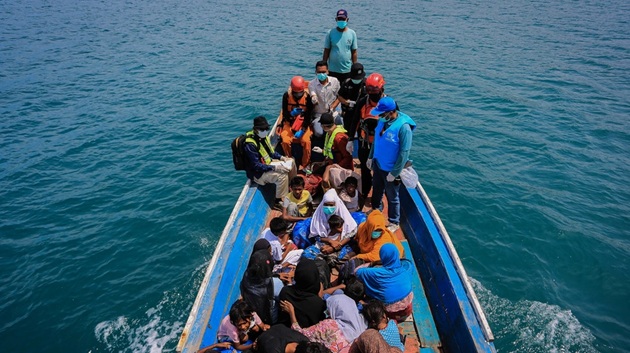
COX’S BAZAR, Bangladesh, Apr 14 (IPS) – While global attention is currently on rising geopolitical tensions involving the United States, Israel and Iran, another crisis is quietly brewing in Bangladesh.
Starting from April 1, 2026, the World Food Program (WFP) launched a revised Targeting and Prioritization Exercise (TPE) for Rohingya refugees living in camps in Cox’s Bazar and Bhasan Char. statement Released by the United Nations on 2 April in Bangladesh.
Under the new system, refugee families will receive food assistance of $12, $10, or $7 per person per month, depending on their assessed level of food insecurity. Previously, all refugees received $12 per person.
On paper, vulnerability-based targeting seems reasonable. In many humanitarian crises, such systems help ensure that limited resources reach those most in need. However, the Rohingya context is different.
Nearly nine years after fleeing genocide and persecution in Myanmar, more than one million Rohingya refugees remain confined to camps in Bangladesh, including 144,456 biometrically identified new arrivals and 1,040,408 registered refugees between 1990 and 2017, according to the latest data from UNHCR Bangladesh. Of these, 78% are women and children.
Unlike refugees in many other countries, the Rohingya in Bangladesh have extremely limited freedom of movement and cannot legally work or run small businesses within the camps. Refugees are also not formally employed by humanitarian organizations – except as volunteers receiving small daily allowances. As a result, they depend almost entirely on humanitarian aid.
In this context, reducing aid raises serious concerns. When refugees are not allowed to engage in meaningful economic activity, food insecurity becomes less a household condition and more a structural outcome.
Humanitarian agencies have provided life-saving assistance for years, and their efforts should not go unnoticed. But survival is not the same as stability. Instead of creating pathways towards self-reliance for the Rohingya and local communities in Cox’s Bazar impacted by refugee influx, the current system has institutionalized mass dependency.
Many programsLivelihood Initiative“Meaningful results have not been achieved. Skills training programs – such as electrical repair or other technical courses – often fail to translate into real opportunities because refugees do not have motorbikes, access to electricity is limited in many camp areas, refugees cannot legally move out of the camps in search of work, and humanitarian organizations do not employ trained refugees within their own operational structures.
This raises difficult questions: Why invest donor resources in skills that cannot be realistically applied? And what long-term strategy do these initiatives serve?
The new targeting model classifies refugees as extremely food insecure, extremely food insecure or food insecure. Some vulnerable households – such as those headed by older people, people with disabilities or children – will continue to receive the highest level of support.
Yet the broader reality remains unchanged: the entire Rohingya population in Bangladesh faces severe restrictions on economic participation.
Recent protests in the camps are often described as a reaction to ration cuts. In reality, they reflect deep concerns about uncertainty and the absence of long-term planning. Refugees are asking a simple question: What if funding declines further in the future? Where will we go? So will Bangladesh be left alone to deal with the Rohingya crisis?
They want to send a message to the world: Aid dependency was built around the Rohingya. Now is the time to think beyond relief and give them the tools to get back on their feet.
There is an urgent need for long-term strategic thinking. This includes serious discussions about ensuring a safe and dignified life in the camps until the Rohingyas return to Myanmar, expanding economic participation for refugees, and creating policies that allow them to contribute economically while living under appropriate regulation.
At the same time, Bangladesh itself is going through a post-election transition period and the new government said that it will work together to make Rohingya repatriation possible and it will be shared. Myanmar has data of 8.29 lakh Rohingyas.
But while the Rohingya crisis cannot be a lower priority, the new government also needs to recognize that protracted displacement cannot be managed indefinitely through sanctions and relief alone – the same approach that largely characterized the previous government’s policies.
Carefully regulated work opportunities – such as camp-based enterprises, pilot employment schemes, or limited work authorization programs – can help reduce humanitarian dependency while maintaining government oversight.
If even one or two members of each refugee family were allowed to work legally under a controlled framework, humanitarian costs could gradually decrease, camp economies could stabilize, and youth despair could be reduced.
Most importantly, dignity can begin to return.
Nearly nine years later, international agencies have managed one of the world’s largest refugee operations with remarkable logistical capacity. Yet the central question remains: What sustainable arrangements are designed to help refugees get back on their feet?
As global funding pressures mount and donor fatigue grows, humanitarian aid is being recalibrated downwards. Without structural reforms, it risks reducing dependency rather than managing it more efficiently.
The Rohingya did not choose aid dependence. This was created by the restrictions placed around them. Food aid remains essential. But the future of an entire population cannot be defined by ration cards and vulnerability categories alone.
The Rohingya crisis requires more than better targeting of aid. This requires policies that link participation with security and life with security.
The world has learned how to feed the Rohingya.
The real test is whether it will allow them to stand by – until the day they can safely return to their homes in Myanmar with rights, safety and dignity.
Otherwise, families quietly cut back on food. Young people seek insecure informal labour. Dangers of child labour, early marriage, unsafe migration. And involvement in illegal activities increases. When the opportunity ends, disappointment fills the void.
Mohammed Zonaid He is a Rohingya SOPA 2025 awardee, freelance journalist, award-winning photographer and fixer. He works with international agencies and has contributed to Myanmar Now, The Arakan Express News, The Diplomat Magazine, Frontier Myanmar, Inter Press Service and Myanmar Pressphoto Agency.
IPS UN Bureau
© Inter Press Service (20260414080249) – All rights reserved. Original source: Inter Press Service
