

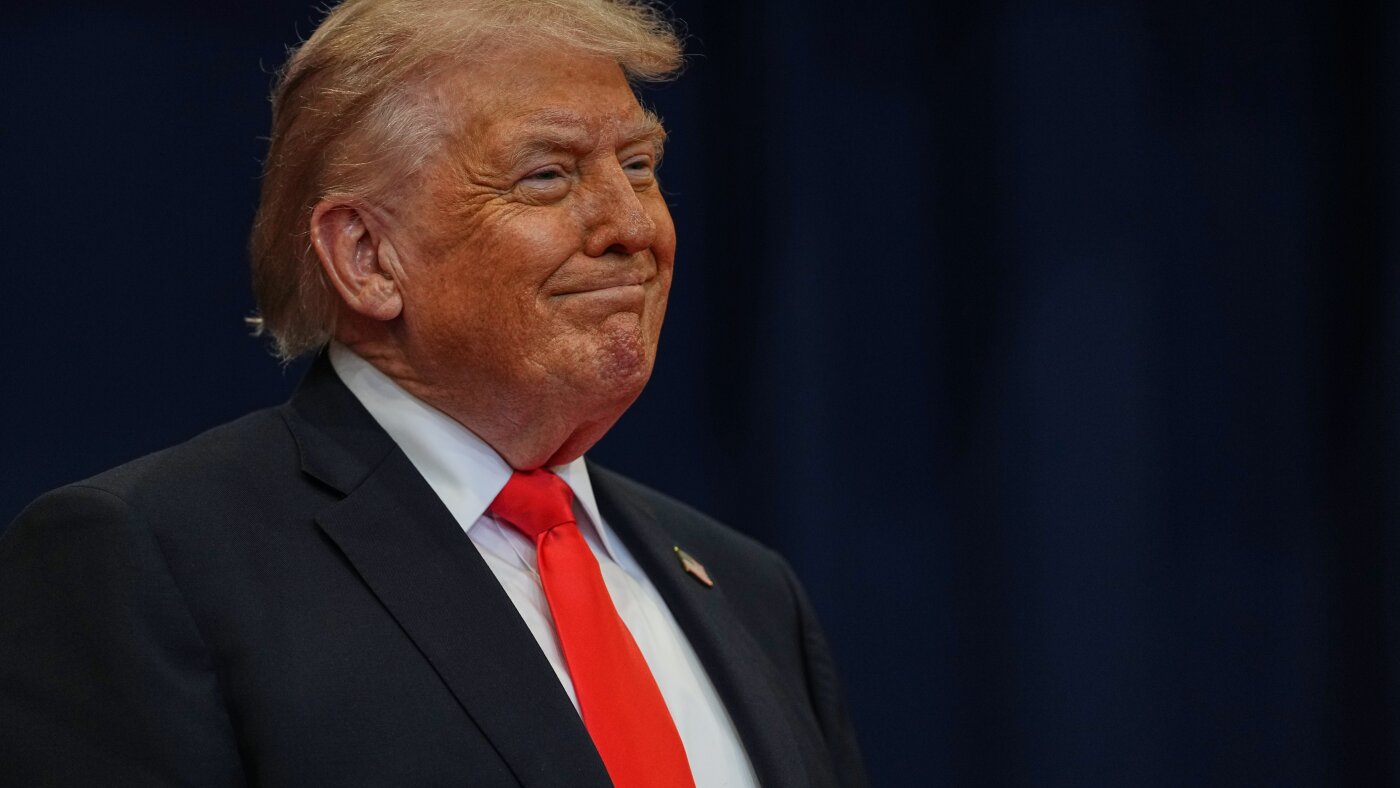
President Donald Trump arrives to speak at a charter school in The Villages, Florida, on Friday, May 1, 2026.
Matt Rourke/AP
hide caption
toggle caption
Matt Rourke/AP
WASHINGTON — The United States will withdraw about 5,000 troops from Germany over the next six to 12 months, the Pentagon said Friday, fulfilling a threat from President Donald Trump as he clashes with the German leader over the U.S. war with Iran.
Trump threatened to withdraw some troops from the NATO ally earlier this week after Chancellor Friedrich Mertz said the US was being “humiliated” by the Iranian leadership and criticized Washington’s lack of strategy in the war.
Pentagon spokesman Sean Parnell said in a statement that “This decision follows a thorough review of the Department’s force posture in Europe and is in recognition of the needs and conditions of the theater on the ground.”
Germany hosts several US military facilities, including the headquarters of its European and African Command, Ramstein Air Base, and a medical center in Landstuhl, where casualties of the wars in Afghanistan and Iraq were treated. American nuclear missiles are also deployed in the country.
The number of troops leaving Germany will amount to 14% of the 36,000 U.S. service members stationed there.
The news of the troop withdrawal drew a strong reaction from Democrats in Congress as well as hawkish Washington think tanks. He said the move would benefit Russian President Vladimir Putin and undermine US security interests.
“The withdrawal shows that American commitments to our allies are dependent on the president’s mood,” said Senator Jack Reed of Rhode Island, the ranking Democrat on the Senate Armed Services Committee.
“The President must immediately stop this reckless action before it has irreversible consequences for our alliances and long-term national security,” Reed said.
Bradley Bowman, a scholar at the Foundation for Defense of Democracies, said the U.S. military presence in Germany and elsewhere in Europe “not only strengthens deterrence against additional Kremlin aggression but also facilitates the projection of U.S. military power into the Mediterranean, the Middle East, and Africa.”
Trump ignored reporters’ questions about the return as he boarded Air Force One in Ocala, Florida, after a rally to promote his economic agenda on Friday.
Trump made a similar threat in his first term, saying he would withdraw about 9,500 of the approximately 34,500 US troops stationed in Germany, but he did not start the process and Democratic President Joe Biden formally halted the planned withdrawal soon after taking office in 2021.
The volatile US leader has for years thought about reducing the US military presence in Germany, and has criticized NATO for refusing to assist Washington in the war, which began with US-Israeli strikes on Iran on February 28.
Trump wrote on social media on Wednesday that the US is reviewing possible troop cuts in Germany, which will soon be “resolved”. On Thursday, he was still thinking about Merz, posting that the German leader should spend more time on “ending the war with Russia/Ukraine” and “fixing his broken country” rather than worrying about Iran.

As US allies in NATO have been gearing up for the withdrawal of US troops since Trump took office, Washington has warned that Europe will have to take care of its own security in the future, including Ukraine.
Depending on operations, exercises, and troop rotations, approximately 80,000–100,000 US personnel are typically deployed to Europe. NATO allies have expected for more than a year that US troops deployed in Ukraine would be the first to leave after Russia launched an all-out war in February 2022.
Ed Arnold, an expert on European security at the Royal United Services Institute, or RUSI, in London, said Europe is more concerned about issues such as the US’s redeployment of Patriot missile systems and ammunition from Germany to the Middle East.
In October, the US confirmed it would reduce its troop presence on NATO’s borders with Ukraine. The move to cut 1,500-3,000 troops came at short notice and unsettled NATO ally Romania, where the military organization runs an air base.
