


On May 8, 2025, white smoke billowed from the chimney on the roof of the Sistine Chapel, signaling that a new Pope had been elected. That day, the world was introduced to Pope Leo XIV, who just hours earlier was known as Cardinal Robert Prevost, prefect of the Vatican’s bishops’ department.
A year later, Pope Leo has captured the hearts of the faithful through events such as his papal visits, canonizations and special religious observances, as well as through his spoken and printed words, including an apostolic letter, and much more.
Here are the 10 most important events and moments from Leo XIV’s first year as Pope:
Inauguration Mass of the new Pontiff
On May 18, 2025, Pope Leo XIV inaugurated his papal certiorari with a Mass in St. Peter’s Square calling for a united Church. Addressing approximately 150,000 attendees, he emphasized fraternal unity, servant leadership and reconciliation, marking the official beginning of his ministry as the 266th Successor of St. Peter.
At the Mass, held with members of the College of Cardinals, Leo expressed his intention “to come to you as a brother, who wants to be a servant of your faith and of your joy, wanting to walk with you on the path of God’s love, because he wants us all to be united in one family.”
Visiting the tomb of Pope Francis
Less than 48 hours after his election, Pope Leo made his first visit outside the Vatican to the shrine of the Mother of Good Counsel in Genazzano, located about an hour east of Rome and run by the Order of St. Augustine.
On his way back to the Vatican, the new pope stopped at the Basilica of St. Mary Major, where he prayed in front of Pope Francis’ tomb and the icon of the Blessed Virgin Mary there, “Salus Populi Romani.”
Pope Leo left a white rose, which is said to have been Pope Francis’ favorite flower.
Powerful address to the youth
During his first year as Pope, the Holy Father had powerful experiences with young people. Two that particularly stand out are his address to nearly 1 million young adults during the Jubilee of Youth and his live interaction with young people gathered at the National Catholic Youth Conference (NCYC).
During the Jubilee of Youth, which took place on 28 July–Aug. 3 and was part of the annual Jubilee of Hope, as young adults from around the world filled the streets of Rome. Each day was filled with different opportunities and events for the youth to experience the richness of the Catholic faith.
On August 2, Pope Leo was welcomed by the largest crowd ever addressed during his papacy for evening mass at Tor Vergata, an outdoor venue 10 miles east of Rome. An estimated 10 lakh people were present. The Holy Father arrived by helicopter and then drove through the grounds in the Popemobile, waving to the excited youth before the prayer service began.
The Jubilee of the Youth concluded on August 3 with a mass celebrated by Pope Leo on the 237-acre grounds of the Tor Vergata, where more than one million young pilgrims spent the night following prayers and eucharistic adoration.
In his sermon, Pope Leo invited pilgrims to open their hearts to God and venture with Him “toward eternity.”
Pope Leo XIV arrives at Tor Vergata in Rome by helicopter on Saturday, August 2, 2025. Credit: Vatican Media
The NCYC took place at Lucas Oil Stadium in Indianapolis from November 20–22. On November 21, Pope Leo held a historic digital meeting with American teenagers.
During this live conversation, five teenagers asked the Pope questions regarding using technology, recovering from mistakes, giving concern to Jesus, avoiding distractions and preparing for the future of the Church. The Pope offered guidance to the young crowd with words applicable to both teenagers and the universal Church.
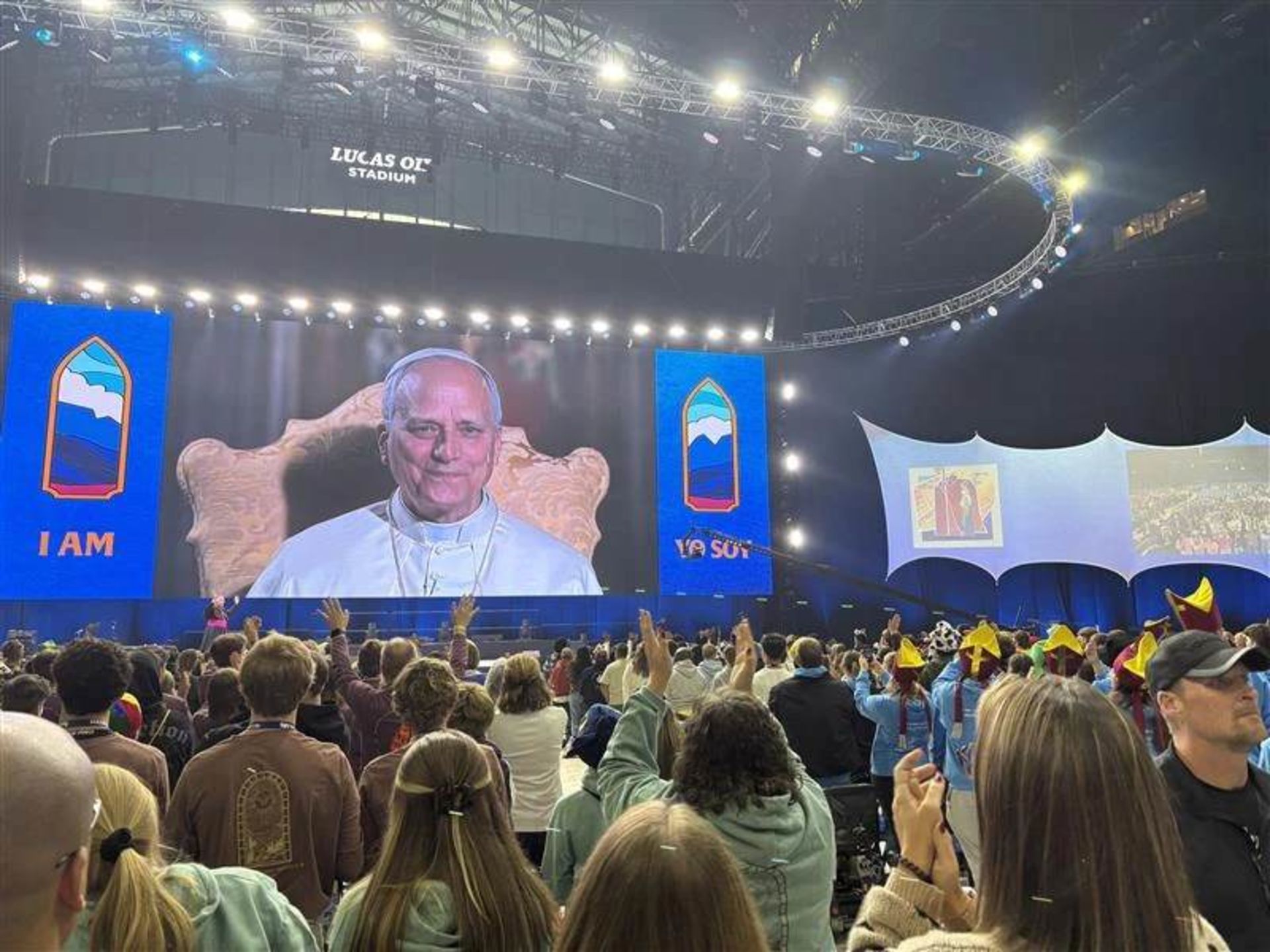
Pope Leo XIV speaks to teenagers during a digital encounter at Lucas Oil Stadium in Indianapolis during the 2025 National Catholic Youth Conference (NCYC) on November 21, 2025. Credit: Tessa Gervasini/CNA
Canonization of Pier Giorgio Frassati and Carlo Acutis
On September 7, 2025, Pope Leo canonized Pier Giorgio Frassati and Carlo Acutis. first canonization ceremony In front of an estimated 70,000 people in St. Peter’s Square.
“Today we see St. Pier Giorgio Frascati and St. Carlo Acutis: a young man from the beginning of the 20th century and a teenager from our own time, both of whom love Jesus and are willing to give everything for him,” he said during his homily.
He added: “Dear friends, Saints Pier Giorgio Frascati and Carlo Acutis are an invitation to all of us, especially young people, not to waste our lives but to direct it upward and make it a masterpiece.”
Release of his first apostolic letter
Pope Leo XIV issues his first apostolic letter, delexy teOn October 9, 2025. The document emphasizes the idea that the poor are not merely objects of charity, but also evangelists who can inspire us to conversion through their example of weakness and dependence on God.
“The poor can act as silent teachers for us, alerting us to our presumption and instilling within us the true spirit of humility,” Leo writes in delexy te (“Wanted you”). “For example, the elderly, by their physical frailty, remind us of our frailty, even though we try to hide it behind our apparent prosperity and outward show. The poor…remind us how uncertain and empty our safe and secure lives can be.”
The pontiff quotes his predecessor throughout the document, which was first drafted during Pope Francis’ papacy and is based largely on the late pope’s first apostolic exhortation, Evangelii Gaudium, On the joy of the gospel.
First major international trip: Türkiye and Lebanon
Pope Leo made his first international papal visit to Türkiye and Lebanon on 27 November–December. 2, 2025. Extensive international travel included historic ecumenical meetings, deeply symbolic gestures of prayer, and pastoral visits to Christian communities under pressure. Pope Leo highlighted the importance of unity, peace and fraternity and offered encouragement to a region marked by ancient faith and current suffering.
A highlight of his time in Turkey included commemorating the 1,700th anniversary of the Council of Nicaea with Ecumenical Patriarch Bartholomew I of Constantinople in the city of Iznik, Turkey, the site of the Council of Nicaea, historically known as the birthplace of the Nicaean Creed.
In Lebanon, Pope Leo became the first Pope in history to visit the tomb of St. Charbel Makhlouf when he arrived at the Monastery of St. Maron in Annaya.
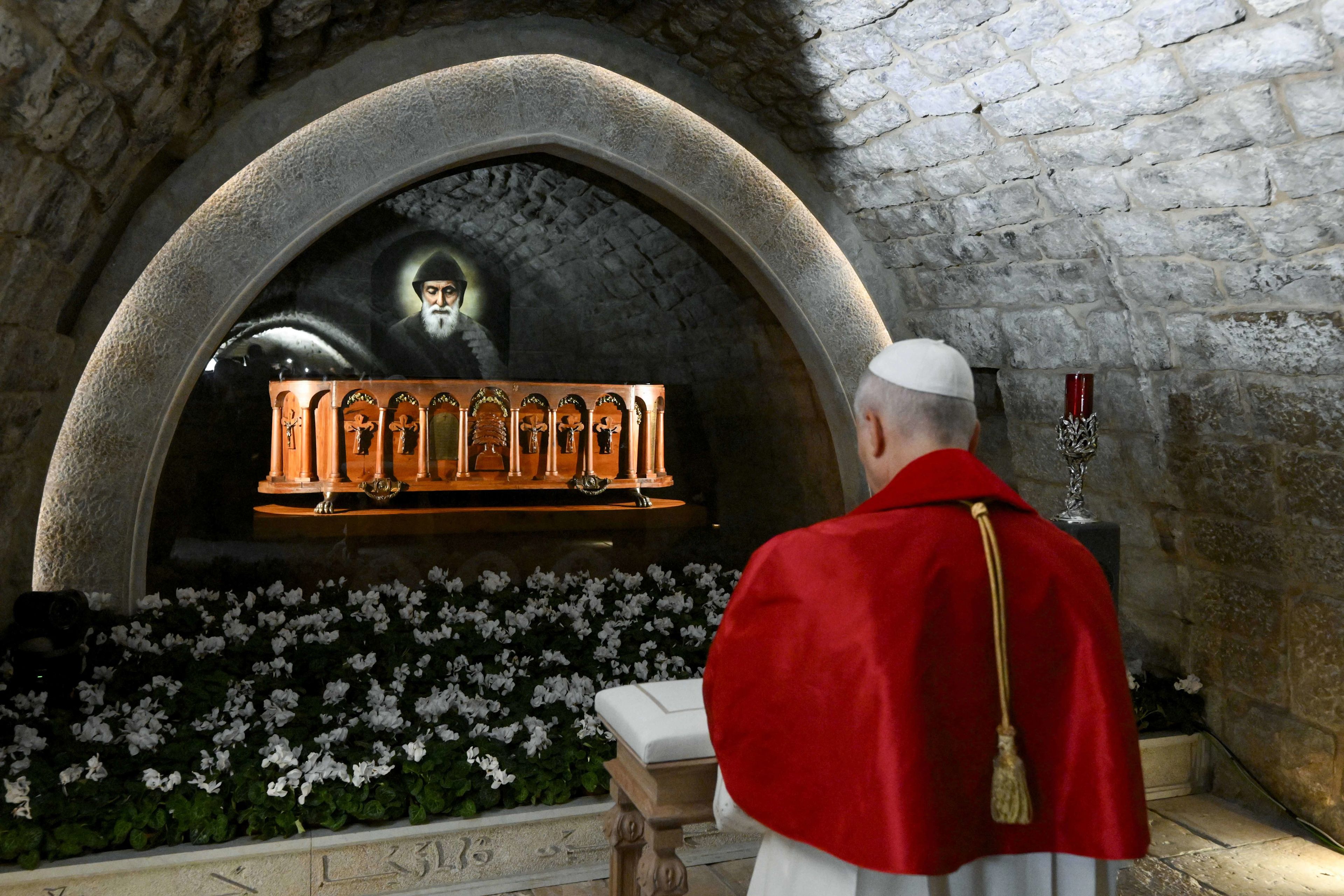
Pope Leo XIV contemplates the enduring message of St. Charbel Makhlouf at the saint’s tomb at the Monastery of St. Maron in Annaya, Lebanon, December 1, 2025. Credit: Vatican Media
an extraordinary fellowship
at its inauguration Address In an extraordinary conclave – which convened on January 7–8 – Pope Leo assured cardinals from around the world gathered at the Vatican that “I am here to listen.”
According to a statement from the Holy See, this extraordinary Congregation – different from ordinary ones, which are more limited and frequent – was to take place immediately after the Jubilee of Hope to “support and advise the Holy Father in the exercise of his high and difficult responsibility to govern the Church”.
The Consistory was a closed-door meeting to which no media were admitted, and the Cardinals were asked to keep the proceedings confidential. However, the Cardinals were expected to present to the new Pontiff their views on two specific topics: synods and synods, and the mission of evangelization and the missionary character of the Church.
First Holy Week and Easter celebrations as Pope
During Holy Week and Easter 2026, Pope Leo presided over the Church’s most solemn liturgies in Rome, beginning on Palm Sunday and continuing through the Christmas Mass on Holy Thursday, the Mass of the Lord’s Supper, the Good Friday Passion celebration, the Stations of the Cross in the Colosseum, the Easter Vigil in St. Peter’s Basilica, and finally the Easter Sunday Mass with the “Urbi et Orbi” blessing from St. Peter’s Square.
It was the first time in many years that a Pope participated in all the liturgies of Holy Week and Easter. Due to Pope Francis’ declining health towards the end of his tenure, he had to reduce his participation in many of these events.
Pope Leo was also the first Pope since John Paul II in 1994 to carry a wooden cross at all 14 stations during the Stations of the Cross in the Colosseum on Good Friday.
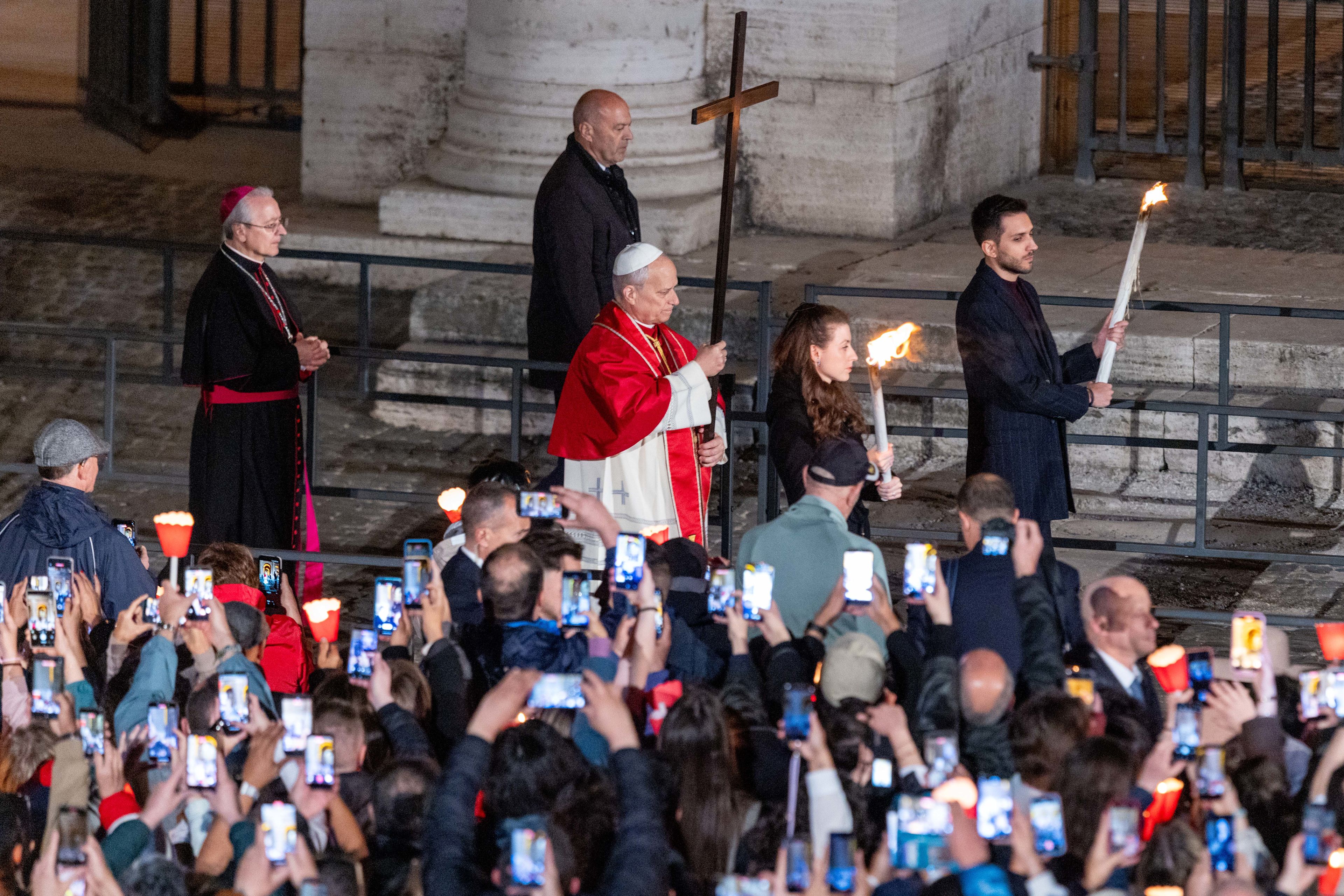
Pope Leo XIV carries the cross during the Via Crucis at the Colosseum in Rome, Friday, April 3, 2026. Credit: Daniel Ibanez/EWTN News
Historic 11 day trip to Africa
Pope Leo spent 11 days in Africa from April 13–23, visiting four countries: Algeria, Cameroon, Angola and Equatorial Guinea. During this trip he traveled more than 11,000 miles on 18 separate flights. Stopping in 11 cities in those countries, the Holy Father met with youth, political leaders, prisoners, families and many others to share the Gospel message.
Throughout his trip, he emphasized the themes of peace, reconciliation, and economic justice while meeting with local leaders, pastors, and believers. Large crowds gathered for the outdoor mass, reflecting the vibrancy and rapid growth of Catholicism in many African communities.
One of the highlights of the trip was Pope Leo’s visit to Enaba – ancient Hippo – which for the Augustinian pontiff was a return to the roots of his faith and vocation. Despite heavy rain, the Pope walked through the ruins and, at the end of the path, stopped for a moment to lay a wreath and pray, clearly emotional.
The Pope also visited the Bata Peninsula in Equatorial Guinea and told prisoners that “no one is deprived of God’s love” and urged them to see that even behind bars, there remains the possibility of change, reconciliation and hope. This jail is one of the harshest jails in the country, known for its difficult conditions.
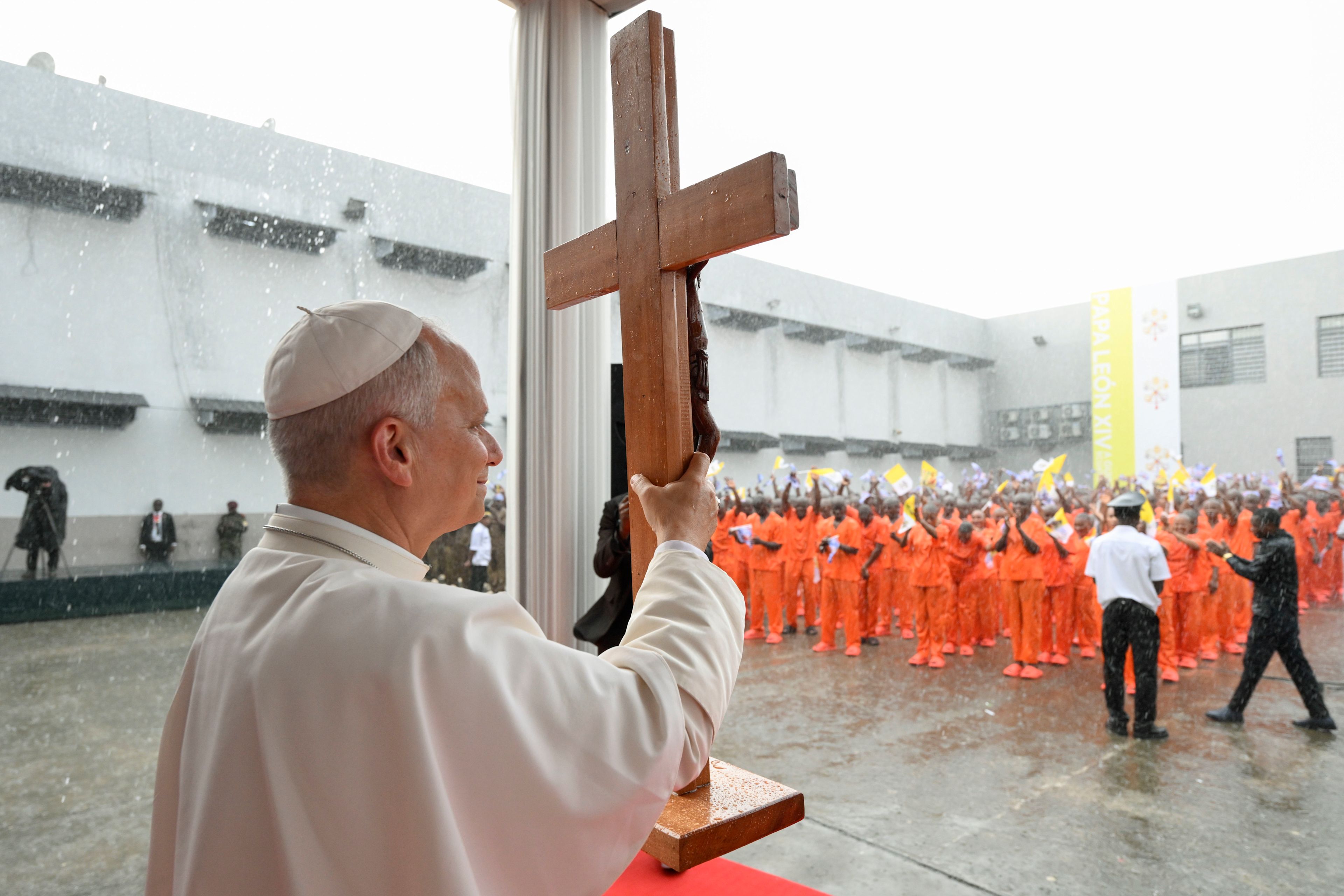
Pope Leo XIV displays a crucifix while speaking to prisoners at Bata prison, Equatorial Guinea, on Wednesday, April 22, 2026. Credit: Vatican Media
Strong message on war and peace
The Holy Father has made peace a defining theme of his Pontificate from the beginning, beginning his first public remarks with the words “Peace be with you.” That simple greeting set the tone for a broader vision—one rooted in the gospel but clearly directed at a world marked by conflict and division.
In sermons and international addresses, he has consistently defined peace not as the absence of war, but as an active, daily commitment based on justice, reconciliation and respect for human dignity.
The Pope has urged world leaders to reject cycles of violence and instead promote what he has called a “culture of peace”. Speaking in the context of ongoing global tensions, he warned against normalizing war as a tool of policy, and stressed that lasting solutions can only come through dialogue and mutual understanding.
The Pope has also addressed the dangers of modern war, including the threat of nuclear escalation. He called for renewed international efforts toward disarmament and de-escalation, stressing that the destructive power of nuclear weapons demands a moral as well as a political response.
Reiterating the long-standing teaching of the Church, Pope Leo has encouraged nations to embrace diplomacy over aggression, presenting negotiation not as a form of weakness but as the strongest and most lasting path to peace.
