

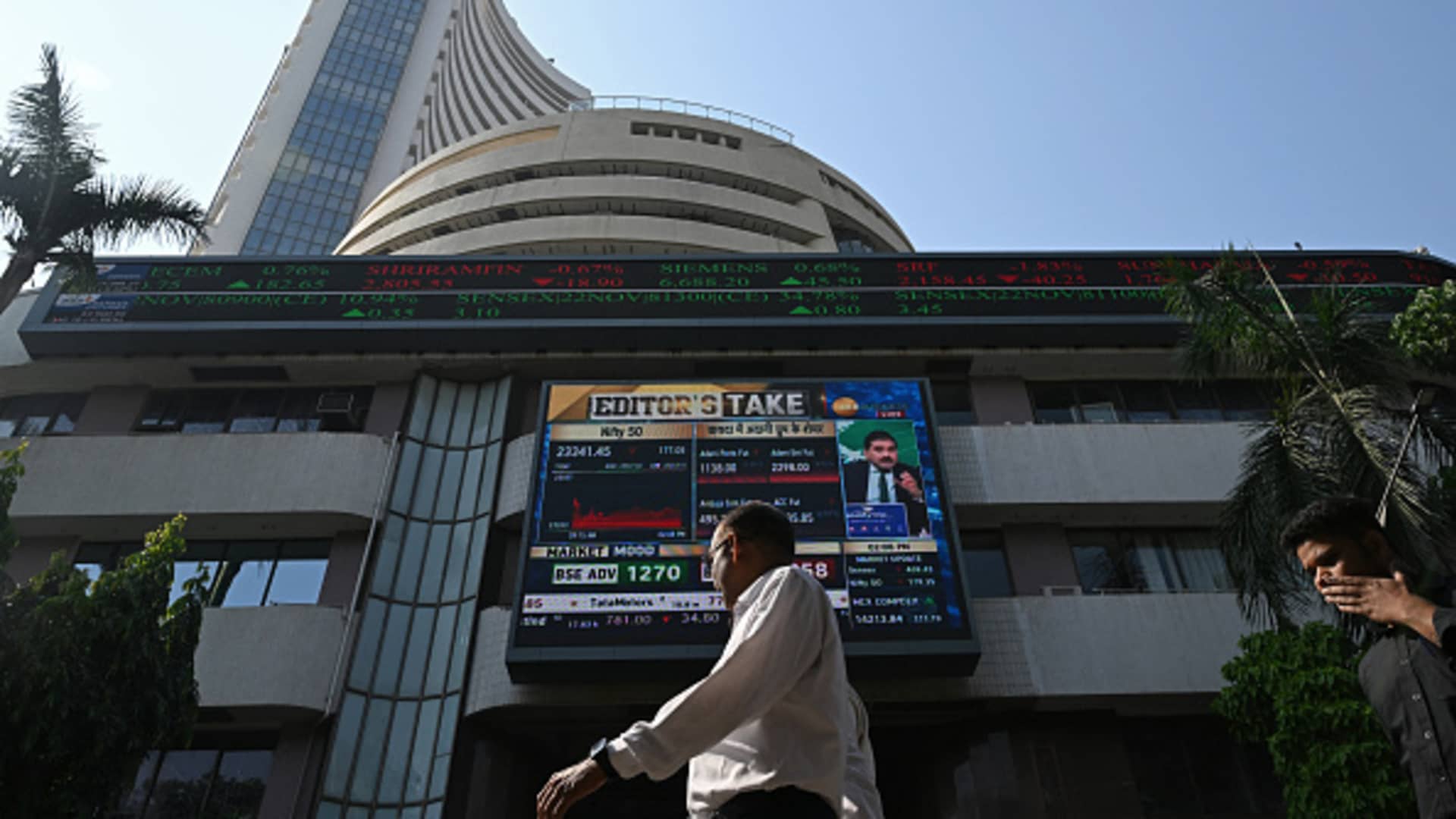
Pedestrians walk past a digital broadcast on the Bombay Stock Exchange (BSE) in Mumbai.
Indranil Mukherjee AFP | getty images
Domestic investors played a key role in saving the Indian equity market from a “freefall” after foreign investors sold billions worth of equities last year, the chief executive of the country’s oldest stock exchange told CNBC’s “Squawk Box Asia” on Tuesday.
“India is growing, and a large section of the population is yet to enter the capital markets,” Sundararaman Ramamurthy, managing director of the Bombay Stock Exchange (BSE), told CNBC. He said that last year 35 million Indian investors have registered through BSE.
“The stake of foreign participants in the Indian stock market used to be higher than that of domestic institutions, but today it is the reverse,” he said.
Indian institutional investors invested a net $91 billion in equity markets last year, while foreign investors pulled out $35 billion, the CEO said.
“It has not only checked the outflow of (foreign capital) but has also strengthened the Sensex to a great extent and prevented it from falling,” Ramamurthy said on the sidelines of the Motilal Oswal India Corporate Day 2026 in Singapore.
Foreign investors continue to be bearish on India due to weak earnings and worsening economic impact from rising global oil prices amid conflict in the Middle East.
Despite being a global information technology leader, India does not have any major AI ecosystem companies, further weakening foreign investor sentiment.

HSBC Research said in a report on Tuesday that India does not have a clear “AI-based story” and its market is down about 10% in US dollar terms.
“Asian stock markets are largely driven by bullish sentiments around AI,” the report said. Unlike India, AI-focused markets like Korea and Taiwan are up about 80% and 40%, respectively, since the beginning of the year, the report said.
However, it has had no impact on domestic capital flows into equities. According to local media reports, net inflows into equity Mutual funds rose to 384.4 billion rupees (about $4 billion) in April, up 58% from a year earlier.
India’s benchmark index, BSE Sensex, is down 11% on a year-to-date basis and is one of the worst performers in Asia, according to LSEG data.
