

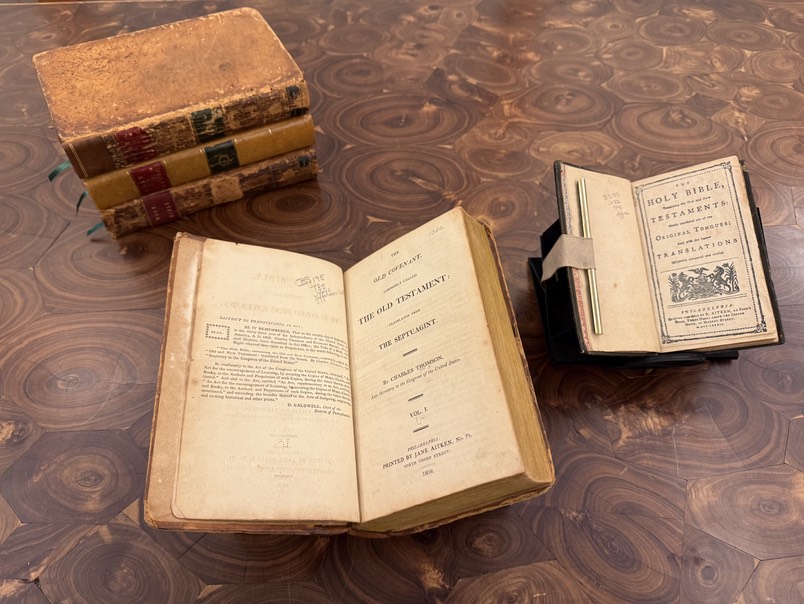
Robert Aitken is rightly celebrated as the printer of the first English-language <a href="https://christiancorner.us/2026/07/21/insufficient-the-bible-and-baptist-progressives/” title=”Insufficient? The Bible And Baptist Progressives”>Bible printed in America, and his daughter, Jane Aitken, later printed a Bible that likewise achieved noteworthy firsts
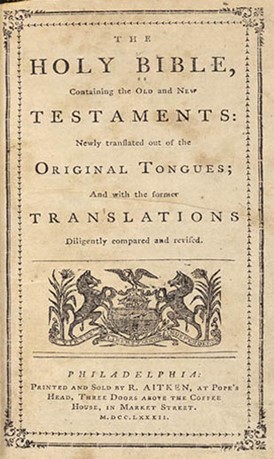
Robert Aitken‘s 1782 printing of the Bible, sometimes called “The Bible of the Revolution,” met the growing need for Bibles in the first years of the United States. The cessation of trade between the United States and Great Britain during the Revolutionary War created a scarcity of new copies of the Bible in America. Because the British Crown tightly restricted who could print the King James Version of the Bible, Aitken sent copies of his edition to the Continental Congress for their authorization. Congress assembled a committee to study Aitken’s Bible and enlisted two Congressional Chaplains to assess the text; in September of 1782, they attested to the faithfulness of Aitken’s Bible, as documented in the Journals of the Continental Congress: “Having selected and examined a variety of passages throughout the work, we are of opinion that it is executed with great accuracy.” Congress then resolved “that the United States in Congress assembled highly approve the pious and laudable undertaking of Mr. Aitken.”
At great personal expense, Aitken printed 10,000 copies of this historic edition of the Bible
Unfortunately for him, the war soon ended, trade with Britain resumed, and the American market was flooded with cheap British Bibles printed on better paper and in larger formats. While Aitken suffered a financial loss on the project, his effort to produce an American Bible was an important step in the United States establishing itself as an independent nation
When Robert Aitken died in 1802, he passed on his printing business to his daughter, Jane Aitken, who quickly earned renown for her “well and handsomely executed” printed works. She was trusted by Charles Thomson to print his unique translation of the Bible in 1808

You might recognize Charles Thomson’s name as one of only three that appear at the bottom of the first printing of the Declaration of Independence. Thomson served as the Secretary of the Continental Congress throughout the institution’s fifteen years, from 1774-1789. Prior to this service to the new nation, Thomson was trained in the classics and became a teacher of Latin. At the age of 21, Thomson became the first tutor hired by the Academy of Philadelphia, the school founded by Benjamin Franklin that would eventually become the University of Pennsylvania. He would later take a detour from his academic career and spend a few decades in business and politics.
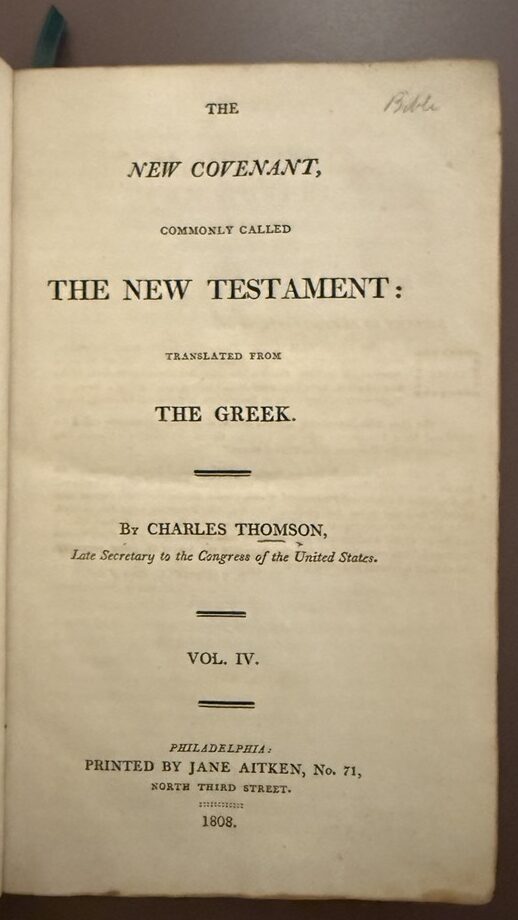
After his retirement from politics, Thomson began studying Greek. He eventually became the first person to translate the Septuagint (Greek Old Testament) into a modern language and was the first American to translate the Greek New Testament into English. He entrusted Jane Aitken with printing this translation. Her 1808 edition of Thomson’s Bible was the first Bible printed in the United States by a woman

Thomas Jefferson, while President of the United States, sent a letter to Charles Thomson, his old friend and colleague from the Continental Congress, offering suggestions about the Bible that Jane Aitken was preparing to print. Jefferson was particular about the size of his books and preferred a handheld book whenever possible. He wrote to Thomson, “I see by the newspapers your translation of the Septuagint is now to be printed, & … I wish it may not be too late for you to reconsider the size in which it is to be published.” He goes on to suggest an “edition of the bible in 4 volumes Octavo.”
In 1808, Jane Aitken printed 1,000 copies of Thompson’s Bible in the exact format Jefferson suggested: four volumes in octavo format. Aitken’s innovation in this edition was to print the text across the page and in paragraph form as readers would find in most other books, not in double columns as had been standard for Bibles for centuries
Jane Aitken’s elegant typesetting and clear printing of Thomson’s Bible have earned her acclaim across centuries as a master printer. Like father, like daughter
Carté, K. (2021). “Revisiting the Aitken Bible.” The University of North Carolina Press Blog
Hudak, L. M. (1978). Early American Women Printers and Publishers, 1639-1820. London and Metuchen, NJ: Scarecrow Press
Michaels, J. R. (2011). “Charles Thomson and the First American New Testament.” The Harvard Theological Review, Vol. 104, No. 3, 349–365
Pears, T. C. (1939). “The Story of the Aitken Bible.” Journal of the Department of History (The Presbyterian Historical Society) of the Presbyterian Church in the U.S.A., Vol. 18, No. 6, 225–241.
University of Pennsylvania Library. “Charles Thomson, (1729-1824).” Penn People
Walker, G. (1987). “Women Printers in Early American Printing History.” The Yale University Library Gazette, Vol. 61, No. 3/4, 116–124.
