

To report on the new bread prices, I decided first to enter through the northern gate of the Saadabad Palace Museum Complex and leave through its southern gate into the wealthy hillside neighbourhoods of northern Tehran, where I planned to examine prices and listen to buyers’ reactions
However, soldiers guarding the entrance stopped both me and an Iraqi family carrying large suitcases
“Since eight months ago, Golestan Palace in Tehran’s Grand Bazaar and the Saadabad complex have been closed. No visitors are allowed.”
With the palace off-limits, I turned to the first bakery on the corner beside the complex
It was an Azadpaz bakery, selling Taftoon bread made with unsubsidised flour at free-market prices
Taftoon is a traditional Iranian flatbread, thin but chewy, made from wheat flour
The baker was standing beside the traditional oven
“So, an Azadpaz bakery means you no longer receive government-subsidised flour?”
“Yes, brother,” he replied. “The government says it can no longer afford to subsidise flour. We also have to pay much higher wages to the skilled bakers who shape the dough and bake the bread in the traditional oven you see behind me.”
I asked him another question:
“If you compare the price of your Taftoon bread with its price two months ago, how much has it increased?”
“Compared with two months ago, it has increased by more than 100 per cent.”
While I was interviewing the baker, a man in his fifties bought ten round Taftoon loaves
He paid 160,000 tomans (about 67p)
I asked him:
“At this time last year, how much did you pay for the same number of Taftoon loaves?”
“Oh, Allahu Akbar,” he replied. “Around 50,000 tomans (about 21p).”
“So, you’re paying roughly three times as much as you were a year ago?”
The baker immediately interrupted, insisting that the customer was mistaken
“No, no. The increase has not been that high. It has been much less than that.”
To end the disagreement between the customer and the baker, I invited the man to walk with me along Darband Street, beside the long, whitewashed wall of the Saadabad Palace Museum Complex
The slogans “Death to Israel” and “Death to America” remained untouched on the wall, but the slogan “Long Live the Shah” had been painted over with black paint using a brush
Carrying the Taftoon loaves under one arm, he began to tell me his story
“I am the caretaker of a building under construction and also a gardener looking after private houses with courtyard gardens in the Darband area. Once, my four children could have Taftoon bread with a skewer of Koobideh kebab or grilled liver once a month. But now, each piece of Taftoon is spread with only a thin layer of cheese and eaten with sweet tea, just to fill their stomachs.”
“How much is your monthly income?” I asked
“Around 25 million tomans (about £104). You can imagine what that means. My income can only provide basic staples, nothing more.”
Walking further down Darband Street, I passed the pavement outside Shohadaye Tajrish Hospital
A family had spread straw mats on the pavement and were resting. They appeared to have spent the night there because they could not afford a nearby hotel while a close relative remained in intensive care
About ten metres before Quds Square, I came across a Barbari bakery
Barbari is another traditional Persian flatbread, known for its crisp, golden crust and soft, light interior
The baker was selling each buttered Barbari loaf for 35,000 tomans (about 15p)
I asked him:
“Has an increase of more than 150 per cent in bread prices reduced your customer numbers?”
“The working class, taxi drivers and Afghan workers no longer buy my buttered Barbari bread,” the baker replied. “Yes, we’ve lost some customers, but we still have a large enough market because wealthier households that buy baguettes and other so-called Fantazi breads – artisan-style breads made with unsubsidised flour – have been paying market prices for years, long before the latest increase in subsidised bread prices
“As a result, the latest rise in bread prices has had virtually no impact on either their daily food budgets or our sales.”
However, as I continued walking downhill towards southern Tehran, the contrast became increasingly visible
Descending from the foothills of the Alborz Mountains towards central and southern Tehran, the city’s elevation falls by roughly 1,000 metres. Along Valiasr Avenue and other main roads across Tehran, four traditional breads – Lavash, Barbari, Taftoon and Sangak – remain essential staples for middle-class, lower-middle-class and poorer households
Lavash is an extremely thin, soft flatbread, lighter and more delicate than a wrap or tortilla
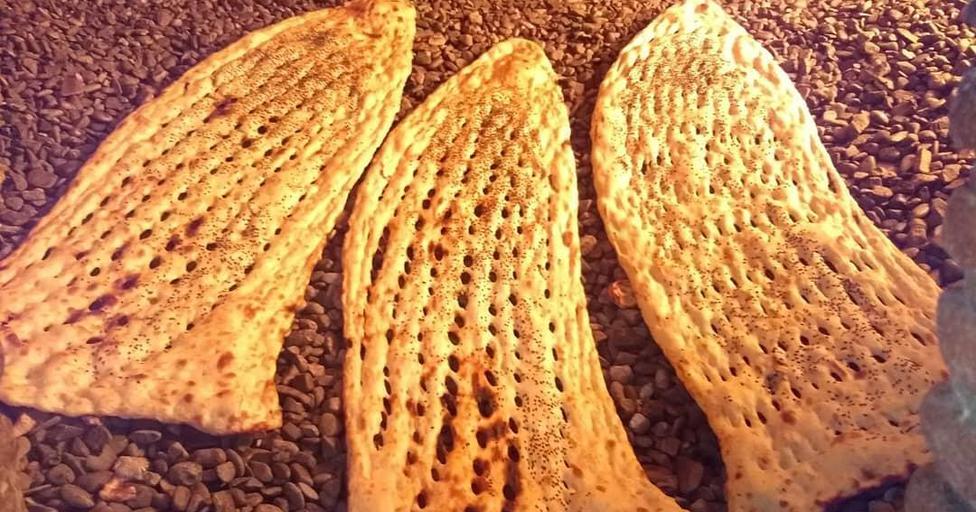
Sangak is a rustic wholemeal flatbread with a crisp crust, a soft, chewy interior and a distinctive pebble-patterned surface created by baking it on hot stones
In front of a Sangak bakery, I met an exhausted baker squatting on the pavement, drawing deeply on his cigarette
“How much do you sell each Sangak for?” I asked
“Plain Sangak, without sesame seeds, costs 20,000 tomans (about 8p). If it is topped with sesame seeds, the price varies between 25,000 tomans (about 10p) and 40,000 tomans (about 17p), depending on the weight of the dough.”
I noticed a sign on the bakery’s glass door addressed to people in need
Kindness Bread
Free bread is available here for underprivileged individuals
I asked the baker:
“Does this mean the number of people who cannot afford to buy bread is increasing?”
“Yes,” he replied. “The price of bread itself is modest compared with rice, eggs or meat. But when a family with four or five children wants to fill their stomachs, spending around 150,000 tomans (about 63p) a day on Sangak bread, while also paying rent, school supply and clothing costs, consumes a major part of their income
“Bread has become the only affordable way to fill their stomachs because rice is no longer within reach for many families.”
As I walked further through Tehran, the contrast between the wealthy northern districts and the poorer southern neighbourhoods became even clearer
Even Sangak bread, traditionally considered one of the most affordable staple foods, can sell for as much as 80,000 tomans (about 33p) in central Tehran. There appears to be no clear ceiling on the price of bread made with unsubsidised flour
In the north, many households continue buying baguettes and other artisan-style breads made with unsubsidised flour, whose prices have reflected market costs for years. For them, the latest increase in subsidised bread prices has made little difference
For many working-class families, however, especially those relying on traditional flatbreads such as Lavash, Barbari, Taftoon and Sangak, bread remains the foundation of their daily diet
At 7,000 tomans (about 3p) a loaf, Lavash is the cheapest of Iran’s traditional flatbreads. It is also the lightest, meaning people generally need to eat more of it than other breads to feel full
The journey from the gates of Saadabad Palace to the streets of southern Tehran revealed more than a change in altitude. It exposed a widening economic divide: neighbourhoods where rising bread prices scarcely affect household budgets, and others where even a basic loaf has become a measure of financial hardship
In today’s Tehran, bread is no longer merely a staple food. It has become a symbol of the struggle to preserve dignity and simply get by as the cost of living continues to rise
