

- What Is Mindfulness?
- Take our Mindfulness Test
- Find a mindfulness-based therapist
Key points
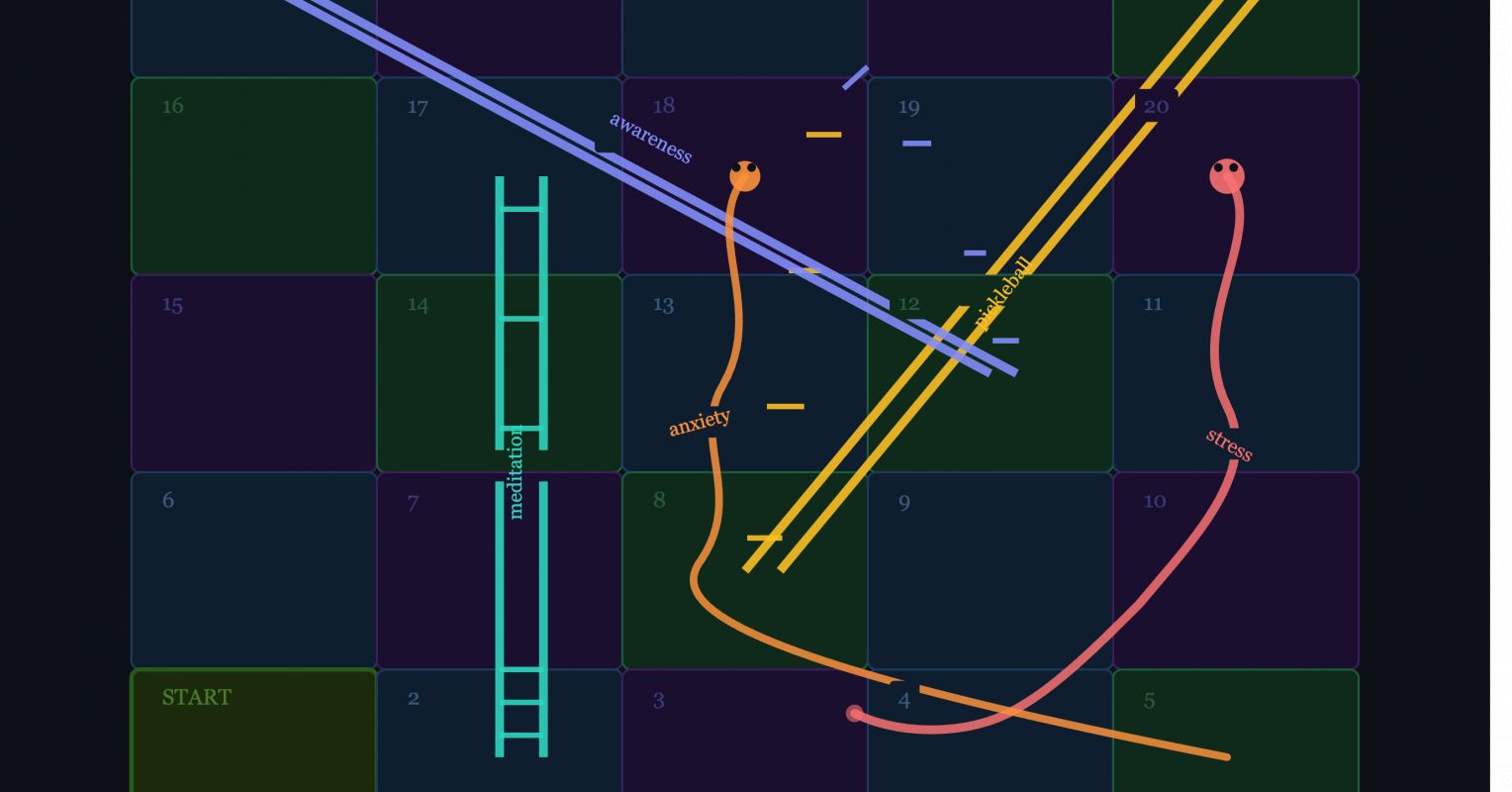
- Pickleball teaches you to wait for the ball. The brain that meditates learns to wait for life.
- Stress hijacks the prefrontal cortex. Mindfulness practice rebuilds the pause between reaction and response.
- Life is snakes and ladders. You cannot prevent the snakes. But daily practice builds more ladders.
A neighbor of mine, a woman of a certain age and considerable wisdom, stopped me on the street recently with advice I have not been able to shake
“Bala,” she said, “it is simple. Eat less and walk more.”
She was not wrong. But I would like to propose one addition to her formula
Play pickleball
The Court as a Classroom
I came to pickleball the way most people my age do — reluctantly, then completely. It’s a smaller court than tennis, a slower ball, and a game that appears, at first glance, to be a gentler version of something you already know. It is not
Pickleball has taught me more about the mind, and about how the mind fails under pressure, than almost anything else I have encountered outside of a <a href="https://christiancorner.us/2026/08/07/whirling-dervishes-and-more-at-2-day-music-and-meditation-festival-in-surrey-surrey-now/” title=”Whirling dervishes and more at 2-day Music and Meditation Festival in Surrey – Surrey Now”>meditation cushion or an operating theatre
Here is the central lesson, the one I return to every time I step on the court: It is a small ball in a large square
You have more time than you think. The ball is coming to you. Your job is not to chase it. It is to be ready for it. The days when you know this, you play well. The days when you forget, the ball is playing you
And here is what I have noticed: the days I play badly are not the days my technique fails. They are the days my awareness fails. I rush. I play by reflex. I go to the ball before it has decided where it is going. Every rushed shot I regret. Every shot I wait for, I place
That is not a pickleball observation. That is a neuroscience finding
What Happens in the Brain When You Rush
When you rush, in pickleball, in a difficult conversation, in a crisis, your brain is doing something specific. The amygdala fires. The insula, which integrates body sensation and threat, escalates the alarm. The prefrontal cortex, the seat of planning, judgment, and choice, gets partially hijacked
You are no longer choosing. You are reacting
Our research at the Sadhguru Center for a Conscious Planet hasdocumented this pattern across multiple contexts. Stress and anxiety narrow the brain’s repertoire of responses. The reactive brain plays the same shot regardless of where the ball lands
This is what I call the one-trick pony problem
Every pickleball player has one reliable shot. For a while, it wins points. Then the opponent figures it out. And once they do, that single trick stops working. Life works the same way. When a variety of stressors arrive, and they always do, the brain with only one coping strategy is vulnerable. Work harder. Avoid the conflict. Control everything. These tricks work, until they do not. And when they fail, the amygdala fires, the anterior cortex is hijacked, and the results are rarely ones we are proud of.
- What Is Mindfulness?
- Take our Mindfulness Test
- Find a mindfulness-based therapist
The answer is not a better trick. The answer is a more flexible, more aware, more practiced mind
Wait for the Ball
Between stimulus and response, there is a space. That space is where awareness lives, where choice is possible, where the shot can be placed rather than hit
Our EEG research, published in the journal Mindfulness in 2026, mapped this space neurologically. In 103 participants, including people who had never meditated before, we tracked brainwave changes minute by minute during breath-watching meditation. Within two to three minutes, theta and alpha waves, the neural signature of calm and focused attention, began rising. By seven minutes, the practice became effortless and spontaneous. The brain had found its rhythm
The science says: You can train this every day—starting at two minutes and reaching its peak at seven
Snakes, Ladders, and Life Skills
Think of life as a game of snakes and ladders. You cannot control the board. Stressors come like snakes, sudden, unwelcome, and capable of sending you back several squares in an instant. But the ladders are not luck. They are built from the skills, physical, mental, and emotional, that you have cultivated before the snake arrives. You cannot prevent the snakes. But you can build more ladders
Mindfulness Essential Reads

Stop Fighting Reality at 3 A.M.

New Research on How Mindful Hope Can Support Well-Being
Advanced Isha yoga practitioners in our published research show a biological brain age nearly six years younger than matched controls. The practiced brain is literally younger, more resilient, and more flexible. More ladders. More capacity to respond rather than react
The Perfect Combination
My neighbor was right. The body needs to keep moving. Pickleball, as we age, is an excellent answer. A smaller court, gentler on aging joints, but still a real physical and mental challenge. An hour a day engages the cardiovascular system, sharpens spatial attention, and puts you in a social environment where you are genuinely present
Add seven minutes of meditation and five minutes of Yoga Namaskar. The Miracle of Mind app, free and guided by Sadhguru, delivers exactly the neurological window our research identified. Yoga Namaskar, a simple yogic sequence available free through the Isha Foundation, stretches the body and coordinates breath with movement. Together, pickleball, meditation, and Yoga Namaskar form a neurologically coherent daily practice that addresses the body, the breath, and the brain
On the days I play pickleball well, I am not thinking about winning. I am watching the ball. I am feeling my feet. I am waiting
On the days I live well, I notice the same quality: not urgency but presence; not reaction but response; not chasing the ball but allowing it to come
Eat less. Walk more. Play pickleball. Meditate for seven minutes. Stretch the body
Allow life to come to you. And when the ball arrives, and it always does, you will be ready to place it exactly where you intended
Temporal EEG Signatures of Meditation Experience: Peak Brainwave Changes at 7 Minutes During Isha Yoga Breath Watching. Saketh, M., Sasidharan, A., Venugopal, R. et al. Temporal EEG Signatures of Meditation Experience: Peak Brainwave Changes at 7 Minutes During Isha Yoga Breath Watching. Mindfulness 17, 762–778 (2026). https://doi.org/10.1007/s12671-026-02790-1
Sleep-Based Brain Age Is Reduced in Advanced Inner Engineering Meditators. Banks, J.C., Hariri, S., Kveraga, K. et al. Sleep-Based Brain Age Is Reduced in Advanced Inner Engineering Meditators. Mindfulness 16, 1675–1692 (2025). https://doi.org/10.1007/s12671-025-02583-y
Inner engineering is associated with perceived improvements in relationship quality, interpersonal connections, and interpersonal compassion. Jafari N, Manvelian A, Mohamed E, Rayapuraju A, Orui H, Alkuhaimi S, Reed PU and Subramaniam B (2024) Inner engineering is associated with perceived improvements in relationship quality, interpersonal connections, and interpersonal compassion. Front. Psychol. 15:1454293. https://doi.org/10.3389/fpsyg.2024.1454293
Inner Engineering Completion Online Program on Stress & Well-Being. Upadhyay, P., Joshi, A., Mishra, I., Kelly, L., Novack, L., Hariri, S., Kveraga, K., & Subramaniam, B. (2022). Short-Term Effects of Inner Engineering Completion Online Program on Stress and Well-Being Measures. Frontiers in Psychology, 13. https://doi.org/10.3389/fpsyg.2022.814224
Swaminathan A, DeSchryver B, Rayapuraju A, Barbaro J, Orui H, Subramaniam B and Reed PU (2025) From strain to strength: a yearlong study on the transformative influence of inner engineering online program on mental well-being. Front. Psychol. 16:1436910. doi: 10.3389/fpsyg.2025.1436910
