

LOCAL
Bloomington author’s latest book tells of Black presidential adviser
Connie Shakalis
Special to The Herald-Times
July 31, 2026, 5:03 a.m. ET
- A new book by Audrey McCluskey focuses on Mary McLeod Bethune’s early work establishing a school for Black girls in the South.
- Bethune became an adviser to President Franklin D. Roosevelt and formed the influential “Black Cabinet.”
- Known for her diplomatic approach, Bethune received numerous honors, including being the first Black woman to have a national monument in Washington, D.C.
Mary McLeod Bethune (b. 1875) — Black female educator, school founder, personal friend of U.S. presidents — didn’t use the word “integration”; she understood its impact on whites of her era. The Atlanta Daily World said Bethune’s life was “One of the most dramatic careers ever enacted at any time upon the stage of human activity.”
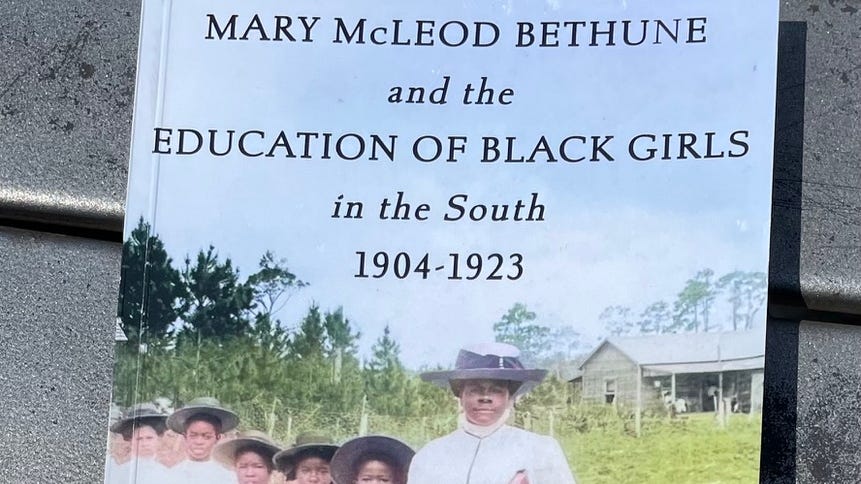
Bloomington’s Audrey Thomas McCluskey is, among other activities, an author and emerita professor of African and African diaspora studies at Indiana University. She has written her seventh book, “Mary McLeod Bethune and the Education of Black Girls in the South 1904-1923.” McCluskey will sign copies Aug. 2 at Morgenstern’s Books & Cafe, where the public may ask her questions and find the book
McCluskey is a longtime admirer of Bethune. In grade school, McCluskey’s sister came dressed as Bethune for “Negro History Week (it wasn’t ‘Month’ yet).”
Bethune entered the world when the U.S. Reconstruction period was ending and belonged to a generation of Black people who were experiencing their first freedom. Slavery’s many repulsions, however, lingered in the South (as well as other areas). “In the South,” McCluskey said, “everything was separated.”
Mary McLeod Bethune was number 15 of 17 children born to former slaves. She learned to walk as the Jim Crow era began. Anti-Black violence would smear the U.S. South for her entire life. Patsy and Samuel McLeod, her parents, owned a small farm in South Carolina
They urged their bright and dynamic daughter into a religious mission school, where she earned a scholarship to study at Scotia Seminary for Negro Girls in Concord, North Carolina. For one year, she studied at the Moody Bible Institute in Chicago. At these two places, she became devoted to “female uplift,” teaching Black girls to lead their populations
Of those 17 children, Bethune’s parents, neighbors — and her 16 siblings — realized early on that Bethune was singular. Her parents would say of her, “Here comes one of the children who is going to do something in life.”
Bethune knew it, too, and took it seriously. Responding to a Bible verse, Bethune as a little girl said, “It meant to me that I, a humble Negro girl had just as much chance as anybody” (McCluskey)
By the age of 10, Bethune knew her life’s mission. She had witnessed the power of religion, hard farm work — and women. She worked to erase the slavery-era image of Black women as “promiscuous” and of Black men as “rapists” (McCluskey) — a dichotomy that had encouraged whites to see Blacks as either “good” or “bad.”
Taught herself to work in a white patriarchy
Bethune began to see that, yes, Blacks needed good jobs, but what they needed more urgently was education. She spent her life building educational throughways for Blacks. The way she accomplished this differed from others’ approaches. She used peacekeeping, not fire and brimstone. She taught herself to work in a white patriarchy, as she accomplished her own goals.
“She was diplomatic, not confrontational,” McCluskey said. “An example is how she would seat a white person next to a Black person so they could talk.”
But Bethune’s politeness and reluctance to rabble rouse naturally brought criticism from other, more provocative leaders
Bethune’s style and track record impressed President Franklin D. Roosevelt. In 1935 he appointed her administrator of the National Youth Administration Division of Negro Affairs, a New Deal agency
In 1898, Mary McLeod married Albertus Bethune. Their son, Albert, was born the following year. The marriage was unhappy, and the family moved from Georgia to Florida, where she worked in a school. In 1904, she founded the Daytona Educational and Industrial School for Negro Girls. In 1907, Albertus left.
In 1923, Bethune merged her Daytona, Florida, school with the Cookman Institute in Jacksonville, Florida. These two institutions created Bethune-Cookman College; it was both four-year and co-ed. Already known as a prestigious organizer of Black education and Black women’s clubs, Bethune worked with the Florida Federation of Colored Women’s clubs to start a residence for at-risk Black girls in Ocala, Florida. She was president of the Southeastern Federation of Colored Women’s Clubs (1920-25), the National Association of Teachers in Colored Schools (1923-24) and president of the National Association of Colored Women (1924-1928.)
Having worked on local and national boards, by 1935 she founded the National Council of Negro Women — as she worked as president of Bethune-Cookman College. President Herbert Hoover had noticed Bethune’s widening range of work and asked her to attend a White House conference in 1930. Bethune used her talent for nonconfrontational persuasion; at the conference’s finale, she was a major voice for African Americans in the U.S
Close friends with Eleanor Roosevelt
Bethune was number 10 on famous journalist Ida Tarbell’s roster of superlative living American women (1931)
A few years earlier, Bethune had met the Roosevelts. Her friendship with Eleanor Roosevelt brought Bethune close to the president as well. President Roosevelt asked Bethune to join the National Youth Administration; as a result, she became the director of Negro Affairs. As such, she earned the highest salary of any African American in government at the time. She saw to it that the National Youth Administration hired hundreds of thousands of African American women and men and established a fund that helped more than 4,000 higher education students.
Then came the modern civil rights movement
Bethune formed and guided the “Black Cabinet,” coming up with its name in 1936. The “Black Cabinet” helped President Roosevelt’s advisers understand Black communities in the U.S. Because Bethune and the Roosevelts were close, the “Black Cabinet” was powerful. Its efforts built the modern civil rights movement
During World War II, Bethune became honorary general of the Women’s Army for National Defense, working, too, as an adviser for the emerging Women’s Army Corps. She motivated President Roosevelt to integrate veteran rehab organizations and kept the president informed about viciousness against Southern Black service members
Bethune advised the president until he died.
Bethune received an invitation to visit Haiti (1949). There, she accepted the highest Hattian civilian honor, the “Medal of Honor and Merit.” As a representative of President Truman, Bethune went to Liberia and accepted the “Commander of the Order of the Star of Africa,” Liberia’s top honor. In her lifetime, she earned 11 honorary degrees from Black and white colleges. One is Rollins College: she was the first African American to receive such an honor in the whole South
One of top 50 traditionally Black colleges and universities in U.S.: Bethune-Cookman University
Bethune died in1955. Her contributions and recognition are enormous. Among the many other accomplishments, she was the first Black woman to have a national monument dedicated to her in Washington, D.C., schools, parks and streets are named for her.
Perhaps her most memorable accomplishment is Bethune-Cookman University, one of the top 50 traditionally Black colleges and universities in the U.S. Bethune expanded her girls’ school to become Bethune-Cookman University, the first African American woman to found a college that becomes a university.
McCluskey writes, “By the time that Mary McLeod was born in 1875, race had become, more than ever, the defining feature of a person’s life
“If you don’t challenge the status quo,” McCluskey said, “nothing gets done.”
“Mary McLeod Bethune and the Education of Black Girls in the South 1904-1923” differs from other publications about Bethune, McCluskey said. “I cover her grounding, her start. She started a school with $1.50!”
And if one still needs a reason to learn about Bethune, Time magazine called her the “first lady of Black America.”
If you go
WHAT: Book signing for Audrey Thomas McCluskey’s new book, “Mary McLeod Bethune and the Education of Black Girls in the South 1904-1923”WHEN: 1-4 p.m. Aug. 2. WHERE: Morgenstern Books & Cafe, 849 S. Auto Mall Road
