

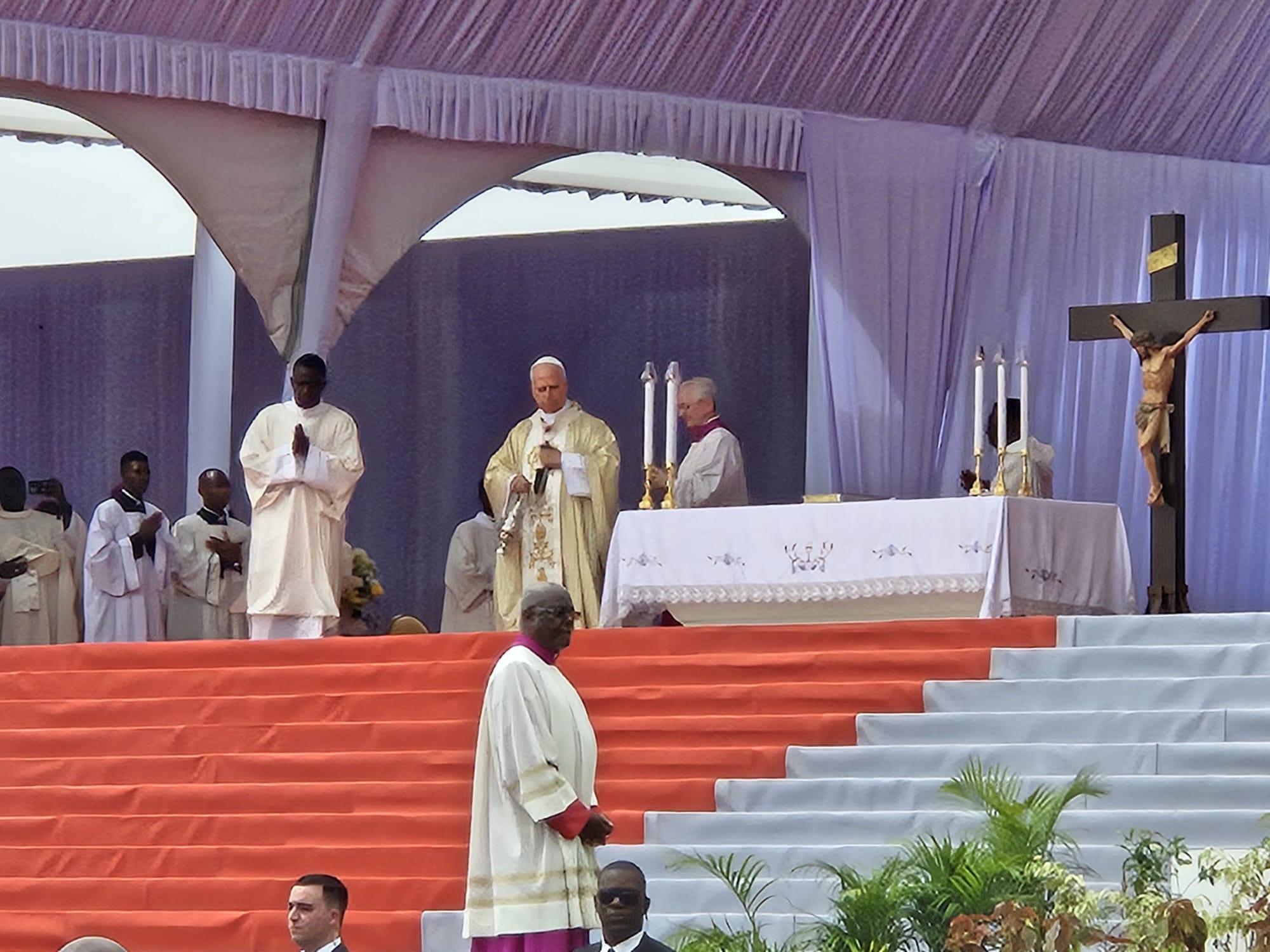
Kilamba, Angola – Pope Leo XIV celebrated his first Mass in Angola on Sunday in Kilamba, a fast-growing town about 20 miles from the capital Luanda, and told the faithful that Angola must “look to the future with hope” and “build hope for the future.”
According to the latest Angolan government census, inaugurated in 2011, Kilamba has grown to a city of approximately 130,000 inhabitants. Built with financing involving a Chinese public investment company, the city’s layout and architecture more closely resemble the urban planning of Chinese population centers than a typical African city.
Yet the atmosphere of the papal Mass was decidedly African.
About 100,000 devotees packed the vast grounds where the eucharistic celebration took place. Many people wore traditional Angolan dress. The Scouts were present in large numbers, as well as members of the army, doctors, nurses, priests and missionaries – lay and religious – who have worked in Angola for years and did not want to miss the opportunity.
“This trip is an occasion of celebration and hope for us and for this beautiful land that is Angola,” a Polish missionary from the Franciscan Missionaries of Mary told EWTN News.
At approximately 10:15 a.m. local time, Pope Leo began the mass. The entrance procession was accompanied by hymns filled with both faith and enthusiasm, typical of the African crowds who have welcomed the Pope during this visit.
“I celebrate the Eucharist here among you with a grateful heart. Thank you to God for this gift, and thank you for your warm welcome!” the Pope said at the beginning of his sermon.
Reflecting on the Gospel account of the disciples on the road to Emmaus, Leo said he saw in that scene “a reflection of the history of Angola, of this beautiful but wounded country, which is hungry and thirsty for hope, peace and brotherhood.”
He added: “Indeed, the conversation between the two disciples on the way, who were expressing grief over what had happened to their master, is reminiscent of the pain that has marked your country: a long civil war resulting in hostility and division, wasted resources and poverty.”
He said, “When one remains immersed in a history full of pain for too long, one can risk losing hope and becoming paralyzed by despair, just like the two disciples.”
The Pope then pointed to what he called the central Christian response to such suffering: “Dear friends, the Good News of the Lord, even for us today, is exactly this: He is alive, He is risen, and He walks with us as we travel the path of suffering and bitterness, opening our eyes so that we can recognize His work and granting us the grace to start anew and rebuild the future.”
Recalling how Jesus supported two disciples in their despair, Leo said the same path now lies before Angola.
He said, “Here too, for us, dear Angolan brothers and sisters, for you, the path has been set out to begin anew. On the one hand, there is the certainty that the Lord accompanies us and has mercy on us, and on the other, there is the commitment that He wants from us.”
The Pope emphasized prayer, Scripture, and especially the Eucharist, where believers encounter God and renew hope. He also warned against distortions of faith.
“For this reason, we must always be cautious about those forms of traditional religiosity that certainly relate to the roots of your culture, but also run the risk of confusing and mixing magical and superstitious elements that do not aid your spiritual journey,” he said.
“Be faithful to what the Church teaches, trust your priests and keep your eyes focused on Jesus, who reveals himself in the Word and the Eucharist,” he said.
Leo then turned to the Church’s mission in Angola, saying that the country’s continuing difficulties required “the presence of a Church that knows how to walk with you and hear the cry of your children.”
He said, “A Church that, with the light of the Word and the nourishment of the Eucharist, knows how to rekindle lost hope.” “A church is made up of people like you who give of themselves just as Jesus gave of himself when he broke bread for the two disciples on the road to Emmaus.”
The Pope said, “Angola needs bishops, priests, missionaries, religious men and women, and people who are willing to ‘break’ their lives and give it to others, to commit themselves to mutual love and forgiveness, to create spaces of fraternity and peace, and to perform acts of compassion and solidarity towards those most in need.”
In the final part of the sermon, Leo appealed for national renewal, saying that “Together it is possible to build a country where old divisions are overcome forever, where hatred and violence disappear, and where the scourge of corruption is healed by a new culture of justice and sharing.”
“Only in this way will a promising future be possible, especially for the many young people who have lost hope,” he said.
He concluded with a direct appeal: “Brothers and sisters, today we need to look to the future with hope and build hope for the future. Don’t be afraid to do so!”
The Pope assured those present of his closeness and prayers and entrusted the people of Angola to the protection of the Virgin Mary under the title of Our Lady of Maxima.
this story was first published By ACI Stampa, EWTN News’ Italian language partner service. It has been translated and adapted by EWTN News English.
