

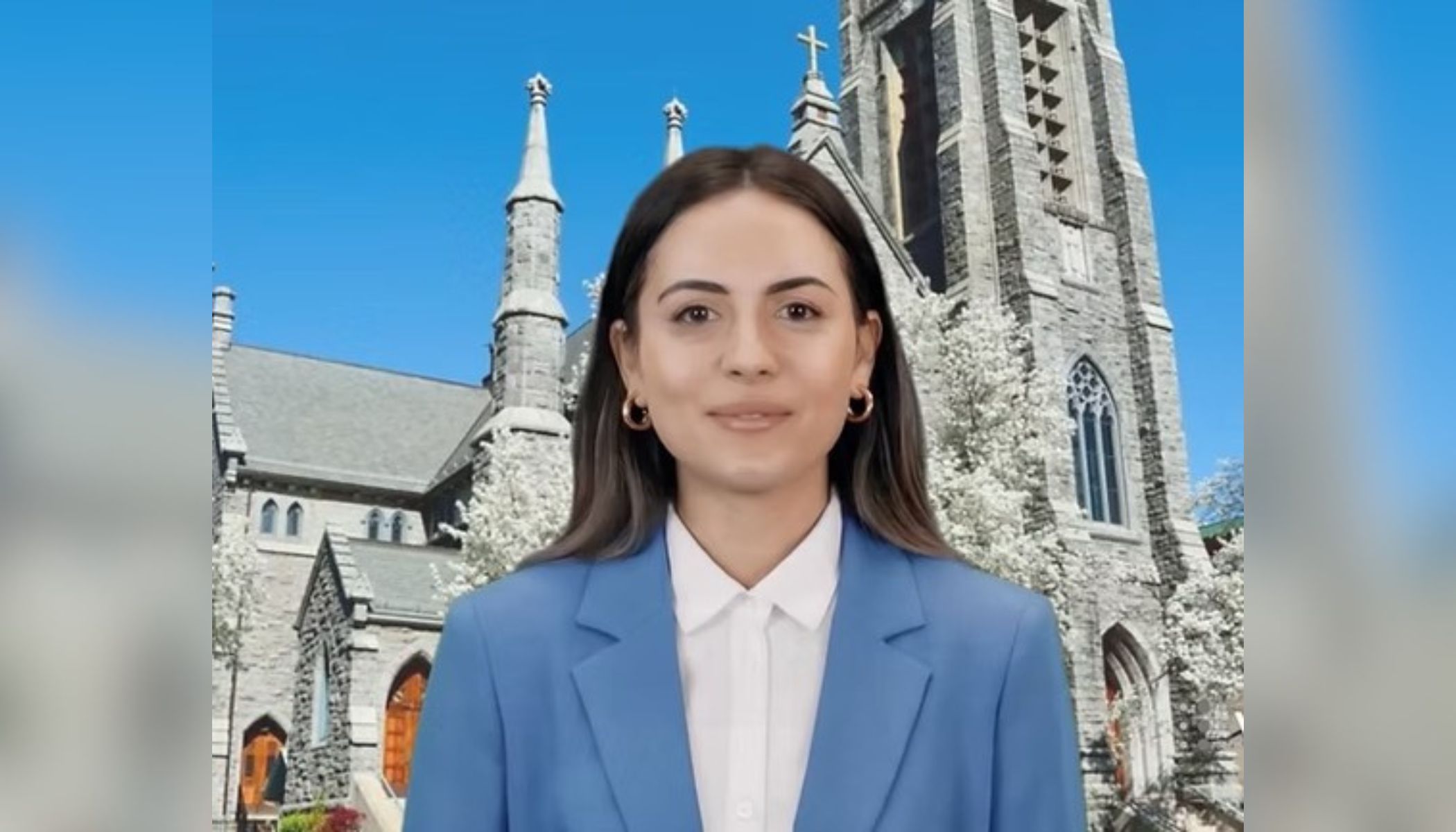
The Diocese of Bridgeport, Connecticut, will supplement its fundraising activities with an AI tool, partly aimed at soliciting donations from local Catholics, using what the diocese is billing as “the world’s first virtual engagement officer.”
Diocese Rollout of “Maria” announced This month. It describes the tool as “a means to thoughtfully explore how new technologies can support more attentive listening, more coherent communication, and more personal engagement with the people we serve.”
On the program’s website Bishop Frank Caggiano says the digital tools will “help us understand how technology can support deeper connections and accompaniment.”
He said, “Maria will help us learn how digital tools can deepen our listening abilities and foster more personal responses, while always keeping human relationships at the center of the Church’s mission.”
Ethical safeguards, ‘huge possibilities’
But 15 April edition On his weekly podcast “Let Me Be Frank”, Caggiano jokingly described himself as “technically a Neanderthal”, but expressed excitement that the tool could be used “not just to raise money but to promote publicity”.
Speaking on the podcast with Diocesan Chancellor Deacon Patrick Tooley, who spent years as an executive with technology giant IBM, Caggiano asked whether an AI agent could “ever get to the point where it can resist human control.”
Toole acknowledged that such a scenario was “possible”, though he added that AI companies take “huge safeguards” to ensure that AI personalities are properly trained.
The deacon said the diocesan chancery is discussing “how to use artificial intelligence for the good of the mission” and that diocesan fundraising “seems like a good opportunity to try it in an area where we don’t have the resources.”
“My primary motivation was that we’re doing a lot of exciting things and it’s hard to get the message across,” he said.
Emily Groccia, vice president of Givzy, the tech company that helped design Maria, said on the podcast that the program launched in late March for 1,000 donors.
He said part of the tool’s programming will be to “graduate” donors into actual human activists in certain circumstances, such as when someone wants to significantly upgrade a donation, or if they raise intimate personal questions that are better addressed by a fellow human being.
“We’re very cautious about allowing ourselves to engage in (AI) conversation lines that are outside of those traditional fundraising conversations,” he said.
Bishop said AI fundraising represents “huge potential” for the nearly 200 dioceses in the United States. But he stressed the need for “guidelines” to ensure that AI agents do not replace humans.
He said, “Off the top of my head, if someone disclosed a death, I wouldn’t want the assistant to respond at all.” “I want a human person to respond… because again, as a church, we are a unique reality.”
Diocesan spokeswoman Mary Oates shared several examples of Maria’s interactions with local Catholics with EWTN News. In one, a parishioner expresses interest in volunteering with immigrants, for which Maria was able to provide information about local Catholic charitable immigration services.
In another, a mother asks Maria for opportunities to attend diocesan events with “other mothers like me.” Maria offers to connect mom’s parish programs with mom’s groups and family ministries.
Maria, the virtual AI assistant from the Diocese of Bridgeport, offers to help connect a local Catholic mother with family ministries. | Credit: Courtesy of the Diocese of Bridgeport
Oates said both conversations “highlight our goal for the program,” adding that it is “focused on using AI (not) as a way to replace human relationships, but as a tool to help us connect more personally.”
“(We want to use AI) to bridge the gap in our ability to communicate directly with everyone as a church, with the goal of fostering more personal and human connection and interaction, so that we can better connect with each other as human beings,” she said.
Meanwhile, on the bishops’ podcast, Toole said Catholics “have the opportunity to produce great fruit” with AI technology as long as we align it and make sure we stay true to it with Christ at the center.
Caggiano described AI innovation as representing “an epochal change in human life”, equivalent to the development of the printing press.
He said, “There is no one alive on Earth – even these great architects of (AI) – who knows exactly where it will all go.” “We need to answer the question where should it go?”
