

From salt and lightThis week’s featured book (eBook free for all).
This essay was first published das new work In April 1921. It was written in the context of widespread political unrest throughout Germany.
Again and again in the life of the nation, In conflicts between nations, and between social classes, we experience violent eruptions of accumulated tensions and conflicts. These outbursts expose the existing state of mutual exploitation and oppression, and not least, the barbaric tendencies of anarchic, greedy passions. Volcanic outbursts of extreme bloodlust, followed by merciless reprisals, have intensified in some areas and spread to such an extent that it is necessary to say clear words here.
Others may see their job as maintaining law and order through lethal means; Others may believe that they are called to fight, if necessary, with bloody fists, for the proletariat, for a future of justice and peace; Others may consider their caste a sacred shrine and declare war on the other. Our lives are full of content that has deep roots. We have been entrusted with a task in life that looks ahead. The mystery of life has been revealed to us. It has come upon us, because Christ is everything to us. We feel united with the entire Church of Jesus Christ, in which no group or individual can live in isolation from the rest. Both the one and the other are members of the same living being whose spirit, head, and heart is Christ who is to come (1 Corinthians 12:12-13; Ephesians 5:23). This is why the testimony of our lives is nothing more than the essence of His life (Gal. 2:20). He reveals the mystery of life to us when He points to the birds in the air and the flowers of the field (Matthew 6:26-29), when He expects good fruit only from a healthy tree (Matthew 6:17-18), and when He reveals to us the heart of a Father who sends His rain and sunshine on both good and evil (Matthew 5:45).
Life is growth and development. Life is a manifestation of love. Murder has no connection with life. It belongs to the world of death. Violence and coercion are not related to development but to suppressing it. The testimony entrusted to us is to live only for that which serves and creates life. It doesn’t matter whether our progress appears evolutionary or revolutionary. It is both at the same time – a matter of growth and upheaval – because that which is living always wants to abandon that which is dying. To live means to give and provide whatever awakens life. Yet neither evolution nor revolution can completely eradicate the deepest roots of world suffering: universal crime, and the deadly poison of evil, hatred, insatiable lust, depravity, and murder.
The new birth that Jesus spoke of is brought about by biological life. It arises from the same God who is at work in all living things. Yet to bring about a new beginning, it must also bring down and destroy the old. It is a painful liberation, it is a new birth. But each individual and mankind collectively needs it.
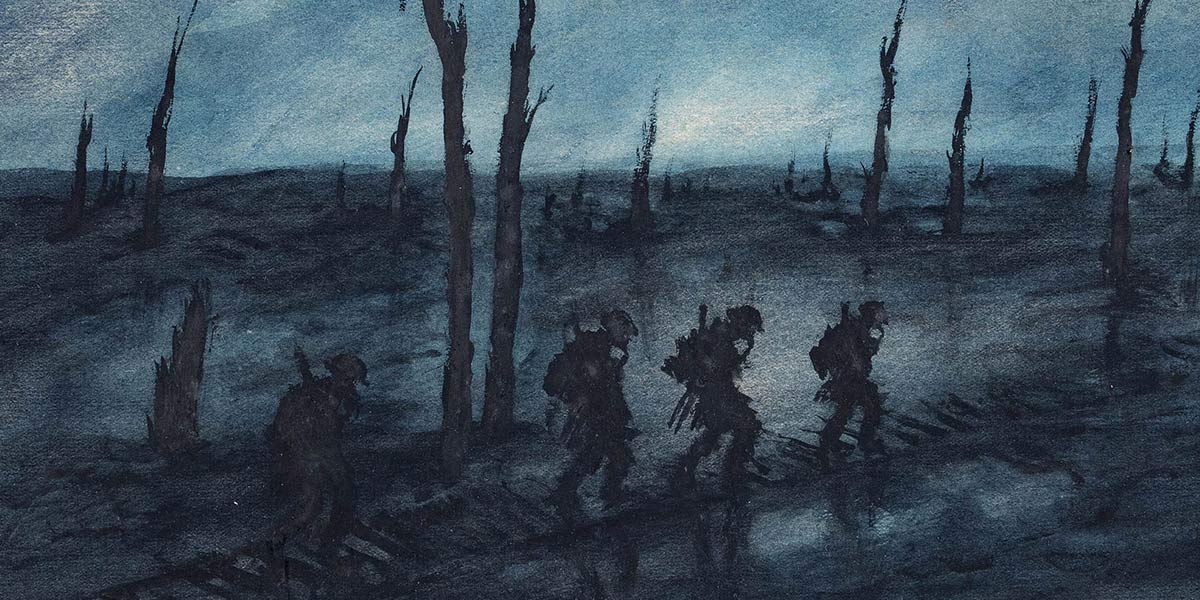
FJ Mears, World War I battlefield at nightInk and watercolour, c. 1913. Wikimedia Commons.
We believe in the new birth of life filled with the light of God. We believe in the future of love and the creative fellowship of human beings. We believe in the peace of the Kingdom that God will bring and establish on this earth. This belief is not a matter of playing with future things that exist only in our imaginations. No, the same God who will bring about this future gives us His heart and His Spirit today. His name is ‘I am who I am’ (Exodus 3:14). His nature is the same now as it will be revealed in the future (Heb. 13:8).
God revealed his heart in Jesus. He gave us His Spirit by giving us the presence of Christ among us. In his Church, the embodiment of the life of Christ, he lives the life of Jesus again and again. This Church is the hidden living seed of the future Kingdom. But the specific spirit of this kingdom – peace and love – is still entrusted to the Church. Therefore, it practices justice and righteousness and nurtures happiness in this world and in the present age.
And so we speak out in the context of this testimony of life against bloodshed and violence, no matter where these forces of death come from. Our witness and our desire for peace, for love at any cost, even at the cost of our lives, have never been more necessary than today. There are those who chide us for speaking about nonviolence, conscientious objection, nonresistance, and following the power of Jesus’ luminous love, which stops all violence and makes it impossible for us to cause any kind of hurt to others. They say these questions are not as important as we make them out to be. But they are mistaken – they are completely mistaken, in fact, if they think that these topics are not highly relevant today. On the contrary, these issues are more urgent today than ever, and it will eventually become clear to everyone that maintaining an attitude of loyal, unconditional love requires immense bravery. It requires manly courage and a readiness to die.
Jesus knew that He would never be able to conquer the soul of the earth by greater violence, but only by greater love. This is why He resisted and overcame the temptation to gain power over the kingdoms of this world (Matthew 4:8-10). He proclaims the reign of God, which is at once present and future. And God’s will was present in his life – in his actions, his words, and his suffering. That is why, in the Sermon on the Mount, He talks about those who are strong in love, about peacemakers, about people of heart who will inherit the land and take possession of the earth, about a people for whom is the Kingdom of God (Matthew 5:3-11). They made ancient proclamations of peace and justice that relate to the future kingdom of God. He intensified the important commandment, “Thou shall not kill”, which forbids the taking of life in every case, because it is the original sacrilege against life; He showed that any cruel treatment, any cruel violation of a person’s inner life, falls under the same prohibition, and anything that injures body and soul is as wrong as actually murdering someone (Matthew 5:3-11).
Therefore, it is a matter of great regret that so many serious-minded Christians today do not share this simple and clear testimony of Jesus and early Christianity that was so strongly represented and promoted by living, Bible-based churches and movements in other centuries. He took a firm stance and declared that participation in war and any military profession was incompatible with the call of Christianity. For example, of course, this does not rule out the need for police forces. Their service is more ethical than the competition between two business entities in which only one is able to survive. But what we are concerned with here is a completely different question – the nature of the mission and testimony of Christ, the question of the Church and the work she has been appointed to do.

FJ Mears, Menin RoadWater color and ink on paper, c. 1929. Wikimedia Commons.
We do not deny the existence of great evil and sin, and we do not deny that one day the world will end. But we do not believe in the ultimate power of evil; We believe that the realm of God is the ultimate reality, and we believe in the rebirth of the earth and mankind. This belief is not evolution, but a belief in an inevitable ascent toward greater, more visible perfection. On the contrary, we believe in the development of the divine seed in the conscience, in the Spirit of Christ which leads to the rebirth of the individual, and in the fellowship of the Church. But we also believe in the necessity of upheaval, the inevitability of world catastrophe and world judgment in war, revolution and all the other horrors of the end times, because we believe in the fall of the corrupt and fallen world of compulsion and duress.
This faith expects everything from God alone. However, it is certain that God’s seed and God’s light are also at work in people – that He reveals His heart and His future kingdom in the Church of Christ. Yes, it is true that tension also exists between the forces of Christ and the forces of Antichrist. It can be found everywhere, even among the Christian churches. And this tension will be stronger the more we believe in perfect love and a future. But faith is not afraid of confrontation between spiritual forces; Rather, he expects and even desires this struggle, because he knows that the end must come, and after that an entirely new world.
It is wrong to think that Jesus only wanted to feed hungry souls. Jesus was as concerned with himself as he was with the human body. He proclaimed the same message of a future world order of peace and justice that we find in John the Baptist and the Old Testament prophets, just as he definitely and firmly proclaimed the reincarnation of the individual.
Because we know that there are many people today who no longer respond to the language of the Bible, or are not yet able to do so, we must find new ways to share this message as often as it is given to us. That’s why we end this confession of our faith with Hermann Hesse’s thought on the word of life, “Thou shall not kill”:
We are not human yet; We are still on the path of humanity. Every disciple of Lao Tzu, every disciple of Jesus, every follower of Francis of Assisi, was far, far ahead of the rules and logic of present civilization. Yet the sentence “Thou shall not kill” has been sincerely respected and followed by thousands of people for thousands of years. There has always been a minority of well-intentioned people who believed in the future, who followed laws that are not listed in any earthly law book. As soldiers they showed kindness and respect to their enemies, or steadfastly refused to kill and hate when ordered to do so, enduring imprisonment and torture for it.
To appreciate these people and what they did, and to overcome our doubts about animals becoming humans one day, we must live in faith. We should consider ideas as valuable as bullets or coins. The “practical” person is always wrong. The future, the idea, the belief is always right, because the power that feeds the world comes from this engine and no other.
And we who believe in the future will raise again and again the ancient demand: “Thou shall not kill.” This is the basic demand of all progress, of becoming human.
We kill at every step, not just in wars, riots and executions. We commit murder when we close our eyes to poverty, suffering and shame. To the consistent socialist all property is theft. In the same way, all disrespect for life, all harshness, all indifference, all contempt is nothing but murder in the eyes of a consistent believer like us. And it is possible to kill not only what exists in the present, but also what belongs to the future. With just a little bit of witty doubt, anyone can ruin a huge part of a young person’s future. Life is waiting everywhere, the future is blooming everywhere, but we see only a small part of it and step on most of it. We kill at every step.
That is why, above all, each of us has an individual task to do. The task is not to help humanity as a whole move forward a little; It is not meant to work for the improvement of any institution, nor to end any particular type of murder. All this is good and necessary. But the most important task for me and you, my fellow human beings, is this: in our personal lives, to take a step forward from animal to human.
