


Comets can be awe-inspiring, and the existence of short-period comets presents a problem for those who believe the Earth evolved billions of years ago. What is that problem, and have evolutionists come up with any satisfactory explanation that means creationists should no longer use that argument?
source of comet’s glow
The source of comets’ brightness are their nuclei, which are only a few miles across. The nucleus of a comet consists of small dust particles held together by ice. Most ice is water, but there are other ices that are usually composed of gases, such as carbon dioxide and methane.
The orbits of comets are highly elliptical, meaning the orbits are like long, stretched circles. One end of a comet’s orbit brings it closest to the Sun, a point we call perihelion. Comets move fastest at perihelion, so comets spend most of their time away from the Sun, so their ices remain frozen most of the time.
But when a comet passes near perihelion for a short period of time, the Sun heats the ice, causing it to turn into gas and the gas rapidly expands from the nucleus, carrying dust particles with it and forming the coma, which is the brightest part of the comet. Sunlight and the solar wind push dust particles and gases away from the Sun, creating a long tail. The gas around the nucleus and tail becomes extremely bright as it approaches perihelion, which is when a comet can perform quite well for a short period of time. But after perihelion, the comet rapidly fades as it moves away from the Sun and is soon no longer visible. After an orbital period, the comet will return and once again shine for a short period.
Comet Tsuchinshan-Atlas
Retrieved October 2024, courtesy of Dr. Danny Faulkner.
two types of comets
Astronomers recognize two types of comets, long period comets and short period comets.
Long-period comets typically have orbital periods of more than 200 years, while short-period comets have orbital periods of less than 200 years. This is not an arbitrary distinction because the orbits of the two groups of comets are very different. The orbits of the planets lie approximately in the same plane, with the planets’ orbital planes being inclined or tilted toward each other by only a few degrees. Astronomers use the ecliptic, Earth’s orbital plane, as a reference plane. The orbits of short-period comets are usually inclined by less than 30 degrees to the ecliptic. Long-period comets, on the other hand, have much higher inclinations, up to 90 degrees.
Another difference between long-period comets and short-period comets is that short-period comets move in their orbits in the same direction as the planets orbit the Sun – counterclockwise when viewed from above Earth’s north pole. But long-period comets are evenly split between orbiting in the same direction as the planets (prograde) and orbiting in the opposite direction to the planets (retrograde). There are some comets that challenge this classification. A notable example is Halley’s Comet, which has a period of only 76 years but has a retrograde orbit.
evolutionists have a problem
If no new short-lived comets are created, then within 20,000 years, there should be no more short-lived comets.
Because comet nuclei are so small, the ice available for comets’ bright displays when near perihelion is limited. So how many times can a comet reach perihelion and still be seen? Estimates vary, but it would be optimistic to think that a comet could survive even 100 revolutions around the Sun. Taking the most optimistic estimate and multiplying by the maximum orbital period for short-period comets, 200 years, we arrive at a figure of 20,000 years. That is, if no new short-period comets are formed, then within 20,000 years, there should be no more short-period comets.
Young-Earth creationists believe that the Solar System is only a little more than 6,000 years old, so the existence of short-period comets within a recently formed framework is not a problem. But this is a serious problem for those who believe that the solar system is billions of years old. And even long-period comets cannot exist for billions of years, so they present a problem even for those who believe that the Solar System has existed for billions of years.
Evolutionists’ explanatory efforts
Of course, committed astronomers have long known about this problem, spanning billions of years. In 1950, Dutch astronomer Jan Oort suggested that comets orbiting far away from the Sun have an almost circular distribution of nuclei. The Oort Cloud, as it has come to be called, is thought to be material left over from the natural formation of the Solar System. Being so far from the Sun, comet nuclei would be very cold and would therefore contain ice. However, a passing star can strip away the orbital energy of these comet nuclei, causing them to fall into the inner Solar System, causing them to become long-period comets.
This might explain the existence of long-period comets, but what about short-period comets? For years, it was thought that the gravitational forces of the planets (mostly Jupiter) on long-period comets as they passed through and on their way to perihelion would shorten the orbits of some comets, turning them into short-period comets. But in the 1980s, computer simulations showed that this mechanism was too inefficient to work – comets would lose all the ice needed to brighten them long before they became short-period comets.
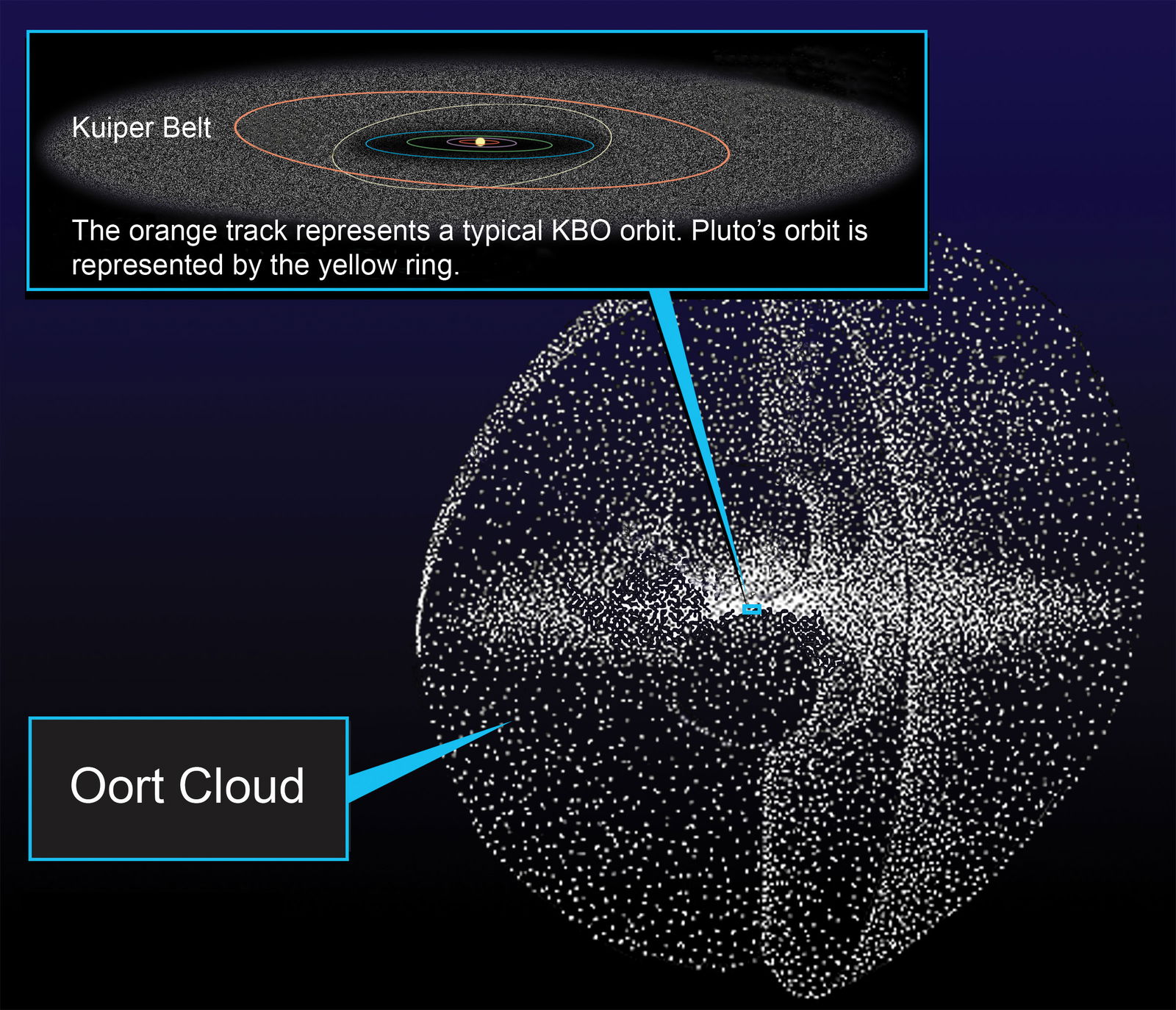
Proposed Oort Cloud and Kuiper Belt
through NASA
In 1951, astronomer Gerard Kuiper proposed that at the beginning of the Solar System, there was a belt of icy asteroids beyond the orbit of Neptune. This would be the material left over from the formation of the solar system. Kuiper thought that his Kuiper Belt no longer existed, because the gravitational pull of the outer planets would have driven them into higher orbits, creating the Oort cloud. Once astronomers realized they needed a source for even shorter-period comets, they began to think that the Kuiper Belt might still exist.
In the 1990s, technology had advanced to such an extent that searching for small icy bodies (comet nuclei) beyond the orbit of Neptune could reveal some of the larger members of the Kuiper Belt. Indeed, in the 1990s, the first trans-Neptunian objects (TNOs) began to be discovered. Some TNOs are quite large. Eris, discovered in 2005, is almost the same size as Pluto. Speaking of Pluto, astronomers now understand that Pluto, discovered in 1930, was the first (and largest to date) TNO known. TNOs form a second asteroid belt beyond Neptune’s orbit. Asteroids in the classic asteroid belt between the orbits of Mars and Jupiter are rocky, but TNOs are probably more icy than rocky.
Sometimes TNOs are called KBOs (Kuiper Belt Objects). What’s the difference? The term TNO is more descriptive without any suggestion about origin or age, while KBO is a more loaded term, implying a bias towards billions of years and natural origins. It is interesting that over the past 30 years, in the technical astronomy literature, I have seen a shift away from using the term KBO in favor of the term TNO.
Should creationists abandon the short-period comet argument?
So are TNOs the source of short-period comets, with the result that the existence of short-period comets is no longer a good argument for recent creationists? not necessarily.
There is a difference in composition between the two types of comets. Evolutionary astronomers explain this by separate evolution over time – although both groups of comets ultimately came from the same source. TNOs, being closer to the Sun, may undergo changes that Oort cloud objects did not.
More problematic is the fact that many TNOs are quite large. For example, Pluto and Eris are more than 1,400 miles wide. This is 100 times larger than what are usually considered large comet nuclei. It is almost unimaginable how bright a comet with a nucleus the size of Pluto or Eris would be. In all of history, no comet of this magnitude has ever been observed. If TNOs are the source of short-period comets (and ultimately all comets), why has mankind never seen the monster comets that must exist?
conclusion
Like many other things, the Kuiper Belt depends on man’s changing views.
Astronomers believe they have found the Kuiper Belt, the source of short-period comets (and under their evolutionary theories, eventually all comets), but problems remain. But like many other things, the Kuiper Belt depends on man’s changing ideas (keep in mind that for many years, astronomers didn’t think the Kuiper Belt existed anymore). In Answers to Genesis, we are committed to the reliability of Scripture, and the Bible clearly teaches that God created all things in heaven and earth just thousands of years ago in six ordinary days (Exodus 20:11). We believe that not only heaven declares Godthe glory of (Psalm 19:1), but they also reveal the glory of Construction and that Construction It didn’t take billions of years.
