

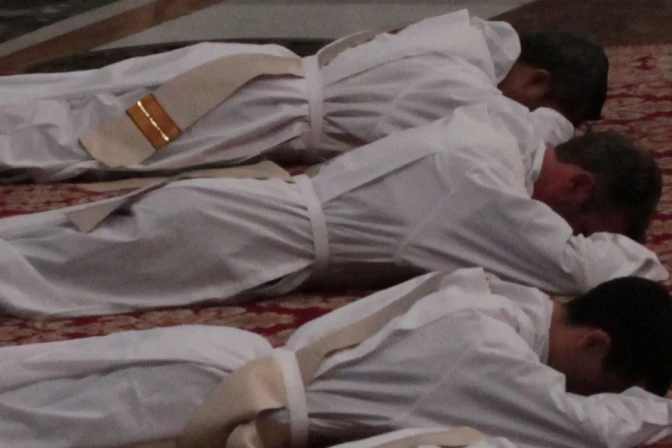
Nicaraguan President Daniel Ortega and his wife and co-president, Rosario Murillo, have banned the ordination of priests and deacons in four dioceses in Nicaragua whose bishops are in exile.
The measure exacerbates a pastoral crisis already marked by years of religious persecution, although the occupation continues.
The four dioceses without bishops present in the country are Jinotega, Siuna, Matagalpa and Estelí. Bishop Carlos Herrera of Jinotega, president of the bishops’ conference, was expelled in November 2024 after criticizing a mayor associated with the regime who interfered with the celebration by playing loud music outside Mass.
A few months earlier, in July of the same year, Herrera had ordained one priest and seven deacons in the neighboring diocese of Matagalpa, whose bishop, Rolando Álvarez, was exiled to Rome by the regime in January 2024 after spending 18 months in detention.
In the words of Martha Patricia Molina, author of the report “Nicaragua: A Persecuted Church”, this ordinance represents a “liturgical oasis” for the Church. “This happened six months after Álvarez, who is also Apostolic Administrator of Estel, and Bishop Isidoro Mora of Siuna were exiled by the dictatorship.”
Dictatorship’s ‘hatred’ of Alvarez prevents coordination
ACI Prensa, EWTN News’ Spanish-language affiliate, spoke to three exiled Nicaraguan priests, who requested anonymity out of fear of retribution from the regime.
One of the priests said, “The government itself is influencing the ordinances. And besides the ordinances, there are a lot of other things like a little more surveillance of priests.”
He reported that “the police are the ones enforcing all this” and attributed the ban in Matagalpa to “the dictatorship’s hatred of Bishop Rolando.”
The same priest alleged that the regime wants to “replace the bishops” and that some priests “fight not with the idea of saving their diocese, to avoid making their lives more difficult, but in the end they are submitting their mandate to whatever the government says.”
Matagalpa is probably the hardest-hit diocese, with at least 32 priests outside the country, the priest said.
‘More extreme vigil’ where there is no bishop
“Especially in dioceses without bishops, the surveillance is even more extreme, preventing a bishop from another diocese from coming to a religious event,” said a second priest contacted by ACI Prensa.
According to this priest, there are currently about seven candidates for the priesthood in Siuna who completed their studies in 2025, as well as another group that finished in 2024, and both groups are still waiting to be ordained. Despite this situation, the incident “had no impact on new admissions” to the seminary.
Why can some dioceses perform ordinations while others cannot?
The third priest explained that “Leon, Granada, Juigalpa and Bluefield are dioceses that have their own diocesan bishops and they take a very prudential approach, even though some media outlets have labeled one of the (bishops) as an ally of the regime. That is not true; they are more pragmatic about the well-being of their parishioners and their flock.”
He also explained that in order to complete an ordination, a letter of authorization from the bishop is required, which “can be easily obtained because it can be sent by email, and they can allow candidates to be ordained in other dioceses.”
However, the obstacle is political. “The problem is that the government interprets that permission, those letters, as an intrusion into its sovereignty and sees as a threat a bishop who is away but continues to rule his diocese,” he explained.
Problems caused by lack of ordinances
For Molina, the ban on ordinations is having an “alarming” effect, for example, “Matagalpa is currently operating with barely 30% of its active clergy. Seven out of 10 priests have been forced into exile or exile,” while “Estelí and Jinotega have experienced cuts of up to 50% in their pastoral capacity, leaving the entire community without the regular celebration of the Eucharist. Have been left without.”
“The human drama is concentrated in seminaries. Dozens of young people who have successfully completed their studies in philosophy, theology and pastoral training find themselves in legal and spiritual crisis. They have the qualifications and the vocation, but they cannot receive the sacrament (of Holy Orders),” the researcher told ACI Prensa.
“Without replacement for priests who have been exiled, expelled, or who have died, the Catholic Church in Nicaragua faces the real possibility of gradual closure,” he warned, adding that “the absence of priests means” for the faithful “the end of social support and the loss of (the grace of) the sacraments.”
ACI Prensa contacted the five dioceses where priestly and diaconal ordinations are allowed to learn why they are allowed there but not in the other four, but has not yet received a response.
The dioceses where ordination is permitted are the Archdiocese of Managua as well as the dioceses of León, Juigalpa, Granada and Bluefields. In December 2025, three deacons were assigned to Juigalpa, and in January this year, two were assigned to Bluefields.
In June 2025, eight deacons were ordained in Managua, and in November they were ordained priests. Six of them were assigned their pastoral missions in February, while in Lyon one deacon was ordained on 28 February.
ACI Prensa also contacted the dioceses where the ordinance is prohibited to inquire about the issue, but has not yet received any response.
Businesses continue to flourish
One point on which the three exiled priests agree is that business continues to flourish in Nicaragua and “God continues to prepare courageous young people who listen to him and enter into the process of vocational discernment.”
A third priest contacted by ACI Prensa emphasized that “even if the government wants to stop priestly ordinations, there are ways in which the Church, the bishops, have managed to do so without the notice of the government. This shows the resourcefulness of the Church in adverse circumstances, how it regenerates itself, how it continues to evangelise.”
Mosaico CSI reported in February that “two Nicaraguans were ordained priests in the Diocese of Limón, Costa Rica, in a ceremony held in secret” to avoid reprisals from the Nicaraguan regime.
The third priest stressed that “the obstacles are not a problem for the Church, but a cross which the Church bravely embraces, as our Lord has taught us, and which leads her on this path of resurrection.”
The Church has been ‘crucified, but not fixed’
This last priest offered a reflection on the dictatorial persecution of the Catholic Church, which has intensified since the 2018 anti-regime protests.
He stressed, “One day, those who ordered us not to celebrate these consecration sacraments will also find that glorious cross in the Church and will realize how much harm they are doing, but in the meantime, the Church has continued to function.”
“The Church in Nicaragua has been crucified, but it is not stable; that is to say, the cross continues to bear even more fruit because the Church is not complacent, it is not stable. It is moving forward,” he said.
this story was first published By ACI Prensa, the Spanish-language affiliate of EWTN News. It has been translated and adapted by EWTN News English.
