

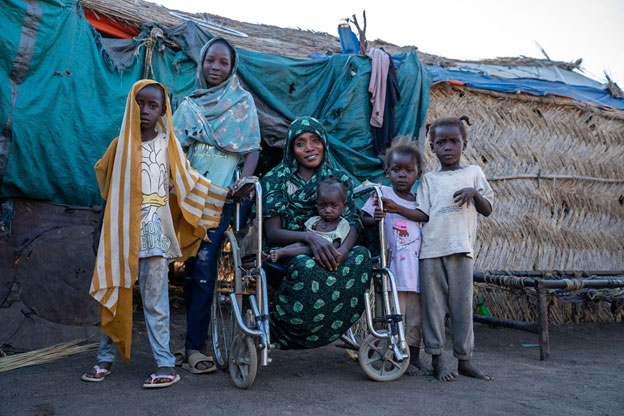
United Nations, March 20 (IPS) – The past two weeks have seen a violent escalation of the Sudanese civil war, with drone strikes and artillery shelling between the Rapid Support Forces (RSF) and the Sudanese Armed Forces (SAF) causing widespread destruction, casualties and displacement. With humanitarian responses severely lacking and the level of needs, including a hunger crisis, continuing to rise, experts warn that millions of people in Sudan could be affected by famine, violence or prolonged displacement.
Since March 4, the Office of the United Nations High Commissioner for Human Rights (OHCHR) More than 200 civilian deaths have been recorded as a result of drone strikes in the Kordofan region and White Nile state. In West Kordofan, SAF drone attacks have killed at least 152 civilians, targeting densely populated areas including hospitals and markets. The conflict has also spread into White Nile state, where attacks have targeted the state capital, Kosi, as well as electrical facilities – causing widespread blackouts – and a student dormitory.
UN High Commissioner for Human Rights Volker Turk said, “It is deeply disturbing that, despite numerous reminders, warnings and appeals, the parties to the conflict in Sudan are continuing to use increasingly powerful drones to deploy mass-effect explosive weapons in populated areas.” “It will soon be three years since Sudan began a senseless conflict that has devastated the lives and livelihoods of millions of people. Yet the violence fueled by these new technologies of warfare continues to spread. Now is the time to end it.”
South Darfur has also been significantly affected, with drone strikes on 12 and 13 March causing widespread damage in several areas. In West Darfur, an attack on a market in Akidong caused a major explosion that hit the Adre border crossing – a vital lifeline for humanitarian aid delivery and a vital route to prevent widespread starvation. On March 16, a deadly drone attack along the Sudan–Chad border in Chad’s Tine region killed 17 people and injured several others. Local witnesses told reporters that people attending the funeral and children playing nearby were also affected by the attack.
Farhan Haq, Deputy Spokesperson of the United Nations Secretary General Said The attack reflects a growing pattern of violence affecting border communities, raising concerns about broader regional instability between the neighboring countries. “The United Nations once again calls on all parties to adhere to their clearly stated obligations under international humanitarian law, including to protect civilians and civilian infrastructure and to ensure the prompt, safe, unhindered delivery of humanitarian assistance to whoever and where it is needed,” Haq said.
Following the attack, Chad strengthened its security forces along the Sudan–Chad border in preparation for defensive operations. On 19 March, Chad’s President Mahamat Idriss Déby confirmed in a statement shared on social media that Chad’s military had been ordered to “retaliate starting tonight against any attacks coming from Sudan”.
A Chadian government spokesman said, “Despite various stern warnings given to the various belligerents in the Sudan conflict and the closure of the border, the city of Tyne has again become the target of a drone attack.” “This latest attack of extreme seriousness has resulted in the death of 17 of our compatriots and the wounding of many others.”
As violence continues to escalate and spread across borders, its humanitarian consequences within Sudan are becoming increasingly clear. Statistics from the International Organization for Migration (IOM)IOM) shows that approximately 9 million people are currently internally displaced across Sudan, one of the largest displacement crises in the world. On 17 March, several people were killed in the Bara area, northeast of the city of El Obeid, the capital of North Kordofan, displacing more than 150 people from the village of Sherim Mima in Bara alone to Um Dam Hajj.
Displacement has decreased in recent days, with approximately 3.8 million civilians beginning to return home, particularly in Khartoum and the eastern regions. Despite this, returnees face many challenges, including the loss of their livelihoods, damage to infrastructure and lack of access to basic services. Approximately 55 percent of internally displaced civilians were children under the age of 18.
Additional reports from humanitarian agencies paint a grim picture of the conditions facing civilians. Doctors Without Borders, also known as Médecins Sans Frontieres (MSF), reports that civilians are at great risk of harm from explosive remains on the ground, with 23 people suffering serious injuries, including four women and seven children.
United Nations Children’s Fund (United Nations Children’s Fund)UNICEF) report that massive and concurrent outbreaks of cholera, measles, dengue, and hepatitis E overwhelmed national health systems, which were already weakened by the vast influx of injured individuals.
World Food Program (WFP)wfp) states that approximately 21.2 million people are currently food insecure across Sudan, with women and children disproportionately affected. Most female-headed households are severely food insecure. According to UNICEF, “catastrophic” malnutrition rates were recorded in Um Baru and Kornoi in North Darfur. Many areas are at risk of developing famine-like conditions and face severe shortages of food, clean water, health care and other basic services.
Despite immense access challenges, the UN and its partners are working on the front lines to restore access to basic services, and managing to install eight 2,000-litre water tanks in displacement shelters and schools. UNICEF has reached struggling communities with food assistance and immunization programmes, providing nutrition screenings to 787,000 children, malnutrition treatment to 25,100 children, and measles and rubella vaccines to more than 540,000 children.
However, these efforts are severely hampered by chronic underfunding, with the 2026 Humanitarian Response Plan for Sudan only 16 percent funded, reaching only $454 million of its $2.9 billion target, which would assist more than 20 million crisis-affected civilians across the country. An additional $1.6 billion is needed to reach refugees and host communities in neighboring countries.
IPS UN Bureau
© Inter Press Service (20260320174404) – All rights reserved. Original source: Inter Press Service
