

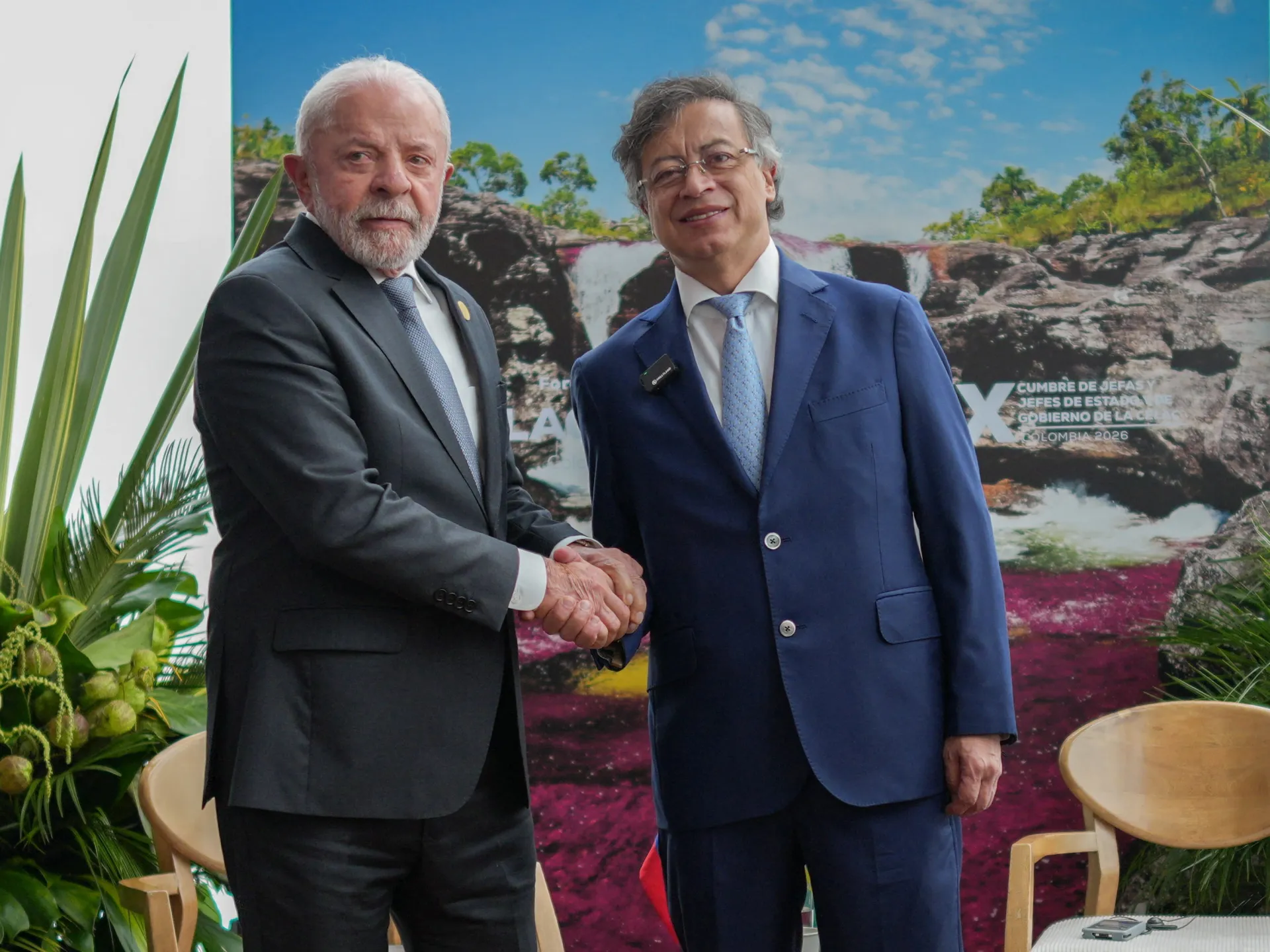
Brazilian President Luiz Inácio Lula da Silva has criticized a return to colonial approaches towards developing countries during a summit in Colombia.
But Lula did not mention United States President Donald Trump in his remarks, pointing to actions taken by the Trump administration, including the kidnapping of Venezuelan leader Nicolas Maduro on January 3 and the fuel blockade of Cuba.
Recommended Stories
list of 3 itemsend of list
“It is not possible for anyone to think that they are the masters of other countries,” Lula said, in an apparent reference to US policy.
“What are they doing to Cuba now? What did they do to Venezuela? Is it democratic?”
Lula made his remarks at Saturday’s summit for the Community of Latin American and Caribbean States (CELAC), which included a high-level forum with representatives from Africa.
He told delegates that their countries had already experienced plundering for gold, silver, diamonds and minerals.
“After taking everything we had, now they want to own the vital minerals and rare earths we have,” Lula said, without specifying who “they” might be. “They want to colonize us again.”
The leftist Brazilian president also criticized the US and Israel’s ongoing war against Iran.
He drew a parallel between that conflict that began on February 28 and the US-led Iraq War that began in 2003 under the pretext of eliminating “weapons of mass destruction”.
“Iran has been attacked under the pretext that Iran is building a nuclear bomb, resulting in the overthrow of Iraqi leader Saddam Hussein,” Lula said, before drawing attention to the US campaign in Iraq.
“Where are Saddam Hussein’s chemical weapons?” Lula asked. “Where are they? Who found them?”
History of intervention
The history of Washington’s intervention in Latin America dates back more than 200 years to when then-President James Monroe claimed the hemisphere as part of the US sphere of influence.
While large-scale, direct US involvement in the region mostly waned after the Cold War, Trump has rekindled the legacy.
Since taking power last year, Trump has launched boat strikes against alleged drug traffickers in the Caribbean, ordered a naval blockade of Venezuelan oil exports, and become involved in electoral politics in Honduras and Argentina.
Last year, Trump had imposed a 50 percent tariff on Brazilian goods, citing a lawsuit against the country’s former President Jair Bolsonaro. The US has also shown keen interest in Brazil’s rare earth reserves.
Then, on January 3, US forces kidnapped and imprisoned Venezuelan leader Nicolas Maduro, and took him to New York to face drug and weapons charges.
While such actions have thrilled right-wing leaders across the continent, they have stoked fear among left-wing politicians, who have expressed serious concerns over what they see as American bullying.
“We cannot allow anyone to interfere and violate the territorial integrity of each country,” Lula said on Saturday.
Disappointment with the United Nations
Lula, who has said he will run for a fourth consecutive term in Brazil’s upcoming October election, also criticized the United Nations for its inability to prevent numerous conflicts around the world.
“What we are seeing is a complete and total failure of the United Nations,” he said, pointing to the situations in Gaza, Ukraine and Iran.
He once again called for reform of the United Nations Security Council, which is responsible for ensuring international peace and security. But it has failed to prevent major conflicts because of the veto power of its five permanent members: China, France, Russia, the United Kingdom and the United States.
Efforts have been going on for decades to reform the Security Council. But they all have failed.
Colombian President Gustavo Petro, who has been designated a “priority target” by the US Drug Enforcement Administration, echoed the UN’s condemnation of Lula.
“The body is functioning impotently, and that’s not what it was created for. It was created after World War II to prevent wars. And yet, what we have today is war,” Petrou said at the summit.
But the world needs the United Nations to provide climate solutions and curb global warming, Petro said.
“The more serious the problems of humanity become, the fewer tools we have for collective action. And that path leads only to barbarism.”
Relatively few presidents and prime ministers from Latin America and the Caribbean attended the summit in Colombia, a sign of the continent’s deep divisions.
Attendees included the Presidents of Brazil, Uruguay, Burundi and Colombia, as well as the Prime Ministers, Deputy Ministers, Foreign Ministers and Ambassadors of Guyana and Saint Vincent and the Grenadines.
