

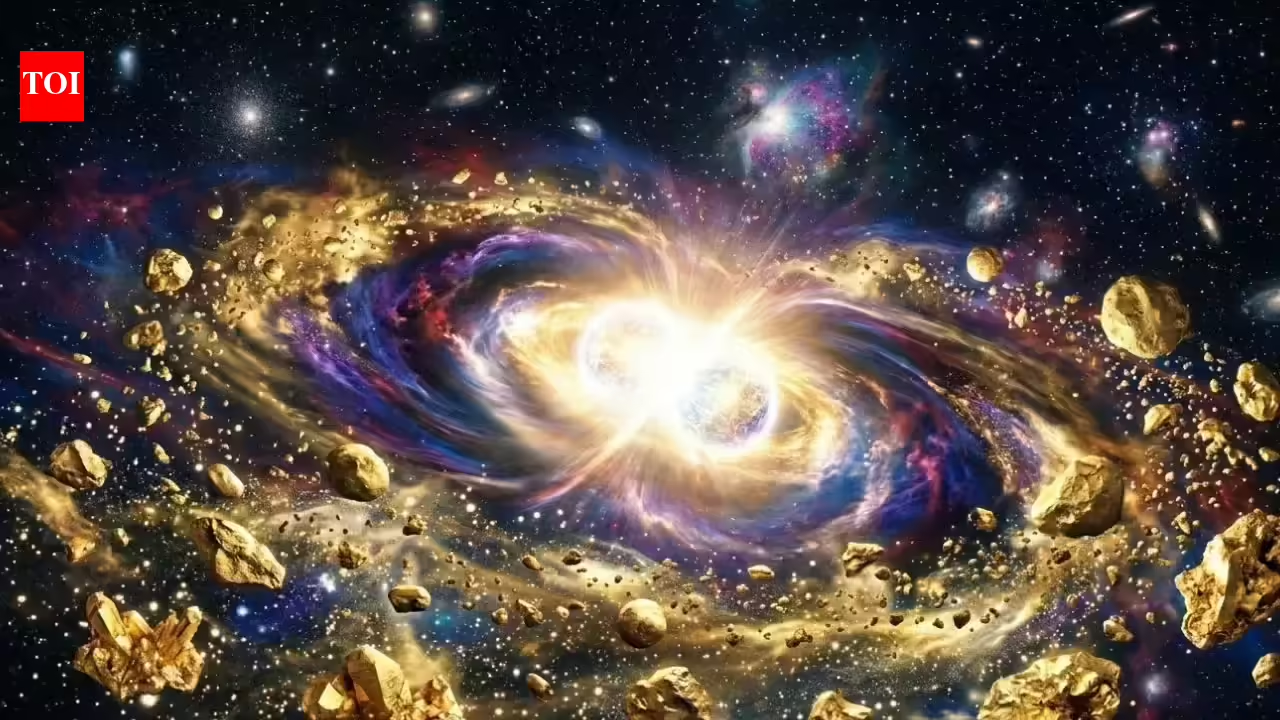
Gold was not born on our planet Earth; It was formed in a violent ‘cosmic forge’ far beyond our solar system. Research published in The Astrophysical Journal Letters Identifies a ‘missing link’ in the universe, proving that gold existed long before rare star collisions in the early universe, with the identification of magnetar giant flares as an important source of heavy element production in the universe. While it has been theorized that rare neutron star mergers were responsible for the formation of heavy elements, magnetar giant flares show that extremely powerful magnetic bursts and the subsequent ejection of neutron-rich material occurring on these ultra-dense remnants of massive stars serve to provide the energy needed to trigger the R-process (rapid neutron-capture) during high-energy ‘starquake’ events. The energy emitted is imparted to neutron-rich materials that form precious metals such as gold and platinum. Based on this study, it was determined that magnetars account for about 10 percent of all r-process elements in the Milky Way galaxy.
Magnetar: the reason behind space explosion who made the earth gold
Magnetars are thought to be one of the neutron stars and are the result of the collapse of a massive star’s core after it goes supernova. All neutron stars are extremely dense (for example, a teaspoon of neutron star matter weighs about a billion tons); However, the magnetar’s magnetic field is 1,000 times greater than that of regular neutron stars and trillions of times greater than that of Earth. Magnetars produce ‘starquakes’. Because of the huge magnetic field associated with the magnetar, there is enormous pressure exerted on different layers of each star. When the crust builds up enough stress, it ruptures, releasing a massive flash of magnetar energy; It will generate so much energy in just one moment that is equal to the total energy produced by our Sun in 100,000 years!
How magnetars create gold throughout the universe
Scientists have spent decades researching how gold can be found in very old stars if neutron star mergers are so rare. New research published The Astrophysical Journal Letters That missing link has finally been provided – magnetar giant flares, which are huge explosions generated by magnetars (an incredibly powerful type of neutron star) that occur when the neutron star’s incredible magnetic field generates a starquake and then suddenly releases enormous amounts of energy and large amounts of neutron-rich material into space.
physics of precious metals
Gold is not produced through normal fusion as are most other elements, but rather through the R-process (which is short for rapid neutron capture). During a magnetar giant flare, an intense stream of neutrons bombards iron nuclei at relativistic speeds. This ‘R-process’ (rapid neutron-capture) forces the atoms to become heavier and transform into gold (Au) and platinum (Pt) in a fraction of a second.While a single kilonova (neutron star merger) creates a huge ‘jackpot’ of gold – far more than a single magnetar flare, these events are incredibly rare. Calculating this, the authors of the Astrophysical Journal Letters estimate that magnetar giant flares occur frequently, acting like a steady ‘cosmic paycheck’ that accounts for 10 percent of the Milky Way’s heavy metal wealth.
Is the universe still making gold today?
Yes, indeed! Due to the frequency of magnetar activity and the constant collision of neutron stars, there are still plenty of deposits left in the ‘cosmic bank account’. magazine That said, as long as these highly dense remains of dead stars exist, the universe will continue to create and distribute heavy metals throughout the universe and create the materials needed to support the growth of new planetary systems.
