

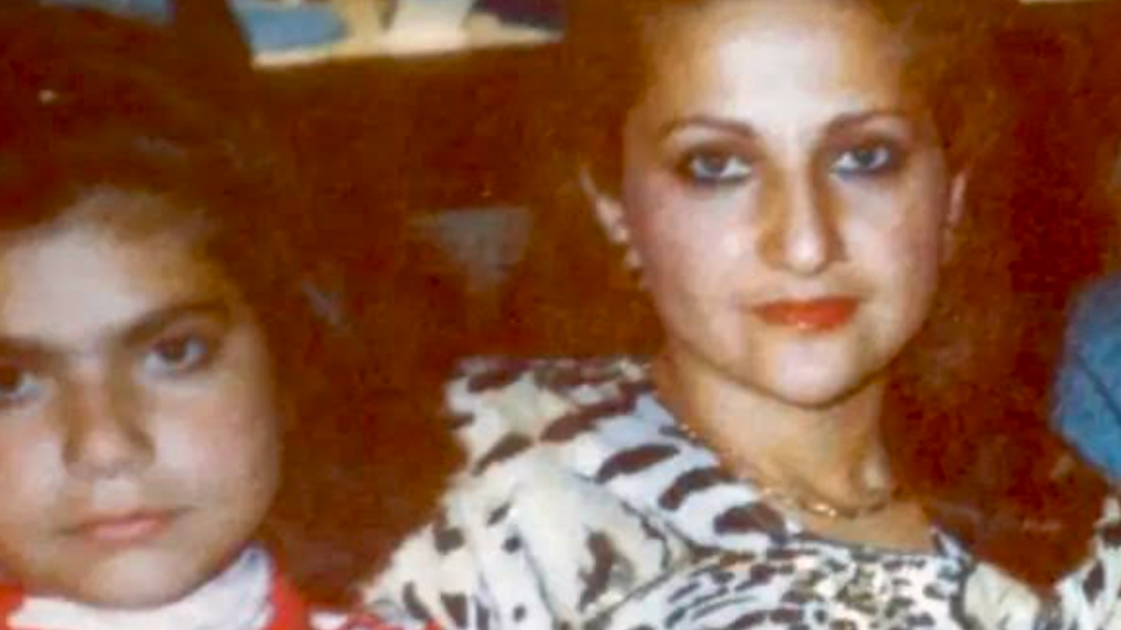
“Don’t worry, you can write about your mother when you grow up. She’s written a whole revenge book about me,” my mother told my teenage son, laughing so hard she had to wipe tears from the corners of her eyes.
Just before my son went to college, my kids and I were visiting him. He had shaved his head completely bald, and I was trying to gently tell him that I liked his normal haircut. He shrugged his shoulders and looked at me and said, Mom, please stop talking.
My mother watched this exchange from the couch, smiling.
“She used to do this to me all the time -” she told my son “- she would get so angry at me for the things I would say to her. And now she has written a whole book telling everyone how bad I was.”
It’s kind of become the family punchline, she calls it my “revenge book.” And I laugh too, but there’s a reason for it, because it’s not completely wrong.
Five years ago, after dreaming about it for decades, I began writing a book about growing up with a mother who wanted me to be skinny. As I wrote the book, I shared details of it with my family, including her description. Everyone knew that the book would echo my complex, and sometimes dark, relationship with my mother. Then two years ago, I got a book deal, and since then, there’s been excitement about it coming out today and the joke of it being my “revenge book.”
Even though the book is not technically a memoir, its emotional framework is my life. The embarrassment, the weight obsession, the impossibly high expectations – these are real. As the mother believed that thinness equaled beauty, and the daughter believed that she had to earn her love by achieving it.
When I was 13, my mother said to me, “Rebecca, I love you, but I don’t like you.” We were fighting for months. I ran to my room, took out my diary and wrote i hate my mother In all caps, followed by a page full of exclamation marks. This was the moment when something broke between us. I was not the daughter she wanted. And she wasn’t the mother I needed.
She grew up in a world and time that told her that a woman’s value was found in the shape of her body. To them, one of the worst things a woman could do was to be fat. Unfortunately, I was exactly the same way. She put me on diets, got me weighed, tried bribery, threats and tears. I interpreted all this as one message: You are too much. huge. You’re not cute like this.
I have never been thin. Instead, I settled into my average-American sized body and learned to love and accept myself exactly as I was. My happiness changed him. It did not erase the past, but gave it a new shape. She stopped seeing my body as a problem and started seeing me as a woman she admired. I became a lawyer, got married and had children. We found a way to talk about our past without criticism. We worked to heal our wounds and love each other in a way that felt wide and true. Two decades later, I started writing my novel.
Then something happened that seemed contrary to the spirit of revenge.
Courtesy of Rebecca Morrison
I noticed that my phone was vibrating. This was my mother. We FaceTime every day, sometimes she jokes for so long it’s as if we live together. I tell him about my work and my kids; She tells me what she and my dad are doing. But today was different.
The essay I wrote about the two of us was recently published “Today” show website. It went viral and was garnering thousands of comments on their social media pages. I couldn’t wait to tell her how our story was resonating — how women and men of all ages were saying it made them feel like they were being seen and helped them understand their mothers or their daughters.
I answered the FaceTime call and expected to see her 72-year-old face still wrinkle-free. Instead, the screen was filled with red swollen eyes and a trembling mouth.
“Don’t do that again,” she said, sobbing. “Don’t ever do that again. Don’t write about me.”
“What? Wait, what’s happening?”
“Margaret called me. Then Lila. She asked if I was okay. She said this piece made her feel very sad for me. As if I was some kind of monster. She asked how a daughter could write such terrible things about her mother.”
“But we’ve talked about writing about us for two years,” I said. “I read your essay. You agreed with it. I’ve written about it before – in The.” new York TimesThe Washington Post — “
“That title.” she cried. “That’s horrible. Why did you write that?”
The headline was, “As a girl, my mother taught me that being fat was the worst thing that could happen to a woman.” It remained at the top of the “Today” show homepage all day, along with articles about the Met Gala and Tina Fey. But it didn’t matter.
“I never said that,” she insisted. And this is true. He never had to say it. He showed it – in his despair, in his desperate attempts to change me, in the sadness that filled the room when I stepped on the scale. But this was not the time to repeat our past.
“I didn’t write the title,” I told him. “And if they actually read the whole piece, they would know that it’s not about you being a bad guy. It’s about you being human, about doing the best you knew at the time, about us getting back together. It’s a love story.”
“I…I’m not a monster,” she sobbed.
Her pain shocked me. I had already been writing the book for two years, not out of revenge, but to understand myself and to help women who were raised in the same system, women who were taught that their value depended on the size of their bodies. I thought my mother and I were on the other side of this. fixed bugs. Safe. Now here we were again, both shattered.
“Okay,” I said. “I won’t write about you.”
“Okay,” she whispered, wiping her face. “I don’t want to talk about it anymore.”
I was sitting in my closet-sized office, my heart pounding, wondering what I had done. The writing had become more than a task; This was my aim. My way of understanding what it means to be a woman in a world that never lets you be at peace with yourself.
Was I a monster sharing our worst parts and her darkest moments?
A few hours later, my phone rang again. it was her.
She said, “I don’t care what anyone says. Don’t worry about me. I’ll be fine. Go after your dreams.” “I love you. Keep writing.”
“Are you sure?” I asked stunned.
“I’m a hundred percent sure. When I read that piece again, I realized that what hurt me most wasn’t the story or the headline. When you wrote there that I didn’t love you unconditionally. That’s not true. I always loved you unconditionally.”
“You never told me this,” I whispered, the lump in my throat growing.
“Well, it’s true. You are my daughter. You are my life. My love for you was always unconditional.”
And there it was. The sentence I waited my whole life to hear.

Courtesy of Rebecca Morrison
This is real love – dirty, hard-earned love that keeps showing up even after loss. even if there is a loss the story is.
I told her what I really believe, that no matter how much the struggle has wounded us, no matter how much pain there is inside that child and that mother, who herself was, in many ways, a child when she gave birth to me, there is always the possibility of recovery. There is hope for reconciliation. For love.
If any of us had refused to move beyond our egos – if we had remained stubborn – we would not be here now, not able to joke about something that was so difficult, so serious and, somehow, so beautiful.
She still calls it my revenge book. And I agree with this. But we both know better.
I didn’t write this to get back at him.
I wrote it for us to understand. To locate the damage and see what is left. I wrote it because he let me. She gave me the opportunity to tell the truth, even when it hurt. This is a powerful kind of love.
So yes, maybe it started as a revenge book.
But it ended up being a love story.
Rebecca Morrison is the author of “The Blue Dress”, based on her childhood as an Iranian immigrant trying to fit in in her homeland and conform to her family’s expectations about beauty. you can find it here rebeccamorrison.com.
Do you have a compelling personal story you’d like to see published on HuffPost? Find out what we’re looking for here and send us a pitch at pitch@huffpost.com.
