

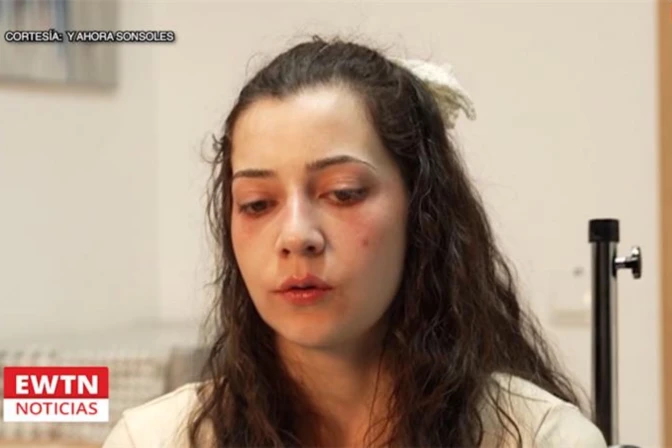
The administration of euthanasia for 25-year-old Noelia Castillo Ramos took place in Spain on March 26 – the event came after she had faced enormous life-threatening challenges since childhood and a nearly two-year legal battle by her parents to save her life.
According to Spanish law, to request euthanasia, a person must be of legal age and be mentally competent and fully conscious at the time of the request; They must also possess Spanish citizenship or maintain legal residence for more than 12 months and be suffering from “a serious and incurable disease or a serious, chronic and disabling condition, as certified by the attending physician.”
On March 24, it was reported that the European Court of Human Rights rejected interim measures requested by Castillo’s family to prevent his euthanasia, ending a nearly two-year legal battle.
The next day, a Interview with Castillo broadcast on the Spanish television network Antena 3 in which she described how she felt: “I have no desire to do anything – not go out, not eat, not do anything. … It is very difficult for me to sleep; in addition, I suffer from back pain as well as leg pain.”
She said, “I have always felt alone because I was never understood; no one sympathized with me and I always struggled with interpersonal relationships.”
“Even before I requested euthanasia, I saw my world as very bleak; I saw a very bleak end in front of me. I had no goals, no purpose – nothing – and I still have no goals, no purpose,” she admitted.
challenges of life
Castillo’s life has been full of many challenges. While under the guardianship of public services after her parents’ separation, she was subjected to multiple sexual assaults.
According to Abogados Cristianos (Christian Advocates) – the organization representing Castillo’s father in efforts to prevent his daughter’s euthanasia – at the time, the young woman was officially recognized as having a 67% disability due to mental illness.
In October 2022, she attempted suicide by throwing herself from a balcony, causing injuries that left her confined to a wheelchair; This increased his disability rating to 74% – a fact which, according to the Christian Lawyers Organization, “indicates that the underlying issue is psychiatric.”
“This is important: the Constitutional Court itself (ruling STC 94/2023) makes it clear that euthanasia cannot be administered when the source of suffering is a mental illness and that the State has an obligation to protect these persons at risk of suicide,” Christian lawyers stressed to ACI Prensa, EWTN News’ Spanish-language sister service.
Although reports claimed she was paralyzed, Castillo herself denied this: “I’m not bedridden or anything like that; I get out of bed. I shower alone. As you’ve seen, I apply my own makeup and manage my own affairs,” she said.
According to his own testimony, Castillo had been admitted to psychiatric facilities at least twice before, and during those stays, he made several suicide attempts. He was discharged in June 2023.
In April 2024, she requested euthanasia according to the procedure established by law, and it was approved for August 2024. This marked the beginning of a legal battle waged by her father, supported by the Christian Lawyers Organization.
During the proceedings, they were successful in obtaining recognition of the right of family members to stop the procedure and object to the euthanasia request.
Concurrently, Christian lawyers filed a criminal complaint against the physician and attorney who initially evaluated Castillo’s request in accordance with protocol.
The organization alleged that, despite agreeing to authorize euthanasia, the two “feigned disagreement in order to refer the decision to the Commission for Guarantees and Evaluation, thereby ‘forcing’ an allegedly higher level of assurance into the decision-making process” – a point that was noted by the Supreme Court in a judgment.
In September 2025, Christian lawyers filed a complaint against seven members of the Guarantee Commission for conflict of interest, as well as the former Catalan Health Minister, Josep Maria Argimón, for appointing them.
Subsequently, in January this year, the Supreme Court upheld the request for euthanasia – a decision which was appealed to the Constitutional Court, which rejected the appeal in February.
The Christian Lawyers Organization also took the case to the European Court of Human Rights, which on March 24 rejected the request for interim measures without ruling on the merits of the case.
It was then announced that the euthanasia procedure would be performed on March 26 at 6 pm local time. This process lasts about 15 minutes and involves the use of three chemical substances. According to Castillo’s decision, her parents were not allowed to attend.
‘This case highlights the failure of euthanasia laws’
According to Christian lawyers, “This case highlights the failure of euthanasia laws. It facilitates suicide without a person receiving prior mental health treatment.”
As a result, the legal organization stressed that “it is imperative to establish protocols mandating an attempt at psychological and psychiatric treatment before euthanasia is authorized. Without treatment, there is no free decision; there is abandonment.”
Finally, they hold the health authorities of the Catalan regional government responsible: “Before offering death, they must ensure that they have offered every alternative to life. In cases of mental illness, they must invest in the most advanced psychiatric treatment and recovery.”
this story was first published By ACI Prensa, the Spanish-language affiliate of EWTN News. It has been translated and adapted by EWTN News English.
