


Doctors treating casualties of Israeli air strikes in Lebanon have urged world leaders to take action to stop daily violations of international humanitarian law.
and the British doctors who worked Gaza talked about the eerie parallels between Israeli tactics and what is happening inside the Palestinian territories lebanon.
Dr. Tom Potokar, who was inside Gaza’s European Hospital when it was bombed, told us: “Violations of international humanitarian law have become normalized.
“Once again we are seeing attacks on medical infrastructure, as we saw in Gaza, but this time in Lebanon. Once again, we are seeing attacks on hospital staff, ambulance crews and first responders.
Dr Potokar said that familiarly there were “condemnations and words from political leaders, yet no action was taken – nothing was done to stop these violations”.
He added: “Hospitals should be a place of refuge where you can receive treatment and be protected under international law. Yet they and first responders continue to be attacked.”
Dr Potokar has traveled to Lebanon to work at the Sidon Government Hospital, home to the country’s leading specialist burns unit, which he helped set up through his Interburns charity more than a year ago.
We saw him treating a patient who had suffered 65% burns in an Israeli airstrike on his home in Nabatieh just a week earlier.
Now almost his entire body is tied with bandages. It will take several months for him to recover. He arrived with two other victims suffering from severe burns after their homes were bombed in the south.
The team caring for him also included Dr. Anna Joseph, another British doctor who had taken time off from her job in the NHS to help the victims in Lebanon.
She told us: “The systematic destruction of health facilities and staff here and in Gaza has created a huge need.
“People are suffering and dying and experts who could help them are being targeted, arrested, denied entry or even killed.”
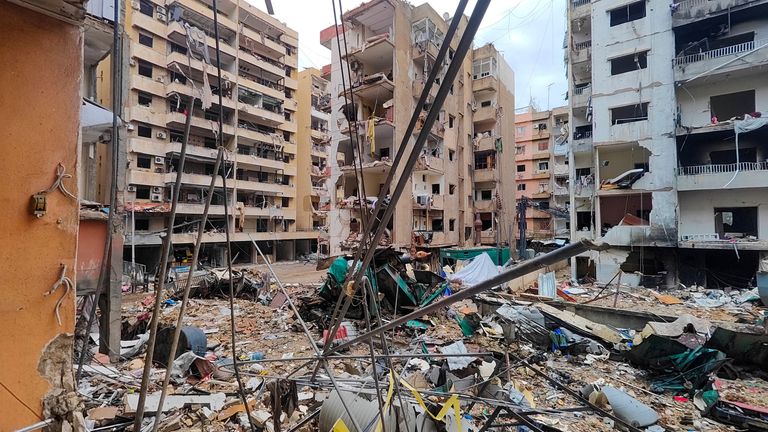
Damage caused by Israeli strikes in southern Beirut. Photo: Reuters
There was also a young doctor deported from Gaza. Mohammed Ziara said he sees tragic echoes of what he suffered when he was working as a doctor in Gaza’s Al Shifa hospital.
“It is clear what is happening in Lebanon,” he told us.
“Attempts are being made to deplete medical facilities to force people to leave Gaza – and this will have a devastating impact on everyone. And this will continue until international law is enforced on all sides.”
The Israeli military says Hezbollah is hiding among civilian structures and using ambulances to transport military equipment, but has provided no evidence.
The Lebanese Health Ministry has angrily denied the claims and said they are an attempt by Israeli authorities to “justify war crimes”.
‘We lost four hospitals’
Ghassan Abu Sitta, a British Palestinian doctor who runs a charity that cares for children and has a clinic in Beirut, told us that children are suffering as a result of the military tactics.
“When israel The southern suburbs (of Beirut) were ordered to evacuate, we lost four hospitals and one of which has a pediatric intensive care unit, and so the system shrunk because we did not have access to these hospitals.
“Ambulances are now afraid to go to peripheral hospitals and we have lost three children waiting for transfer.”
He, too, has worked in Gaza and sees parallels to what is now happening in Lebanon.
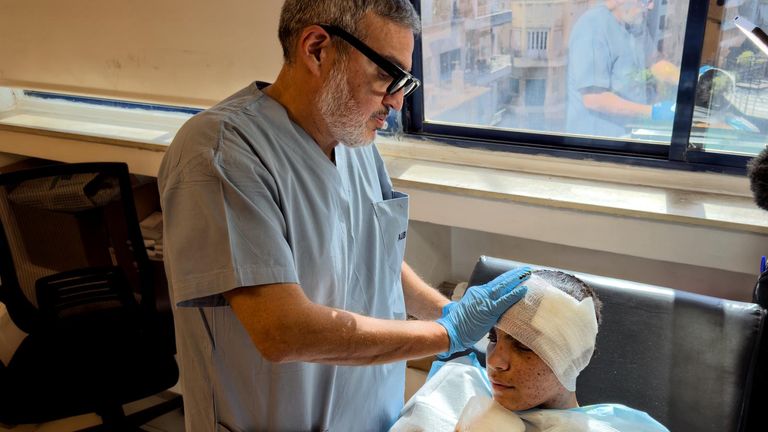
Ghassan Abu Sitta says ambulance workers are becoming more scared and three children have died while waiting to be transferred
“What we’re seeing is a scorched earth policy,” the doctor said.
“Scorched earth, which means making a place uninhabitable, which certainly means the destruction of the health system.
“Because there is this social base in an urban environment that if you get rid of it, it becomes easier to ethnically cleanse people… We saw this again and again in Gaza.”
Fighting between Israeli soldiers and Hezbollah The intensity has increased dramatically in the last few days.
The IDF insists it is killing hundreds of Hezbollah fighters and destroying hundreds of its military infrastructure sites: “More than 30 militants were killed in close combat and from the air,” an IDF statement said Thursday.
But it seems Hezbollah is not finished yet, with it announcing in a statement that its fighters had fired a record 80 rockets into northern Israel in a single day.
The constant hum of Israeli jets is ever-present over southern Lebanese cities, interrupted only by outgoing Hezbollah rockets fired.
But undoubtedly civilians are being killed and injured.
‘Our family used to be of four – now it is three’
Those who died from burns at a Sidon government hospital included the father of a 15-year-old boy, who was killed in a midnight Israeli airstrike as he slept in his apartment in central Beirut.
“I don’t have any emotions right now,” Mohammed Kobeissi told us from the hospital.
“Our family used to be four – now it’s three. I’ve lost my son. He was just 15, what did he do? We’re just civilians. Stop the war! Stop this killing.”
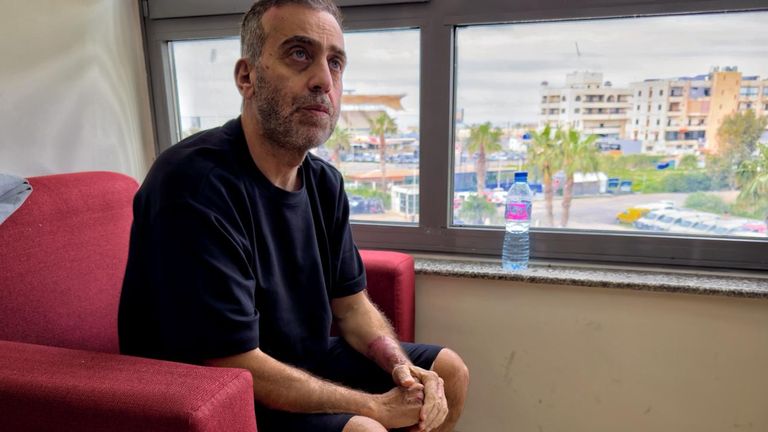
Mohammed Kobesi’s son died in his sleep when his flat was hit by an airstrike
Casualties are rising in the country – the Lebanese Health Ministry says more than 3,000 people have been injured and more than 1,000 have died. The ministry does not differentiate between combatants and civilians.
The war has seen more than a million people flee their homes, most of them in southern communities bordering Israel, but many also from Beirut’s southern suburbs.
The Beirut suburb of Dahieh is a Hezbollah stronghold but is also densely populated. Many victims and survivors insist that they have no connection to Hezbollah or any political affiliation.
The Israeli military has employed a number of tactics to create security “buffer zones”, including blowing up bridges and bombing petrol stations and attacking power plants that supply electricity to entire cities.
It warned Lebanese residents to leave a large part of the country south of the Litani River.
Several Israeli government officials have declared that the intention is for ground troops to occupy the area, which makes up about 10% of Lebanese territory.
