

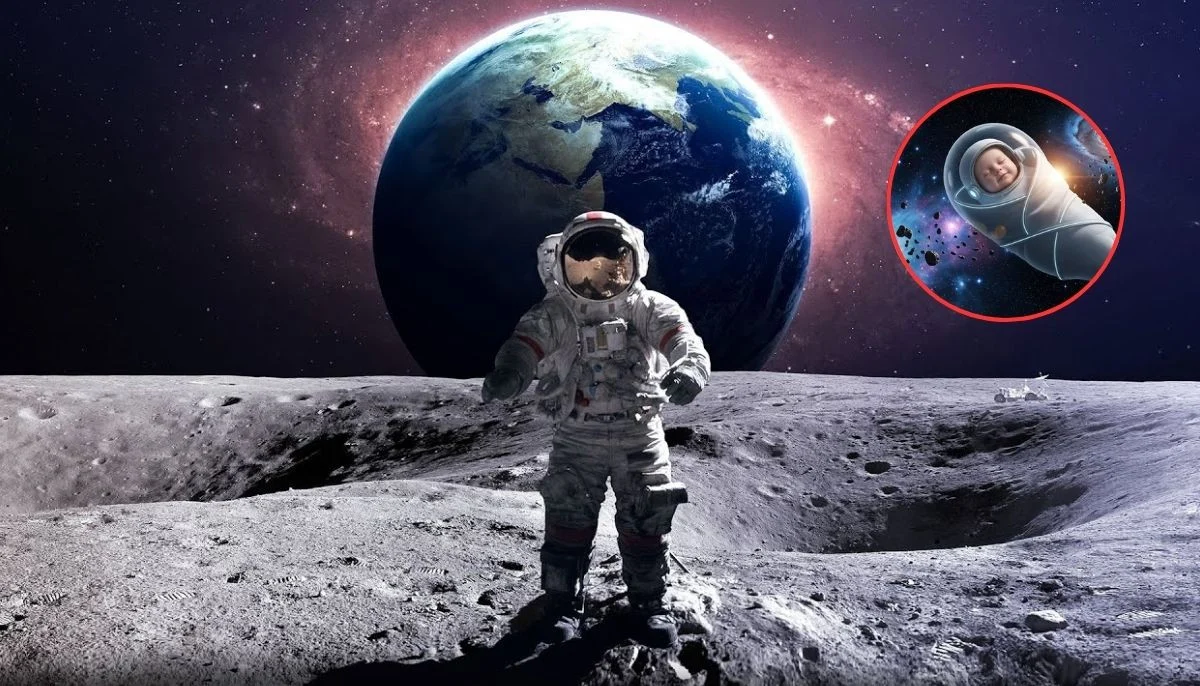
Space has always been the center of attention among the scientific community. Even tech giants are racing to build AI-powered data centers in space.
Elon Musk has envisioned the expansion of human civilization beyond Earth by making it an interplanetary species. For that to happen, one question is of vital importance: Can humans conceive in space?
This is a big question whose answer scientists are trying to find. In a recent study, researchers from Australia have explored this possibility.
Using a “plastic obstacle course” that mimics the female reproductive tract, scientists at the University of Adelaide tested human and rat sperm in simulated space conditions to find out whether sperm would struggle to “navigate” during sex in space.
“Sperm need to actively find their way to the egg, and this study is the first to test that ability under space-like conditions,” said Nicole McPherson, a researcher at the University of Adelaide.
According to the study findings published in the journal communication biologySome flexible sperm were able to navigate the course, highlighting the possibility of conceiving children in space.
On the other hand, sperm were 50 percent worse at navigating the simulated reproductive path compared to Earth’s gravity.
Difficulty navigating the course led to a drop in successful fertilization rates of about 30 percent.
And the successful sperm that completed the course were of high quality, capable of producing highly suitable embryos.
Recent studies show that the stress of microgravity acts as a filter, effectively allowing only the most capable sperm to pass through”, explained McPherson.
Major Challenges
The study is not without challenges. The most serious challenge appears to be the first 24 hours after fertilization, where the quality and quantity of embryo development declines significantly without Earth’s gravity.
“The results rapidly reversed, fewer embryos were formed and those that were formed were of poor quality,” he said.
Implications of space colonization
The study suggests that successful reproduction on the Moon or Mars would require protecting embryos from weightlessness during the “critical first hours.”
While organizations like NASA and SpaceX (Elon Musk) aim for interplanetary life, experts stress that more research is needed to unravel the mystery of reproduction in space, saying that “fertilization” was a small piece of a very long and complex puzzle.
“We’re still a long way from seeing the first space baby,” Ms McPherson said.
