

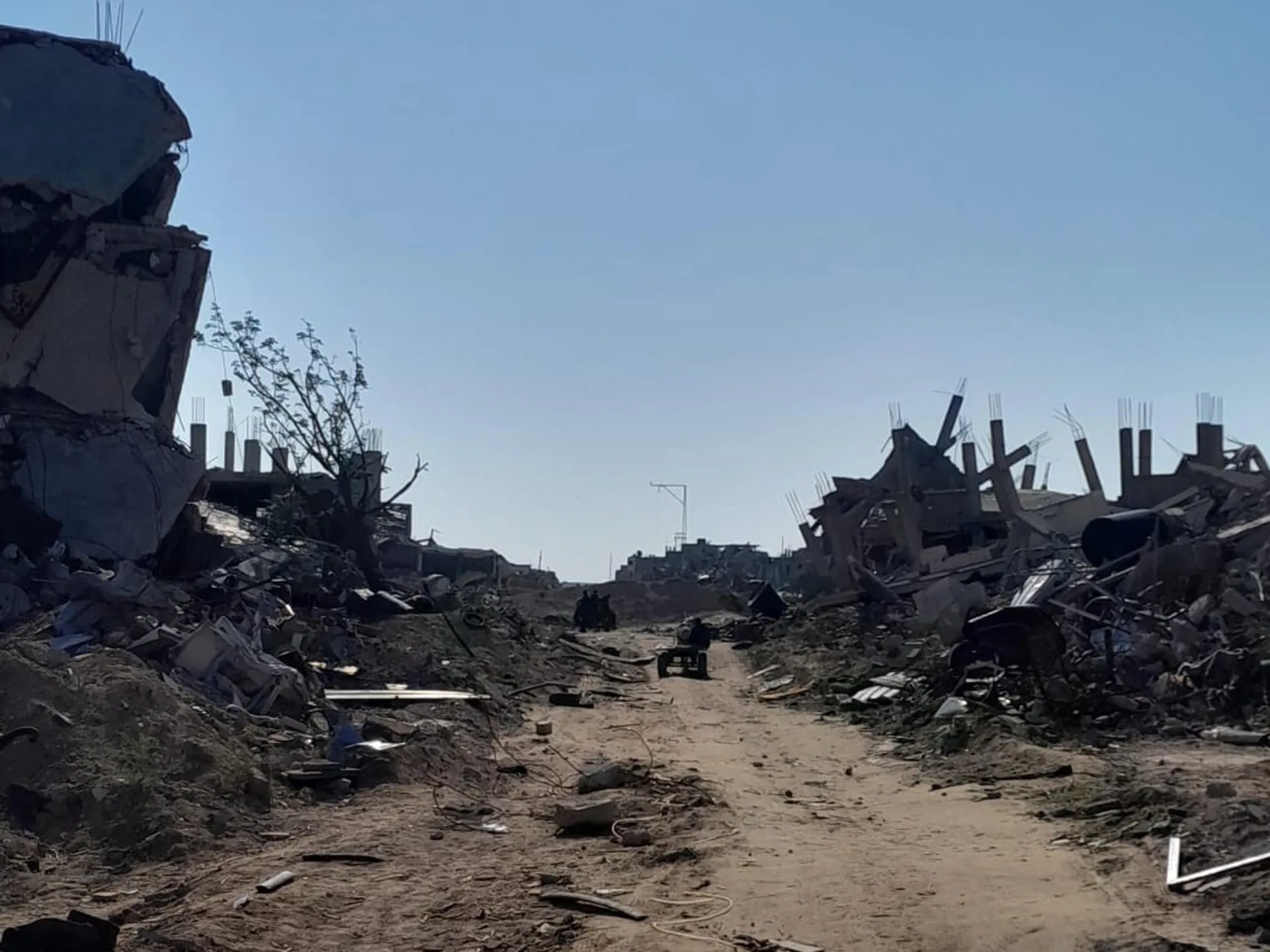
Today is Land Day in Palestine, a day when we celebrate our special bond with the Palestinian land. And I can’t help but think about my grandfather, his eviction, and the recurrence of that trauma in my life.
My grandfather, Hamdan, was 12 years old when Zionist forces began the campaign of ethnic cleansing we now call the Nakba. He lived with his family in Al-Fallujah village. They were farmers who earned money by working their land, raising farm animals, and selling their seasonal crops in local markets.
In early 1948, Al-Fallujah came under attack by Zionist militias. It was a strategic target due to its location at the center of the network of roads leading north to Jerusalem and Jaffa and south to Gaza. As the brutal Zionist attacks intensified, my grandfather fled with his family to nearby villages.
They did not take anything with them, thinking that they would return soon. The only thing he had was the key to the door of his house. An Egyptian brigade held Al-Fallujah, which was besieged by Zionist forces, until 1949. The armistice between Egypt and newly established Israel forced him to leave his post.
The Green Line was drawn, leaving 78 percent of historic Palestine under Zionist control and my grandfather was cut off from his native village for the rest of his life.
It is in the nature of colonists to be afraid of anything that reminds them of the real owners of the land, because it highlights the fact that they have taken what is not theirs. Israeli militias therefore planned to destroy what remained of al-Fallujah along with other Palestinian villages and established several settlements on its land in the 1950s, including Kiryat Gat, Shahar, and Nir Hen.
In Gaza, my grandfather’s family struggled to build a new life. Although the idea of return never left his imagination, the harsh reality forced him to adapt. They settled in an area east of Khan Yunis, where they planted olive and citrus trees and built a house.
My grandfather decided to teach his children and grandchildren about agriculture. But he didn’t just tell us how to plant and grow plants; They taught us how to establish ourselves on the land that is our historical right. He always told us that if it was taken from us by force then it would not be returned as a gift. There will be a heavy price to pay, because Israel knows it has taken something to which it has no right, and so it will respond brutally when we demand it back.
I was just eight years old when I learned what my grandfather had gone through. During the Israeli war on Gaza in 2008-09, I was displaced with my family for the first time.
Five and a half years later, when I was 13, the Israeli war machine struck again. This time, it destroyed my house and the houses of my eight uncles. That experience was the final blow to my grandfather, who carried the burden of nearly 70 years of displacement and destruction in his heart. He died just days after watching our olive groves and homes being destroyed.
But we had learned this lesson well from our grandfather. We stayed on the ground. We rebuilt our houses. We replanted our trees and sank our roots deep into the soil once again.
In October 2023, the occupation began its genocide against the people of Gaza. Amidst death and destruction everywhere, we were once again forced to flee our homes.
Once again, the Israeli army destroyed our houses and uprooted trees, killing many of our relatives and neighbors.
Last year, Israel drew the so-called Yellow Line, which swallowed about 60 percent of the Gaza Strip. This line now stands between me and my home, just as the Green Line stood between my grandfather and Al-Fallujah
When I think about it, my heart feels heavy with the burden of all the years of occupation, even the years I did not live. I feel the pain of those who came before me, my ancestors yearning to go back home.
Today, I carry the keys of my house with me, like my grandfather. I carry it with me, even though I know my house is completely destroyed. I myself have seen it reduced to rubble, its remains carried away by the machinery of destruction. Still I have the key.
Despite all this loss and pain, we have no intention of leaving. For 77 years, Palestinians have been given various incentives to leave their homeland. Israel promises money, tickets and a better life in exile. When that failed, he resorted to terror, imprisonment, home demolitions, and economic blockade in an attempt to break Palestinian will.
Still the Palestinians are standing firm. Their relationship with the land goes beyond ownership. This is an existential relationship.
Perhaps the most obvious response to this colonial project lies in demographic reality. Palestinians in Gaza numbered about 80,000 in 1948; They received about 200,000 refugees, including my grandfather’s family. Today, two years after the genocide, we are two million people holding our lands, resisting evictions and feeling more connected than ever.
It doesn’t matter whether the lines drawn by the occupier, whether green, yellow, or any other color, they will pale in comparison to our deeply rooted existence. No matter how long it takes, no matter how violent the colonial war machine becomes, we will be here. Palestine is us, and we are the only ones.
The views expressed in this article are those of the author and do not necessarily reflect the editorial stance of Al Jazeera.
