

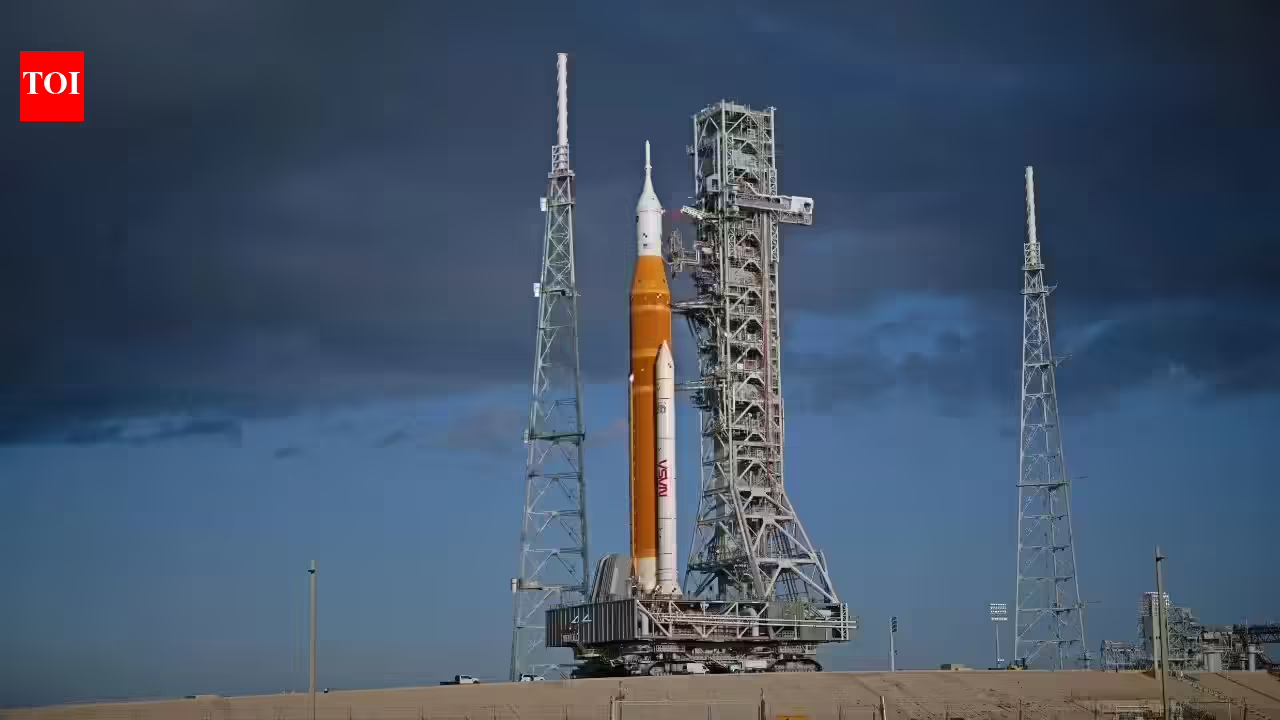
NASA’s Artemis II mission will allow humanity to return to the lunar frontier as we near the end of decades of silence (since the Apollo era). This historic mission, scheduled to launch from Kennedy Space Center on April 1, 2026, will be the first crewed Luna flight in more than 50 years; It will be a long-duration (10-day) crewed Artemis II mission aboard the Orion spacecraft, flown by a multinational crew of four astronauts. Two of the astronauts will be the first women and the first astronauts of color to fly to the Moon. During this high-risk Artemis II crewed lunar flight, the SLS will be tested in terms of its capabilities and reliability; Those assessments will serve as the basis for determining whether Artemis III can land on the Moon. In addition to operations preceding a potential Artemis III lunar landing, Artemis II represents a bold step toward establishing a permanent human presence on the Moon and, ultimately, exploration of Mars.
The goal of Artemis II’s 10-day mission
This mission will not land on the Moon, but will instead carry out a mission to test the feasibility of deep space systems. Following launch from Launch Complex 39B at Kennedy Space Center, the flight crew:Earth Orbit Operations: The first 24 hours will be spent in a high-orbit position (about 230 miles), where life support and communications systems can be tested.Lunar flyby: Then execute a free-return mission that will take the spacecraft to the far side of the Moon, where it will be approximately 248,655 miles from Earth, breaking the record set by Apollo 13.Splashdown: Ultimately, the total distance traveled will be approximately 685,000 miles and will end with high-velocity reentry and splashdown in the Pacific Ocean, which is estimated to occur around April 10, 2026.
Artemis II: launch schedule and lead times
NASA has officially announced that Artemis II will launch from Kennedy Space Center on Wednesday, April 1, 2026. The two-hour launch window will open at 6:24 p.m. EDT (22:24 UTC). Daily backup launches are planned until April 6, but only if problems arise due to weather or other technical difficulties.
Various NASA platforms will provide live coverage of the event:
- NASA+ and NASA TV: Comprehensive coverage without commercials begins April 1 at 12:50 p.m. EDT.
- YouTube: NASA will provide a 24/7 live stream on its YouTube channel that will include both a live view of the Orion spacecraft and live commentary from Mission Control.
- Social Media: NASA will post real-time updates and highlights on NASA’s X (formerly known as Twitter), Facebook and Instagram pages.
Historical crew and their roles for Artemis II
The effort ushers in a new era of diversity by sending four astronauts into outer space together for the first time. The team of four will consist of:
- Commanding Officer, Reed Wiseman, who would be responsible for the first manned lunar flight in fifty years.
- Pilot Victor Glover, who would be the pilot of record and the first person of color to fly on the Moon.
- Mission specialist, Christina Koch, will be the first woman to fly to the Moon.
- Mission specialist, Jeremy Hansen, as a mission engineer representing the Canadian Space Agency, will be the first Canadian and non-American to walk on the Moon.
