


US President Donald Trump’s suggestion that Washington could seize Kharg Island, Iran’s key oil hub, has raised concerns about the strategic, military and economic risks of such a move. While the island is a hub of Iran’s energy exports, experts have warned that any attempt to capture or deactivate it could escalate the conflict, put US forces at significant risk, and still fall short of delivering decisive results.
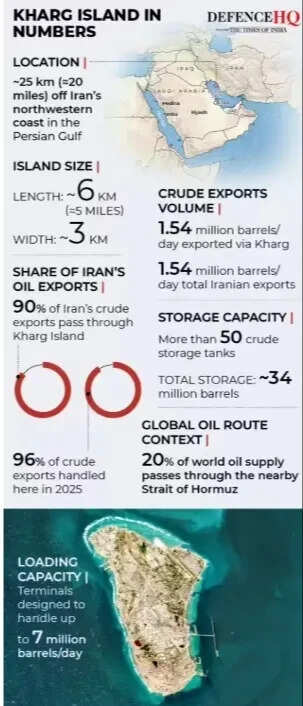
Kharag Island in numbers
a vital oil lifeline
Kharg Island, located in the Persian Gulf, handles about 90 percent of Iran’s crude oil exports, making it a vital node in the country’s economy. Its deep waters allow larger tankers to dock, much of which Iran’s shallow coastline cannot support, ensuring steady shipments, much of which is bound for China, The New York Times reports.Any disruption to the island’s operations would significantly hamper Iran’s export capacity and tighten global oil supplies, especially as energy markets remain volatile amid tensions around the Strait of Hormuz.
Military risks and operational constraints
Despite its strategic importance, analysts say capturing and holding Kharg Island will be extremely challenging. The island is located approximately 33 kilometers from mainland Iran, placing any occupying forces within range of Iranian missiles, drones and artillery.Former US military analyst Michael Eisenstadt cautioned against deploying troops on the ground. “On the other hand, you are putting your own soldiers in danger,” he said, as quoted by the Associated Press. “It’s not that far from the mainland. So if they’re willing to damage their own infrastructure, they could potentially cause a lot of destruction on the island.”The short distance from the mainland will also limit response time against incoming threats, while terrain along Iran’s coast could make low-flying drones and missiles harder to detect.
Increased risk and limited leverage
Experts have warned that such a move could trigger widespread reprisals across the region. Iran and allied groups could step up attacks on US bases, target Gulf infrastructure, or disrupt shipping routes, including mining operations in the Strait of Hormuz, the Associated Press reports.Iran expert Danny Citrinowicz said capturing the island might not yield a decisive advantage. He said, “It will be difficult to bear it. It will be difficult to stop it.” “This is not a decisive blow by any means,” he said.While control over Kharg Island could provide some bargaining power, analysts say it is unlikely to force Tehran into major concessions, given its ability to maintain limited exports through alternative channels.
grassroots action options
Some experts argue that a naval blockade targeting Iranian oil shipments could achieve the same objectives with less risk. Such a strategy could restrict exports without exposing U.S. troops to direct ground combat, the Associated Press reports.“Establish a quarantine that seeks to seize Iranian oil shipments leaving the Gulf,” said energy security expert Clayton Siegel. He said it could be deployed at a safe distance from Iranian weapons systems.Trump himself has indicated uncertainty about the possible operation. “Maybe we take Kharg island, maybe we don’t. We have a lot of options,” he said, adding that such a move “would also mean we have to stay there for some time.”
global economic implications
Any tensions involving Kharg Island could have far-reaching consequences beyond the battlefield. Disruption at Iran’s primary export terminal could drain significant amounts of oil from global markets, sending prices soaring and adding pressure to an already fragile global economy.As tensions rise, the Kharag Islands are emerging as both a strategic prize and a potential flashpoint that could shape not only the conflict, but also global energy dynamics.
