

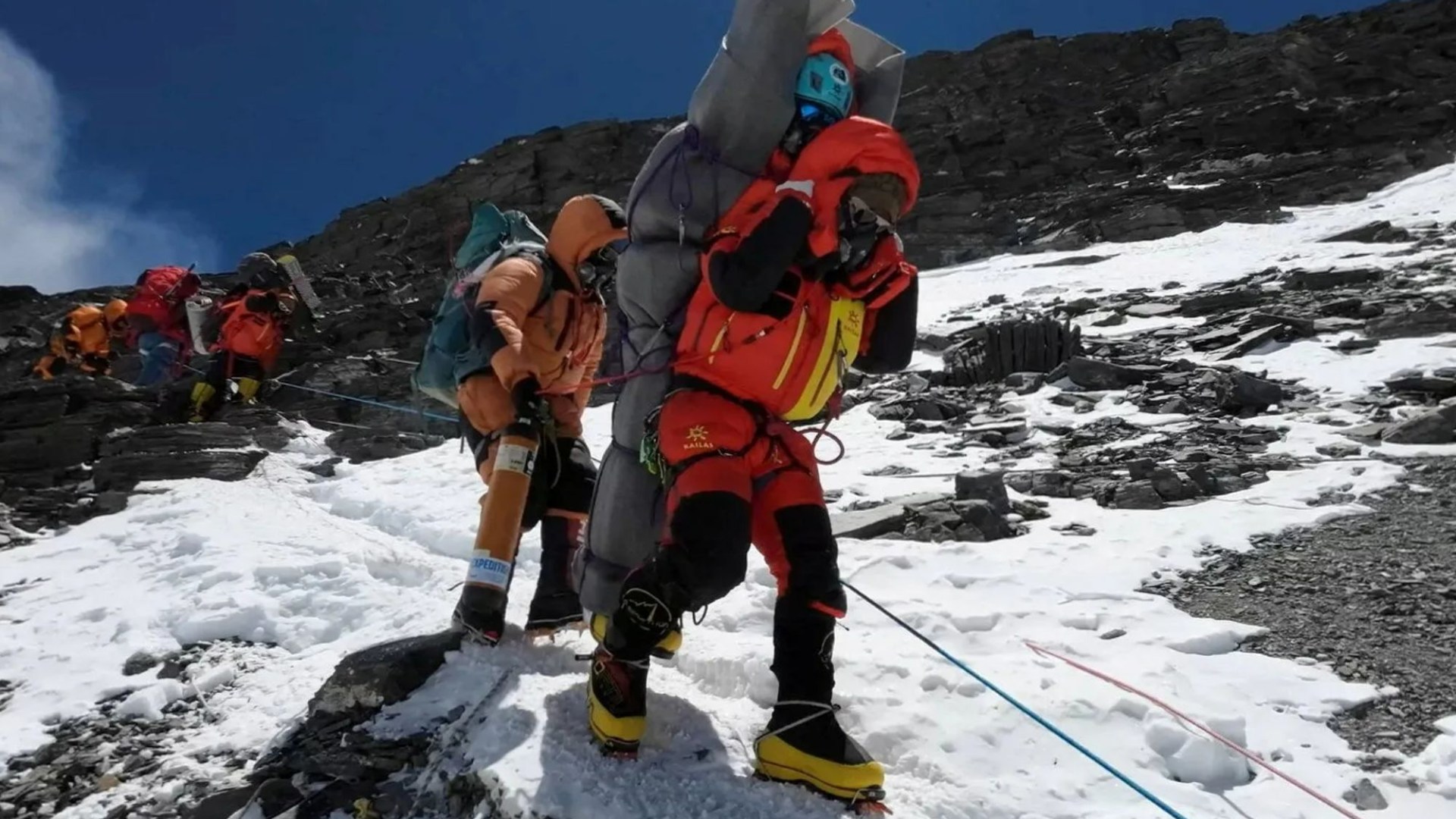
Everest mountain guides have been accused of secretly poisoning climbers to set up expensive helicopter rescues as part of a multi-million pound insurance scam.
According to Kathmandu PostThis racket involves making climbers fake medical emergencies.
A helicopter is then called to take the victim to the nearest hospital, while a fraudulent insurance claim is written.
The Central Investigation Bureau (CIB) of Nepal Police has identified two ways in which this scam can occur.
The first includes tourists who do not want to go back down the mountain.
Some expeditions can take up to three weeks to complete the trek on foot, so guides ask climbers to pretend to have a medical emergency so that they can arrive by helicopter rather than descending themselves.

brash talker
Trump said, Iran has asked for ceasefire…but until the strait is opened, I will say ‘no’

‘deep concern’
Amid dispute with Spain, Trump orders investigation into euthanasia of gang rape victim
The second method is much more sinister, and involves guides convincing climbers that they are experiencing a medical emergency.
At altitudes of 3,000 metres, altitude sickness is extremely common, with symptoms including headache and tingling.
This drop in blood oxygen saturation can often be resolved with rest or hydration.
However, the CIB has revealed that some guides are said to scare tourists into thinking that immediate evacuation is the only thing that will save them.
If this does not work, investigators found that some guides also try giving climbers mild altitude sickness pills and excessive amounts of water to induce the necessary symptoms.
In one case, baking powder was added to food to make tourists unwell.
Guides will try to do this with multiple victims in order to maximize their earnings.
Although a single helicopter can carry several passengers at a time, invoices are prepared as if each required its own aircraft
What should have been a £3,000 charter suddenly becomes a £9,000 claim.
Medical reports are forged using digital signatures of doctors who were never involved in the case – often without their knowledge.
In some instances, fake admission records are created for tourists who were drinking beer in the canteen when they were supposedly receiving treatment.
mount everest

- Mount Everest is the highest mountain on Earth, reaching a height of approximately 29,000 feet.
- It is located in the Himalayas on the border of Nepal and China.
- The first successful summit was achieved by Sir Edmund Hillary and Tenzing Norgay in 1953.
- This mountain is part of the Himalayas, the highest mountain range in the world.
- Temperatures at the summit can drop below -60°C.
- Climbers face dangers such as avalanches, low oxygen levels and extreme weather.
- Despite the risks, hundreds of climbers attempt to reach the summit each year.
Hospitals pay up to 25 percent of the insurance claim to tracking companies and 20 to 25 percent to helicopter rescue operators.
The people behind morally ambiguous operations become rich from the profits.
Between 2022 and 2025, hundreds of fake cases were confirmed, leading to a massive loss of £15 million to fraud.
To make matters worse, the problem was first identified by local media in 2018.
Although this led to a 700-page government report and policy improvements, the problems did not stop there.
CIB chief, Manoj Kumar KC, told the Kathmandu Post, “The scam continued due to laxity in penal action. When there is no action against the crime, it flourishes. As a result, the insurance scam also flourished.”
The government has now stepped up efforts to curb the problem, with the CIB charging 32 people earlier this month in connection with the scam.
The accusers include employees of three different helicopter companies, as well as doctors and administrators from three different hospitals.
So far nine have been arrested, the rest have fled to avoid capture.
